
 View answer copy →
Ravi GangwarRank 616CSE 2023
Answered a very similar question
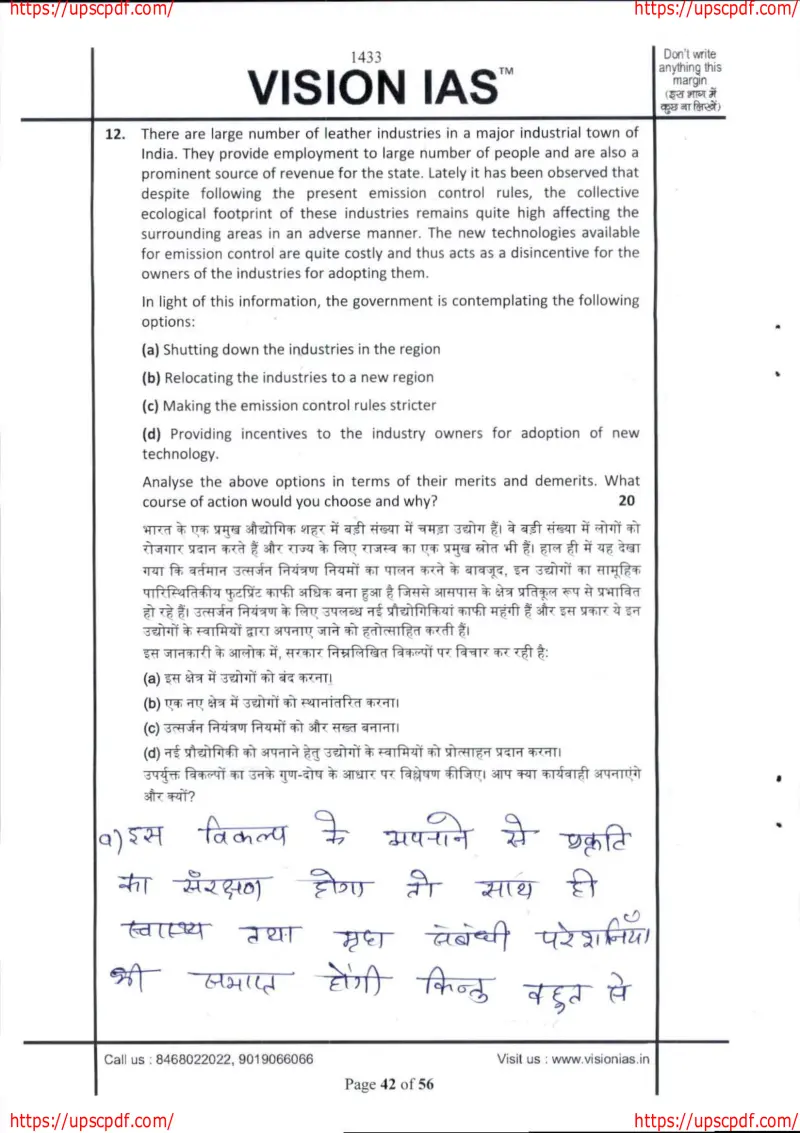
Their question: “Case study: polluting leather industries — shutdown / relocate / stricter norms / incentives — attempted (all four options + chosen course)”
This PYQ is the same regulator's dilemma, cleared industries still polluting while providing employment, so the topper's option-wise treatment and the carbon-credit incentive hook transfer directly.
Key learnings from their answer
- ›All six Section B case studies (Q9-Q14) are attempted part-wise (a/b/c) and each lands a concrete policy hook, carbon credit for the polluting-industry case (Q12), the NGT closure order for unsafe coal mines (Q13), and invoking Bonded Labour rehabilitation for the bonded-worker case (Q14) -> in case studies, close every sub-part with a real, nameable scheme/instrument so your resolution is actionable, not just moral commentary.
- ›A consistent answer architecture is held throughout, open with a quote or crisp definition, then break into numbered sub-points (i/ii/iii, a/b/c) with underlined headings like laabh/haaniyaan (merits/demerits) -> a predictable open-then-segment structure makes a prose Ethics answer scannable for the examiner even with zero diagrams (this copy has none).
What they cited: Carbon credit as an emission-control incentive (Q12)