
 View answer copy →
Sandeep BadadRank 82CSE 2025
Answered a closely related question
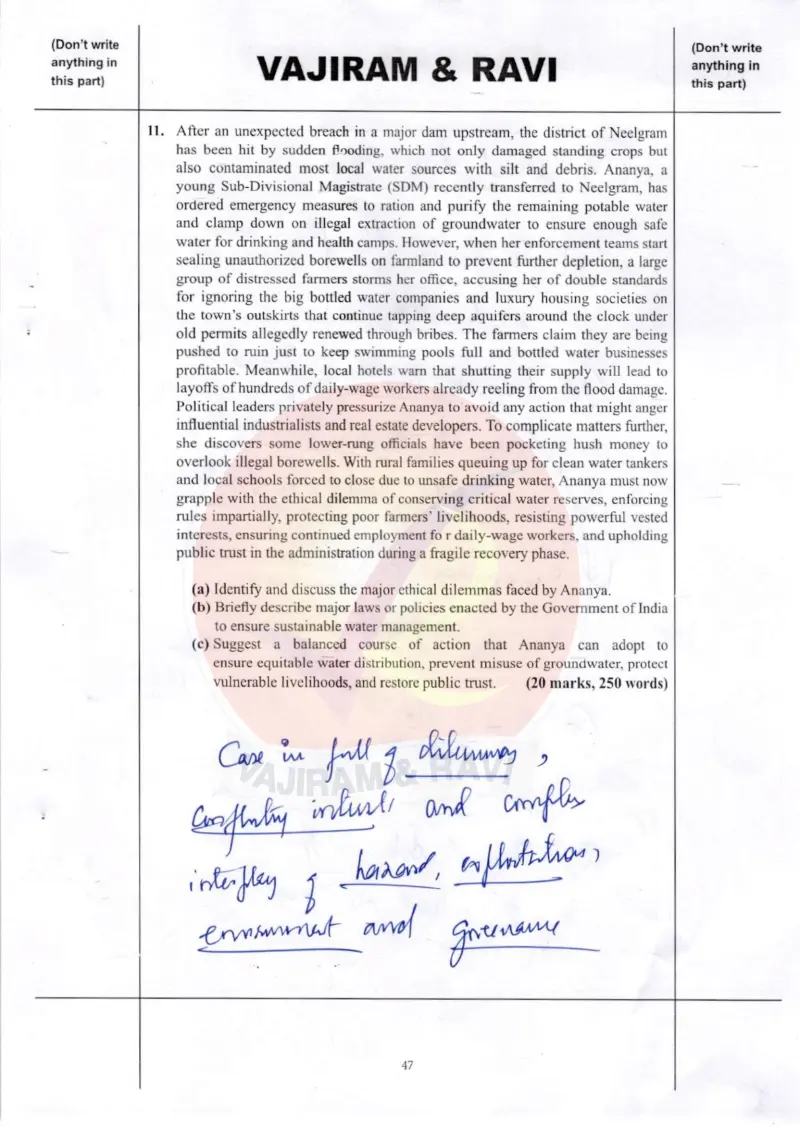
Their question: “Ananya (SDM), Neelgram — dam breach, flooding, water rationing, illegal borewells and farmer unrest”
His water-crisis case (rationing, curbing illegal extraction, committed course of action) mirrors the Collector's severe-water-shortage scenario with strict measures against illegal drawing in 2024 Q12.
Key learnings from their answer
- ›In the case studies (Q7 Kulkarni's scholarship-fund diversion, Q9 Neha's ex-gratia, Q10 dowry) he drew merit/demerit 'lens' schematics and took a clear reasoned stand under headings like 'Course of Action' and 'Ethical dilemmas' rather than hedging -> in ethics case studies, lay out the options visually with a stakeholder/merit-demerit weighing AND then commit to a decision, because examiners reward a defensible verdict over a balanced non-answer.
- ›He grounded administrative answers in cited governance machinery, not vague reform-talk: c-Vigil (ECI), MGNREGA social audit, Gram Sabha and Mission Karmayogi for participative vigilance (Q4b/Q8), and Nolan Committee principles + Operation Sindoor (emotional intelligence) for public-service ethics (Q5b) -> back every ethical prescription with a real, nameable scheme/committee so 'transparency' and 'accountability' read as concrete mechanisms an officer can actually invoke.
Quotes used: “'Jal hai to kal hai' / 'Water is life' (Q11 conclusion)”