
 View answer copy →
Shakti DubeyAIR 1CSE 2024
Answered a closely related question
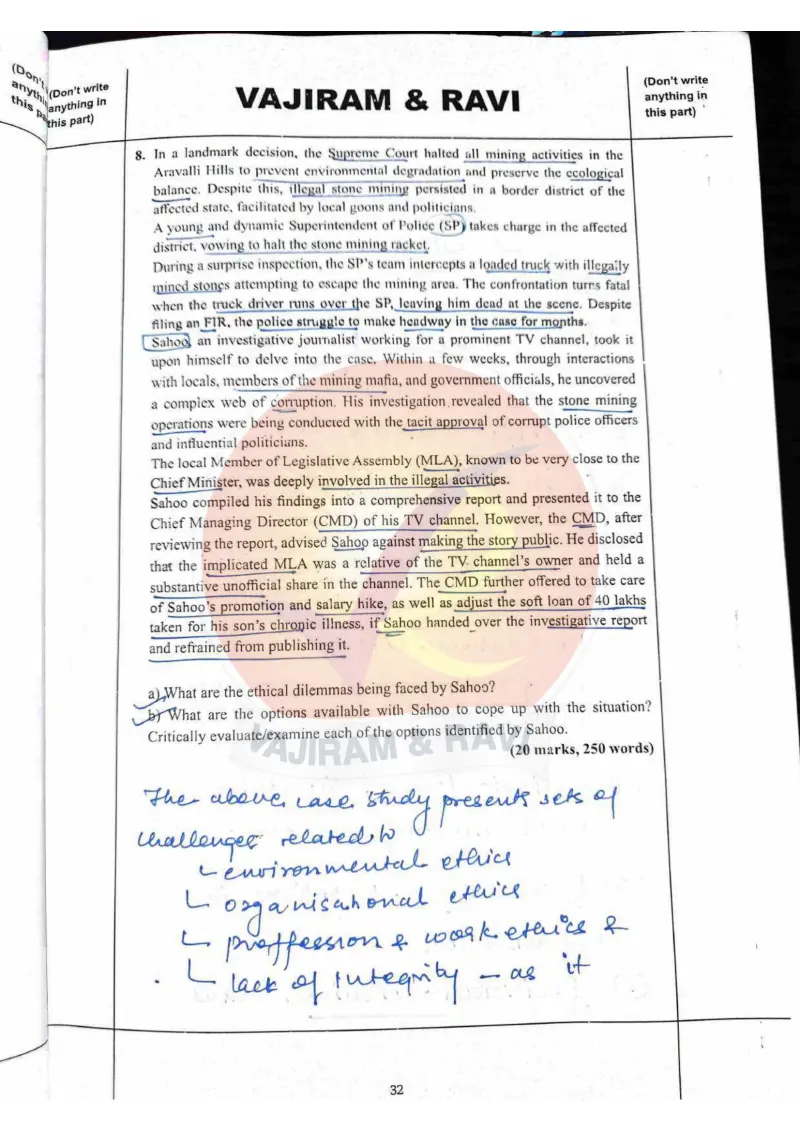
Their question: “Case study: Aravalli illegal stone mining, SP killed, journalist Sahoo bribed by CMD to suppress report; ethical dilemmas + options”
Her illegal-mining case (officer under threat, mafia/corruption, stakeholder-mapped options) is the same milieu as 2021 CS1's young officer confronting an illegal sand-mining mafia.
Key learnings from their answer
- ›Section-B case studies follow one rigid, repeatable template: framing line -> stakeholder bubble/spider diagram (e.g. Q7 maps DCP Aakash, SI Shipra, DIG Samar, Dinesh, public; Q8 maps SP, journalist Sahoo, MLA, channel owner, environment, society) -> numbered ethical issues -> each option weighed in a two-column Positive vs Negative layout (Q8, Q9, Q10) -> chosen option with reasons -> way forward -> Internalise one such case-study skeleton so that under time pressure you only fill content into a structure you never have to invent on the spot.
- ›Body points are not abstract, almost every numbered point is fused to a real 'eg:-' instance: she defends national interest in 2b with the Pathankot strike, Panchsheel, Operation Sankalp and Turkey earthquake relief, and illustrates 'mind over heart' in 3a with the US atomic bombing of Japan, PL-480, and COVID Vaccine Maitri -> Attach a current-affairs or policy example to each point you make; example-density is what separates a topper's ethics answer from a generic one.