 View answer copy →
Komal PuniaAIR 6CSE 2024
Answered a very similar question
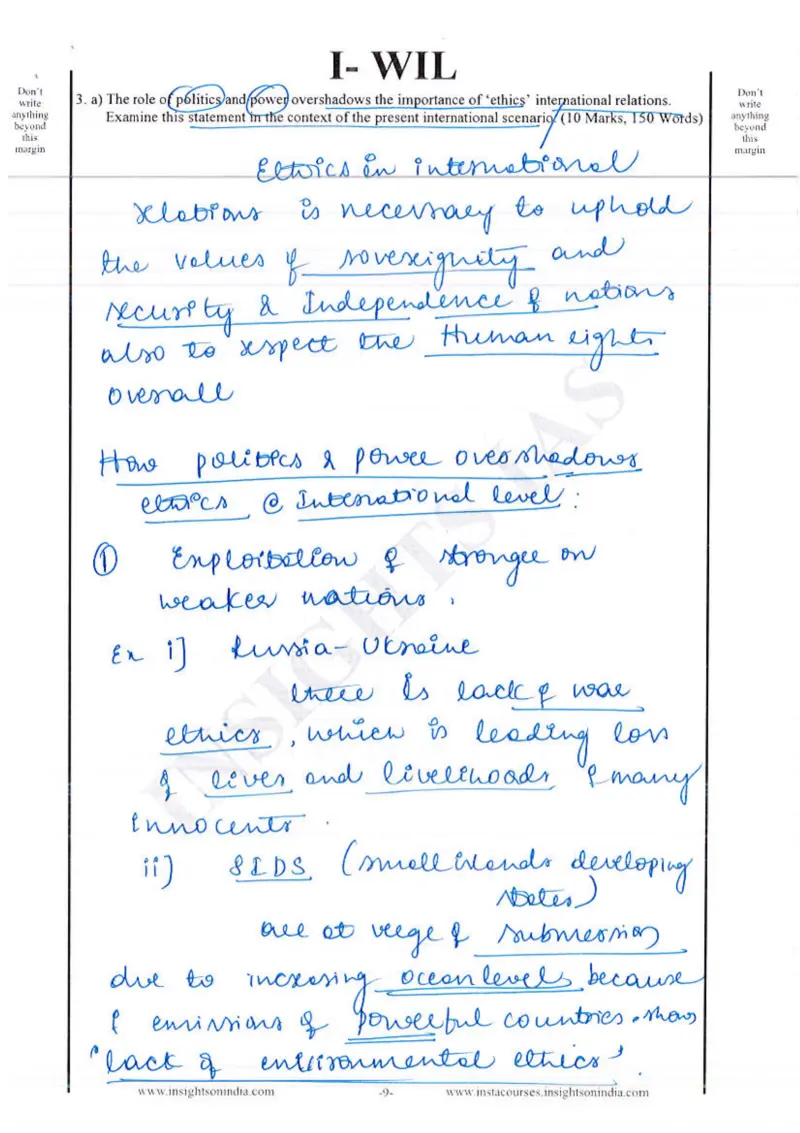
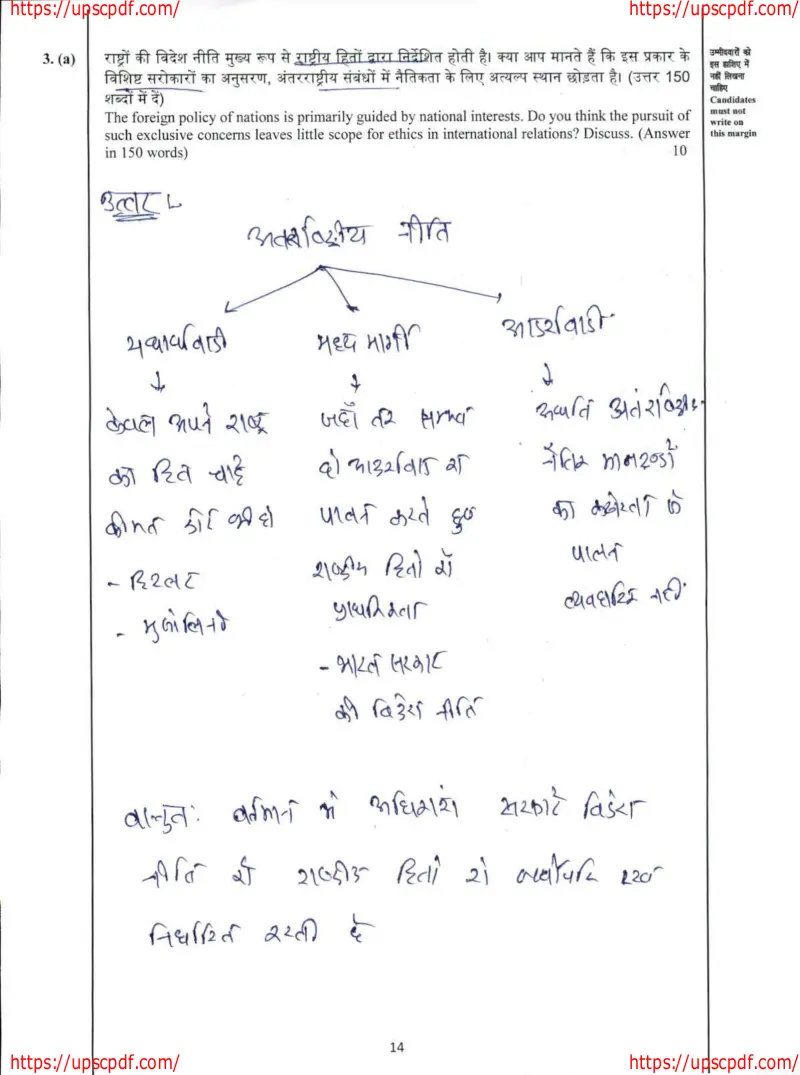
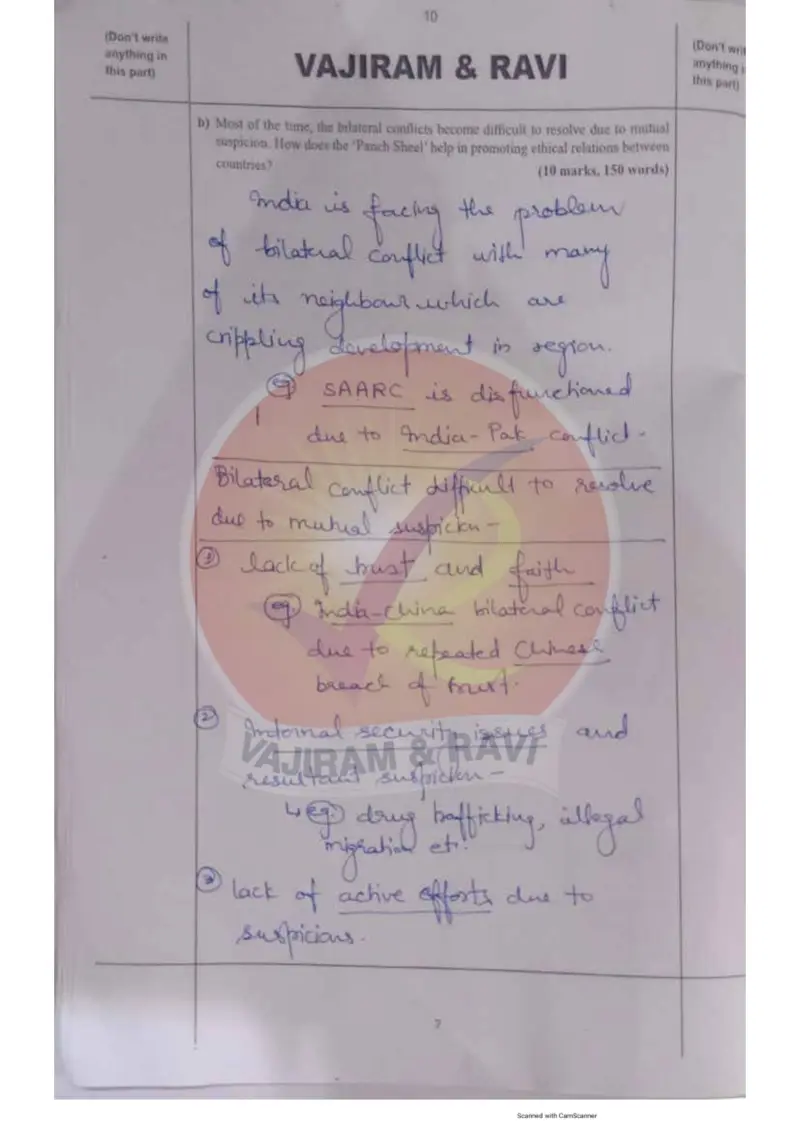
Their question: “Panchsheel promoting ethical relations between countries amid mutual suspicion in bilateral conflicts”
The 2015 PYQ asks how ethical consideration can resolve tensions in national-interest-driven bilateral relations - exactly the topper's Panchsheel answer, backed by India-China/India-Sri Lanka and China debt-trap illustrations.
Key learnings from their answer
- ›She bookended every theory answer with a one-line definition open and a quotation close - e.g. opening Q1(a) with Socrates' 'Education is the kindling of a flame, not the filling of a vessel' and closing Q4(a) with Vivekananda's 'Truth doesn't pay homage to any society; society has to pay homage to truth or else perish' -> a fixed intro-body-conclusion template lets you start fast under time pressure and finish each answer with a memorable, examiner-pleasing line instead of trailing off.
- ›Her example bank was wide and deliberately matched to each prompt - Hitler's Germany and North Korea vs A.P.J. Abdul Kalam to contrast content-without-values for Q1(a), Viktor Frankl surviving the Holocaust through positive attitude for Q1(b), the S. Subramaniam Balaji vs State of Tamil Nadu freebies verdict alongside Amma Vodi for Q3, and Mother Teresa / Sindhutai Sapkal / Dashrath Manjhi for the quote questions -> build a stock of versatile illustrations spanning history, a Supreme Court judgment, current affairs and named Indian schemes so each abstract value lands on a concrete, verifiable anchor.
What they cited: SAARC dysfunction due to India-Pakistan conflict; India-China conflict from breach of trust (Q2b) · India-Sri Lanka relations / doctrine of non-reciprocity; Buddhist circuits and India-Nepal cultural ties; Vasudhaiva Kutumbakam; China's debt-trap as unethical practice (Q2b)