
 View answer copy →
Yashaswi Raj VardhanRank 11CSE 2025
Answered a very similar question
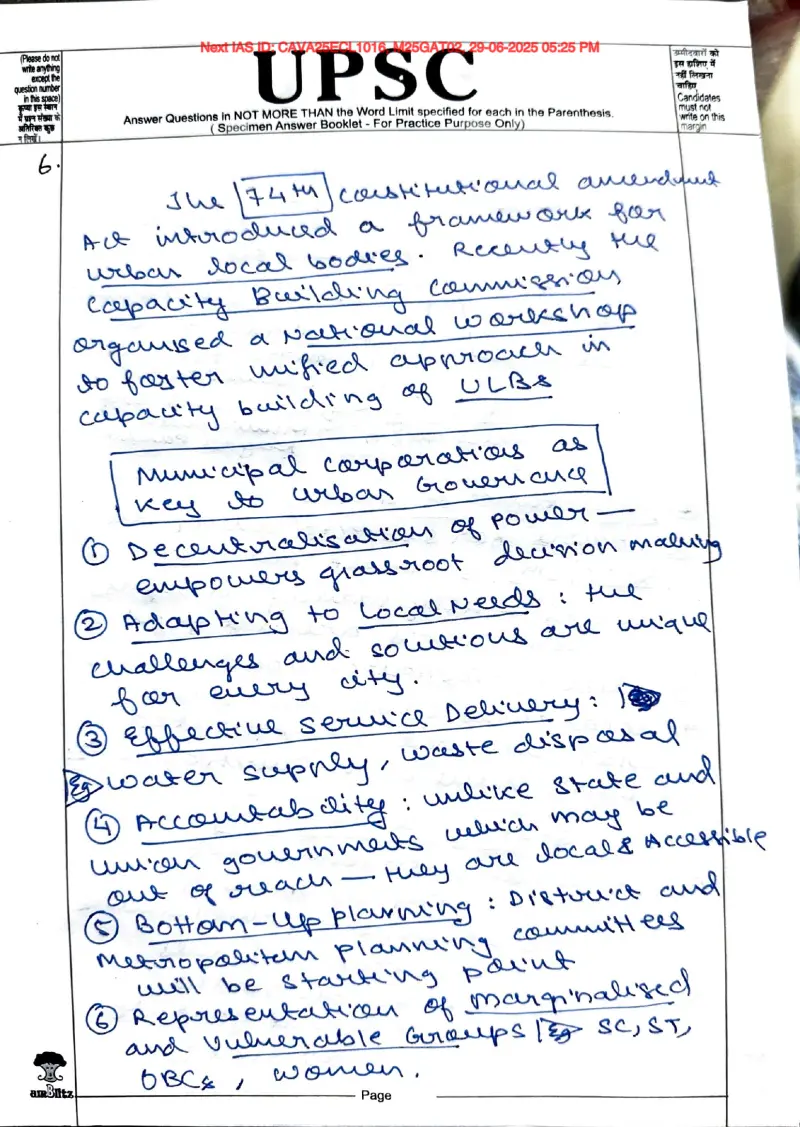
Their question: “74th CAA & urban local bodies; municipal corporations in urban governance”
The topper's 74th-Amendment material on functional and financial empowerment of urban bodies directly answers the claim that states are reluctant to empower them.
Key learnings from their answer
- ›Every one of the 10 answers opens with a current-affairs hook tied to the exact provision being asked, '~1.4 lakh contempt-of-court cases pending vs govt' for Q2, 'SC in 2025... Tamil Nadu Governor case' for Q10, '65% of urban bodies lack a master plan (NITI Aayog, 2021)' for Q6 -> Anchor your intro to a specific, recent, on-point statistic or case rather than a generic definition; it instantly signals relevance and currency to the examiner.
- ›He brings in comparative-governance models beyond the bare Indian syllabus exactly where they sharpen the argument, UK's neutral-Speaker convention ('once a Speaker, always a Speaker') for anti-defection (Q8), Japan's 'glocalisation' for urban governance (Q6), and a US-judiciary contrast for contempt/free-speech (Q2) -> Keep a small bank of foreign best-practice models mapped to specific Indian problems; using them as a 'way forward' lifts an answer above textbook recall.
- ›Diagrams do analytical work rather than fill space: a two-column Indian-vs-USA court table with hierarchy flowcharts (Q2), a 74th-Amendment mind-map radiating to women's reservation, 12th Schedule and SEC/SFC (Q6), and a Legislature–Executive–Judiciary 'checks and balances' triangle with labelled arrows like summon/prorogue, scrutiny, writ (Q9) -> Reserve diagrams for comparison, structure-mapping or relationship questions where a visual genuinely compresses information the prose would labour over.
What they cited: Schemes/programmes: Atal Innovation Mission, Smart City, AMRUT, Aspirational Districts, PM Gati Shakti, Vibrant Villages, e-Amrit (EV), NDAP (National Data Analytics Platform), LPG subsidy (DBT)