 View answer copy →
Kanishak KatariaAIR 1CSE 2018
Answered a very similar question
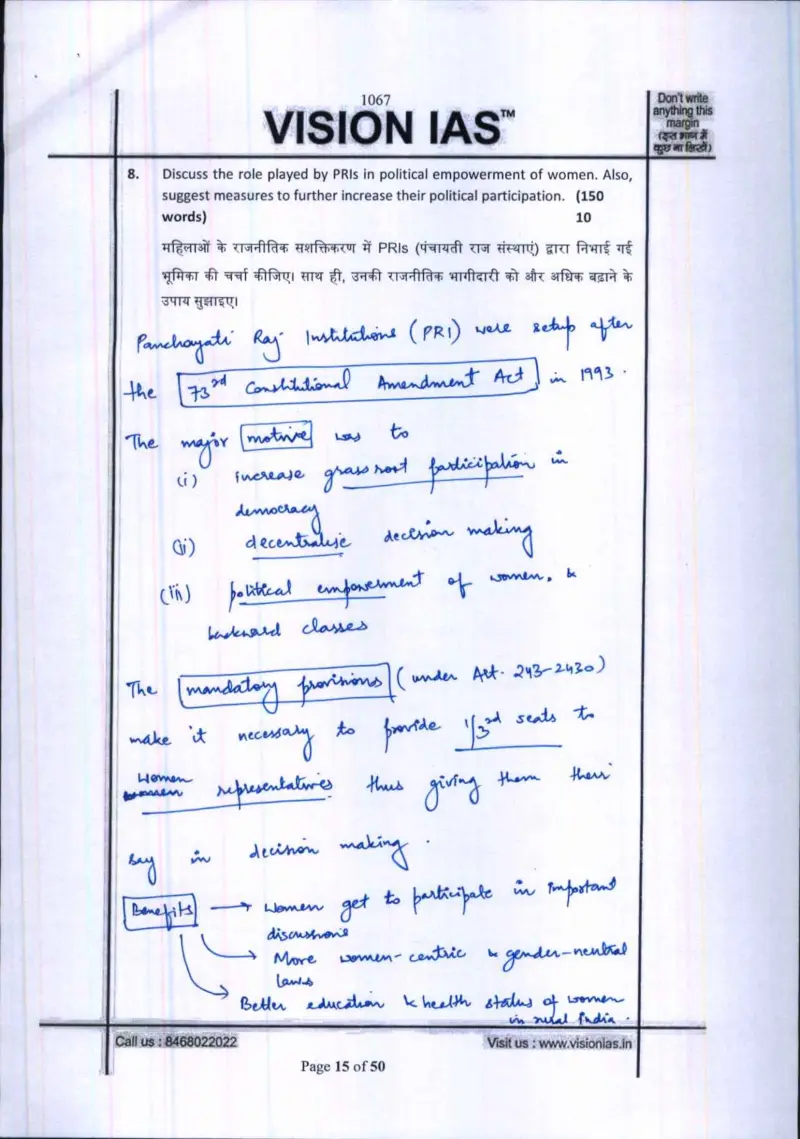
Their question: “Role of PRIs in political empowerment of women; measures to raise their participation”
The topper's analysis of PRIs, one-third women's reservation and measures to raise participation directly addresses the PYQ on reservation's limited impact on patriarchy in local government.
Key learnings from their answer
- ›He anchors polity answers in named case law and exact provisions rather than vague principles: S.R. Bommai (1994) with the composite floor test for Q4, Lily Thomas (2013) and Section 8(4) of RPA 1951 for criminalisation of politics (Q13), and writs tied to Articles 32/226/129/215/136. -> For polity questions, cite the specific landmark judgment + article/section by number; this precision is what separates a top-scoring constitutional answer from a generic one.
- ›He varies the answer format to fit the demand: BRICS vs IBSA (Q10) is written as a clean two-column side-by-side comparison rather than paragraphs, and NITI Aayog (Q3) and the NCM mandate (Q14) are rendered as boxed mind-map/flow diagrams with branching arrows instead of prose. -> When a question is explicitly comparative or asks for challenges/measures, switch to a two-column or boxed-flow layout, it saves time, signals structure to the examiner, and is ideal for short 10-markers.
What they cited: 73rd Constitutional Amendment Act; Articles 243-243O; one-third reservation for women in PRIs; 108th Amendment Bill (women's reservation in legislatures/Parliament) (Q8)