
 View answer copy →
Anudeep DurishettyAIR 1CSE 2017
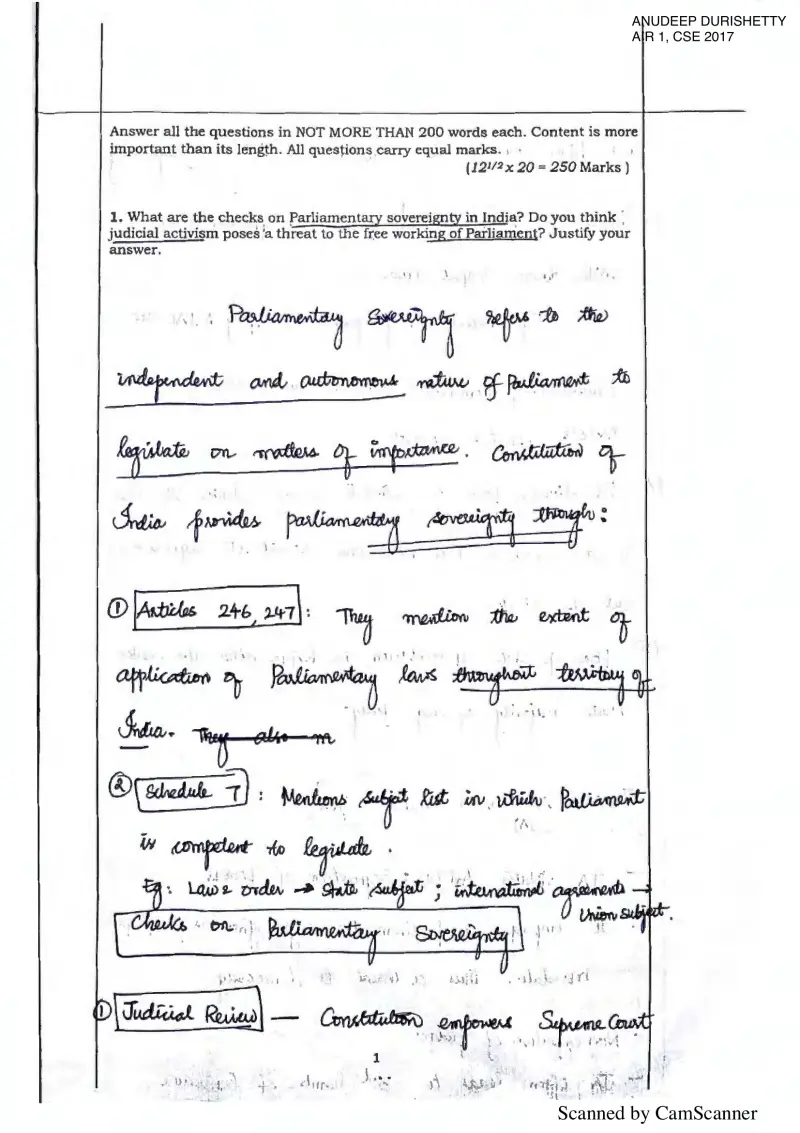
Answered a very similar question
Their question: “Checks on Parliamentary sovereignty in India; does judicial activism threaten free working of Parliament — justify”
The topper's treatment of the judiciary as a check on Parliament (framed by Palkhivala's line) directly serves the PYQ on the Supreme Court checking Parliament's amending power.
Key learnings from their answer
- ›Anudeep opens nearly every answer by naming the exact Constitutional provision the question hinges on before defining anything, Art 312 for the civil-services question (Q9), Art 153 for the Governor (Q11), Art 324 for the Election Commission (Q13), Art 47 for health (Q8). -> Lead your GS2 answer with the precise Article, not a vague intro: it instantly signals constitutional literacy and frames the whole answer in the examiner's first 10 seconds.
- ›He bookends arguments with a memorable, attributed line, closing Q1 on Palkhivala's 'judiciary must be an alarm clock not a time keeper' and opening Q6 with Nehru's Constitution as 'an organic entity that evolves over time'. -> Keep a handful of precise, sourced quotations tied to specific themes (judicial activism, constitutional change) and deploy one at the open or close; a relevant attributed line lifts an otherwise standard answer.
Quotes used: “"Role of judiciary must be of an alarm clock not a time keeper" — N.N. Palkhivala (closing Q1)”