
 View answer copy →
Kanishak KatariaAIR 1CSE 2018
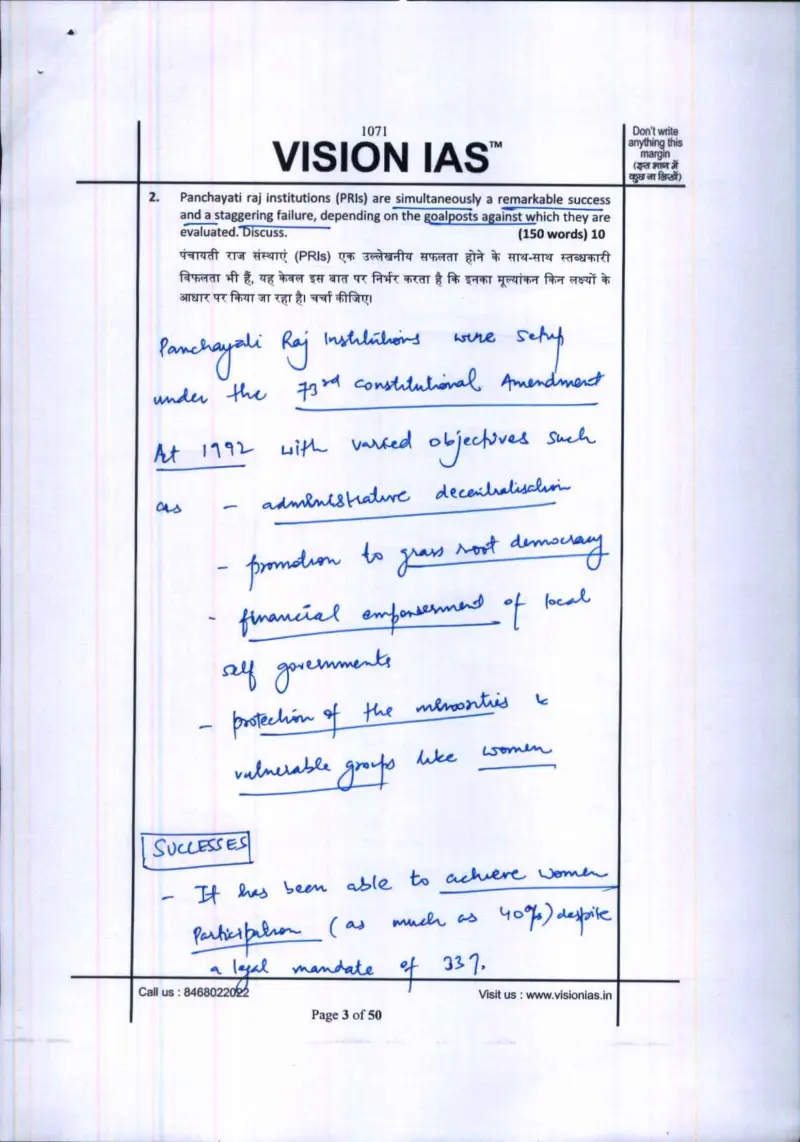
Answered a very similar question
Their question: “Panchayati Raj Institutions as both remarkable success and staggering failure”
The topper's success-and-failure ledger of PRIs (40% women participation vs only 5% own funds) directly informs the PYQ on how far decentralisation has changed grassroots governance.
Key learnings from their answer
- ›He turns soft polity claims into hard evidence: the Parliament answer drops 'sittings ~66 days/yr, budget discussed only ~6% / ~35 hours', the electoral-bond answer cites ADR's '~69% unaccounted funds, corporate funding ~88%', and the Ayushman answer uses '~70% out-of-pocket health spend, 1.2%-of-GDP public health outlay'. -> Memorise 2-3 exact statistics per high-frequency topic so generic assertions ('Parliament is in decline', 'health funding is low') land as proven facts, not opinion.
- ›Every answer runs the same disciplined skeleton: a 1-2 line context/definition intro, then boxed ALL-CAPS sub-headings (SUCCESSES/ISSUES/CHALLENGES/MEASURES/WAY FORWARD) with crisp bullets, closing on a one-line verdict; the judiciary answer (p.28) even branches a boxed 'CHALLENGES' via arrows into 'Judicial Overreach', 'overlap of powers' and 'Executive overreach by Judiciary'. -> Pre-fix a repeatable structural template so under time pressure you produce a scannable, evaluator-friendly answer every time without re-inventing layout.
What they cited: 73rd Constitutional Amendment Act, 1992; ~40% women participation in PRIs; PRIs generate only ~5% of own funds; Digital India Programme; Sarpanch dependence on Block Development Office (Q2)