
With reference to Mangrove Initiative for Shoreline Habitats and Tangible Income (MISHTI), which of the following statements is/are correct ? 1. It was initiated in 2019. 2. It aims to restore Mangrove forests. Select the correct answer from the code given below : Code :
- (a)Only 2
- (b)Both 1 and 2
- (c)Neither 1 nor 2
- (d)Only 1
Correct — A, Only 2. Statement 2 is right: MISHTI's entire purpose is mangrove afforestation and restoration along India's coastline and on salt-pan lands, run by the Ministry of Environment, Forest and Climate Change. Statement 1 is wrong on the year: MISHTI was not initiated in 2019 — it was announced in the Union Budget 2023-24 (1 February 2023) and formally launched on 5 June 2023, World Environment Day. Since only the second statement holds, the answer is 'Only 2'.
- (b)Both 1 and 2 — This would require the 2019 start date to be true. It is not — MISHTI is a Budget 2023-24 announcement, launched in June 2023. 2019 is the year of the Jal Jeevan Mission and Fit India, not of MISHTI; candidates who remember only 'a recent environment scheme' often default to a pre-COVID year.
- (c)Neither 1 nor 2 — Statement 2 is plainly true — the scheme's own name says 'Mangrove Initiative for Shoreline Habitats and Tangible Incomes', and its target is roughly 540 sq km of mangrove cover across nine States and four Union Territories. Rejecting both statements throws away the free half of the question.
- (d)Only 1 — This is the exact inversion of the truth: it accepts the false year and rejects the true aim. It is the option a candidate lands on by misreading the code rather than by misremembering the scheme.
MISHTI — Mangrove Initiative for Shoreline Habitats and Tangible Incomes — is a Government of India programme for mangrove plantation and restoration along the coastline and on salt-pan lands, administered by the Ministry of Environment, Forest and Climate Change. It runs for five years from FY 2023-24 to FY 2027-28 and targets roughly 540 sq km of mangrove area across nine coastal States and four Union Territories. It has no separate budget line of its own: it is funded by convergence between National and State CAMPA (compensatory afforestation) funds, MGNREGS and State plan schemes, on an 80:20 Centre-State sharing pattern.
This is a 'scheme plus year' question, the format UPPSC uses most for government initiatives. One statement is a giveaway (the aim, which the scheme's own expanded name states) and the other is a date you either know or do not. The technique is to date-stamp schemes by their announcing Budget: MISHTI, PM-PRANAM and Amrit Dharohar were all announced in the same Budget 2023-24 speech, so remembering any one of them fixes the other two. India's existing mangrove cover is about 5,000 sq km (Forest Survey of India), which is why a 540 sq km addition is a substantial target rather than a token one.
- MISHTI was announced in the Union Budget 2023-24 (1 February 2023) and launched on 5 June 2023 — not 2019
- Nodal ministry: Ministry of Environment, Forest and Climate Change; period FY 2023-24 to FY 2027-28
- Target: about 540 sq km of mangrove restoration/afforestation across 9 States and 4 Union Territories
- Funding is by convergence — National/State CAMPA + MGNREGS + State plan funds, shared 80:20 between Centre and States
- Announced in the same Budget speech as PM-PRANAM (alternative fertilisers) and Amrit Dharohar (wetlands)
- Assigning a scheme to a plausible-sounding earlier year — MISHTI is 2023, not 2019
- Confusing MISHTI with the Mangrove Alliance for Climate, which India joined at COP27 in 2022
- Assuming MISHTI has a dedicated budget outlay; it is funded by convergence with CAMPA and MGNREGS
UPPSC pairs the scheme's aim (easy) with its launch year (hard) in a two-statement code; UPSC prefers the ecological mechanism — how mangrove roots protect a coast, or which regions hold which forest types.
The 2004 Tsunami made people realize that mangroves can serve as a reliable safety hedge against coastal calamities. How do mangroves function as a safety hedge?
- (a) The mangrove swamps separate the human settlements from the sea by a wide zone in which people neither live nor venture out
- (b) The mangroves provide both food and medicines which people are in need of after any natural disaster
- (c) The mangrove trees are tall with dense canopies and serve as an excellent shelter during a cyclone or tsunami
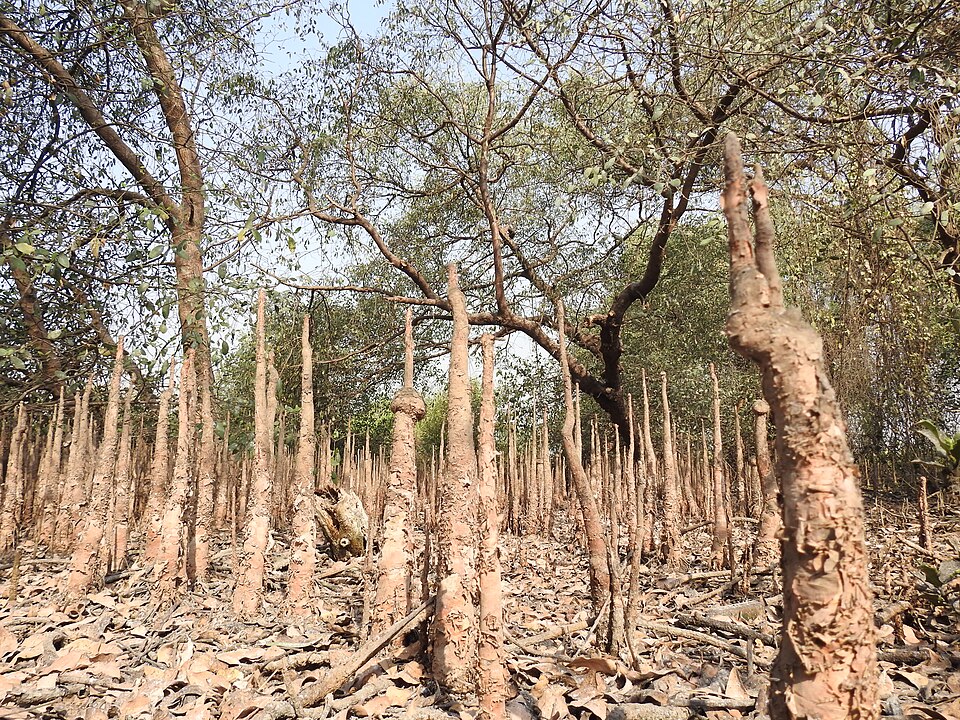
- (d) The mangrove trees do not get uprooted by storms and tides because of their extensive roots
Answer(d) The mangrove trees do not get uprooted by storms and tides because of their extensive roots
The ecological reason MISHTI exists. UPSC asks WHY mangroves protect a coast — their interlocking prop and pneumatophore roots resist uprooting and disperse wave energy — which is precisely the shoreline-habitat function named in MISHTI's title.
Assertion (A): Mangroves are very specialised forest ecosystems of tropical and subtropical regions bordering certain sea coasts. Reason (R): They stabilise the shoreline and act as bulwark against encroachments by sea. In the context of the above two statements, which one of the following is correct?
- (a) Both A and R are true and R is the correct explanation of A
- (b) Both A and R are true but R is not a correct explanation of A
- (c) A is true but R is false
- (d) A is false but R is true
Answer(a) Both A and R are true and R is the correct explanation of A
The same subject in assertion-reason form: mangroves as specialised tropical/subtropical coastal forests that stabilise the shoreline. Together with the 2011 question it gives the full 'what they are + what they do' base that a scheme question like this one sits on.
- practice — not a real PYQ
MISHTI, launched in 2023, is implemented by which Union Ministry?
- (a)Ministry of Jal Shakti
- (b)Ministry of Earth Sciences
- (c)Ministry of Environment, Forest and Climate Change
- (d)Ministry of Ports, Shipping and Waterways
Answer(c) Ministry of Environment, Forest and Climate Change — it is a mangrove afforestation programme funded through CAMPA and MGNREGS convergence.
- practice — not a real PYQ
Consider the following statements about mangroves: 1. They are found in the intertidal zone of tropical and subtropical coasts. 2. Pneumatophores help them take in oxygen in waterlogged, saline soil. Which of the statements given above is/are correct?
- (a)Only 1
- (b)Only 2
- (c)Both 1 and 2
- (d)Neither 1 nor 2
Answer(c) Both 1 and 2 — mangroves are salt-tolerant intertidal forests, and their upward-growing pneumatophore roots are breathing structures for oxygen-poor tidal mud.