
Match List - I with List - II and select the correct answer using the code given below the lists : List - I (Mission) A. Chandrayaan - 3 B. Aditya L1 C. INSAT - 3DS D. RLV-LEX-01 List - II (Date of Launch) 1. 02 September 2023 2. 17 February 2024 3. 14 July 2023 4. 02 April 2023
- (a)A-1, B-3, C-4, D-2
- (b)A-3, B-1, C-4, D-2
- (c)A-3, B-1, C-2, D-4
- (d)A-1, B-3, C-2, D-4
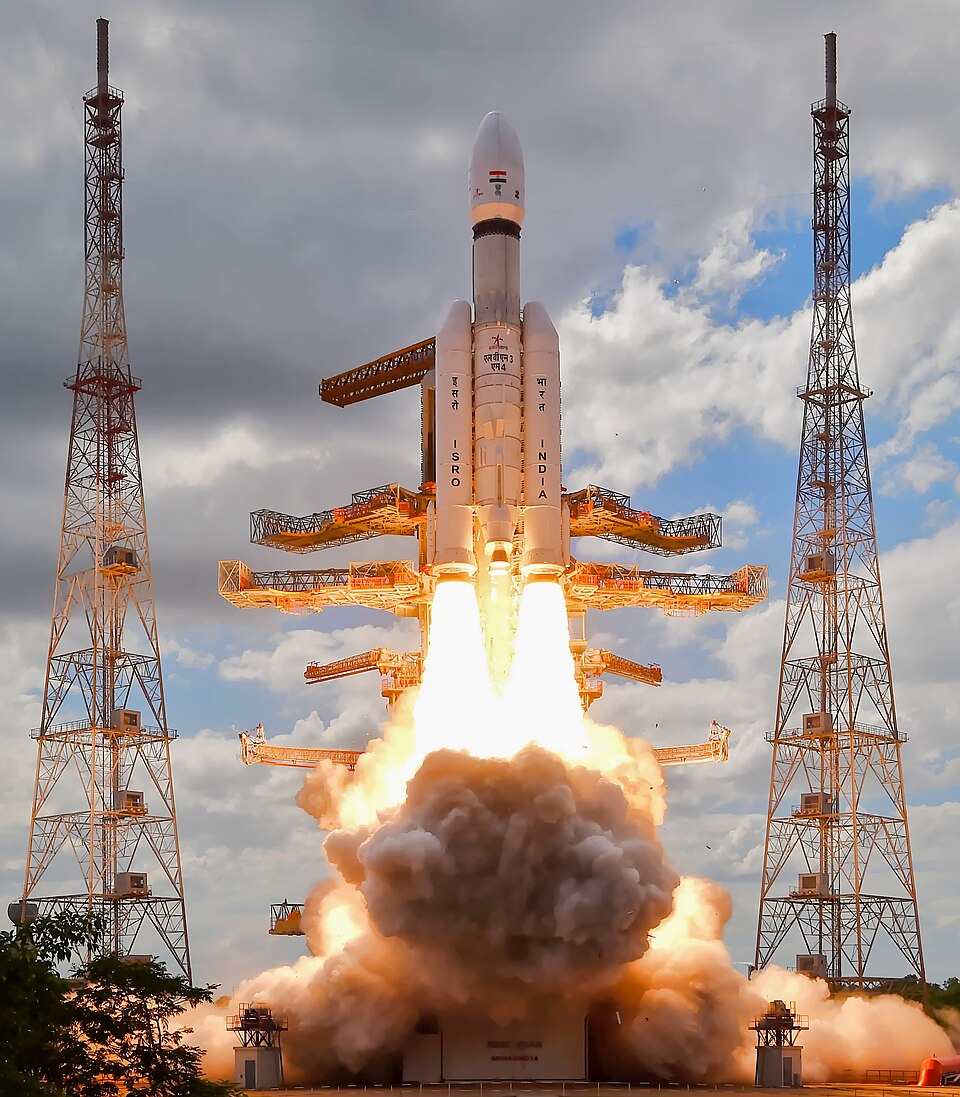
Correct — C, A-3, B-1, C-2, D-4. Chandrayaan-3 (A) lifted off on 14 July 2023 (3) aboard LVM3-M4 from the Satish Dhawan Space Centre, Sriharikota. Aditya-L1 (B), India's first dedicated solar observatory, followed on 2 September 2023 (1) on PSLV-C57. INSAT-3DS (C), a meteorological satellite funded by the Ministry of Earth Sciences, went up on 17 February 2024 (2) on GSLV-F14. RLV-LEX-01 (D), the Reusable Launch Vehicle Autonomous Landing Experiment, was carried out on 2 April 2023 (4) at the Aeronautical Test Range, Chitradurga, Karnataka — the earliest of the four events. Only option (c) puts all four missions against the right dates.
- (a)A-1, B-3, C-4, D-2 — It reverses both pairs. Chandrayaan-3 is given 2 September 2023 and Aditya-L1 14 July 2023, but the Moon mission came first and the Sun mission second — Aditya-L1 was launched about ten days after Chandrayaan-3's Vikram lander touched down on 23 August 2023. It also swaps INSAT-3DS with the RLV landing experiment.
- (b)A-3, B-1, C-4, D-2 — The first half is right (Chandrayaan-3 = 14 July 2023, Aditya-L1 = 2 September 2023) but the second half is inverted: it dates INSAT-3DS to 2 April 2023 and the RLV landing experiment to 17 February 2024. In fact the RLV-LEX-01 drop test was the earliest event of the four (April 2023) and INSAT-3DS was the only one from 2024.
- (d)A-1, B-3, C-2, D-4 — It gets INSAT-3DS and RLV-LEX-01 right but flips the two headline missions, dating Chandrayaan-3 to 2 September 2023 and Aditya-L1 to 14 July 2023. This is the commonest error, because both missions belong to the same monsoon of 2023 and candidates remember the Chandrayaan-3 landing date (23 August) rather than its launch date.
Between April 2023 and February 2024 ISRO ran an unusually dense sequence of very different missions — a lunar lander, a solar observatory, a weather satellite and a reusable-launch-vehicle landing trial. UPPSC's favourite way of testing that window is a mission-to-date match list, so each mission has to be stored with its launch date, its launch vehicle and what it was for, not just its name.
You do not need to recall all four dates independently — you only need the order. RLV-LEX-01 (April 2023) came first, Chandrayaan-3 (July 2023) next, Aditya-L1 (September 2023) after the Moon landing, and INSAT-3DS (February 2024) is the only 2024 entry. Fix one anchor you certainly know — Chandrayaan-3 launched 14 July 2023 and landed 23 August 2023 — and the rest of the list falls into place. The trap the paper is built on is confusing Chandrayaan-3's launch date with its landing date, which is what makes 2 September (Aditya-L1) feel plausible for the Moon mission.
- Chandrayaan-3 was launched on 14 July 2023 on LVM3-M4 from Sriharikota; the Vikram lander touched down near the lunar south pole on 23 August 2023, making India the first country to land in that region — the site was named Shiv Shakti Point and 23 August is now observed as National Space Day
- Aditya-L1, India's first dedicated solar mission, was launched on 2 September 2023 on PSLV-C57 and was inserted into a halo orbit around the Sun-Earth L1 point on 6 January 2024
- INSAT-3DS, a meteorological satellite funded by the Ministry of Earth Sciences, was launched on 17 February 2024 on GSLV-F14
- RLV-LEX-01 on 2 April 2023 was not a rocket launch at all — the winged vehicle (later called Pushpak) was carried aloft by an Indian Air Force Chinook helicopter, released at about 4.5 km and made an autonomous runway landing at the Aeronautical Test Range, Chitradurga, Karnataka
- Chronological order of the four: RLV-LEX-01 (Apr 2023) → Chandrayaan-3 (Jul 2023) → Aditya-L1 (Sep 2023) → INSAT-3DS (Feb 2024)
- Substituting a mission's landing or orbit-insertion date for its launch date — Chandrayaan-3 launched 14 July 2023 but landed 23 August 2023; Aditya-L1 launched 2 September 2023 but reached L1 on 6 January 2024
- Assuming every ISRO event is a launch from Sriharikota — RLV-LEX-01 was a helicopter-drop landing experiment at Chitradurga, Karnataka
- Mixing up INSAT-3DS (2024, GSLV-F14) with the earlier INSAT-3D/3DR meteorological satellites
UPPSC asks this as a mission-to-date or mission-to-launch-vehicle match list; UPSC rarely asks the bare date and instead probes what the mission does — orbit type, payload, or which vehicle suits which class of satellite.
With reference to India's satellite launch vehicles, consider the following statements: 1. PSLVs launch the satellites useful for Earth resources monitoring whereas GSLVs are designed mainly to launch communication satellites. 2. Satellites launched by PSLV appear to remain permanently fixed in the same position in the sky, as viewed from a particular location on Earth. 3. GSLV Mk III is a four-stage launch vehicle with the first and third stages using solid rocket motors; and the second and fourth stages using liquid rocket engines. Which of the statements given above is/are correct?
- (a) 1 only
- (b) 2 and 3
- (c) 1 and 2
- (d) 3 only
Answer(a) 1 only
The same body of knowledge from the vehicle side: which ISRO launcher is used for which class of satellite. Knowing that PSLV lifts remote-sensing payloads, GSLV the communication and meteorological ones and LVM3 the heaviest missions is exactly what lets you sanity-check a mission-to-date list like this one.
Consider the following statements: The Mangalyaan launched by ISRO 1. Is also called the Mars Orbiter Mission 2. Made India the second country to have a spacecraft orbit the Mars after USA 3. Made India the only country to be successful in making its spacecraft orbit the Mars in its very first attempt Which of the statements given above is/are correct?
- (a) 1 only
- (b) 2 and 3 only
- (c) 1 and 3 only
- (d) 1, 2 and 3
Answer(c) 1 and 3 only
The same mission-fact pattern applied to Mangalyaan — UPSC tests whether the candidate has stored the correct claim about a flagship ISRO mission rather than a half-remembered superlative, which is precisely the skill this match list needs.
Which Geosynchronous Satellite Launch Vehicle was used by ISRO to launch Chandrayaan-2 space craft ?
- (a) GSLV – MK III – M1
- (b) GSLV – MK II – M2
- (c) GSLV – MK IV – M8
- (d) GSLV – MK V – M4
Answer(a) GSLV – MK III – M1
Same concept in the same exam — UPPSC pairing an ISRO mission with its launch detail. There the mission was Chandrayaan-2 and the detail was the launch vehicle (GSLV Mk III-M1); here it is Chandrayaan-3 and the launch date.
- practice — not a real PYQ
Aditya-L1 was placed in a halo orbit around the Sun-Earth L1 point mainly because that location:
- (a)is the point in space closest to the Sun
- (b)allows continuous observation of the Sun without occultation by eclipses
- (c)lies outside the influence of the Sun's gravity
- (d)is the only orbit from which the Sun's poles are visible
Answer(b) allows continuous observation of the Sun without occultation by eclipses — a satellite in a halo orbit at L1 has an uninterrupted view of the Sun, which is why the point was chosen.
- practice — not a real PYQ
Which launch vehicle was used to place Chandrayaan-3 into orbit?
- (a)PSLV-C57
- (b)GSLV-F14
- (c)LVM3-M4
- (d)SSLV-D2
Answer(c) LVM3-M4 — PSLV-C57 carried Aditya-L1 and GSLV-F14 carried INSAT-3DS.