
With reference to the “Kohima Peace Memorial and Eco-Park” which of the following statements is/are correct ? 1. Its inauguration programme was held on 8th March, 2024 at Kohima. 2. It will be developed by South Korea. Select the correct answer from the codes given below :
- (a)Only 2
- (b)Neither 1 nor 2
- (c)Only 1
- (d)Both 1 and 2
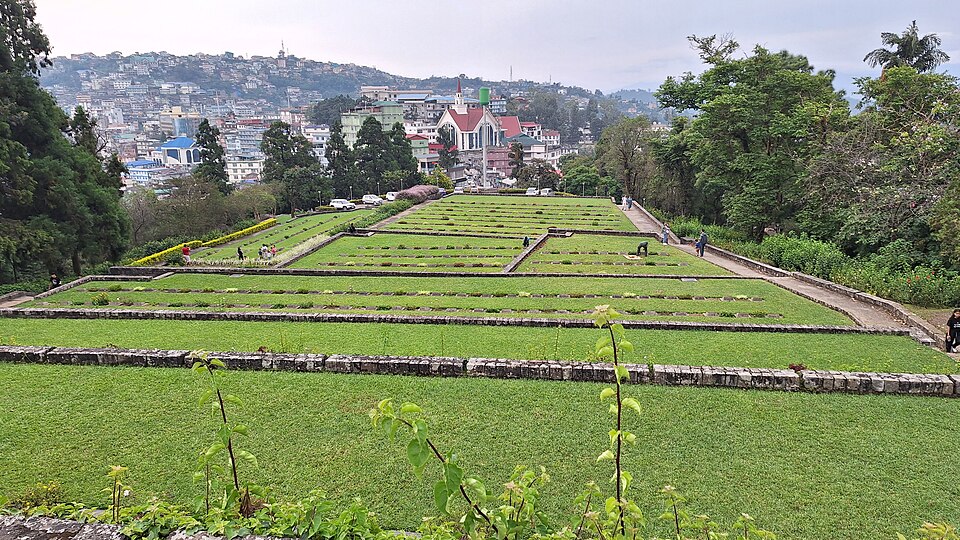
Correct — C, Only 1. The whole item turns on statement 2, and statement 2 is false: the Kohima Peace Memorial and Eco-Park is a Japan–Nagaland project, not a South Korean one. It is built with Japanese support — Japanese Official Development Assistance channelled through JICA, alongside the Japan-assisted Nagaland Forest Management Project — and it was unveiled at Kohima with Japan's Ambassador to India, Suzuki Hiroshi, together with Nagaland's Chief Minister Neiphiu Rio. The reason it is Japan and could not sensibly be anyone else is the history under it. Kohima is where the Japanese Fifteenth Army's U-Go offensive into India was stopped in the summer of 1944; 2024 was the eightieth anniversary of that battle, and the memorial and eco-park were conceived as a monument to reconciliation between the Naga people and the country whose army fought there. Statement 1 gives the inauguration as 8 March 2024 at Kohima, and the commission has treated that as correct — which is what makes 'Only 1' the marked answer rather than 'Neither 1 nor 2'. Be aware, honestly, that the date is the soft part of this question: two Nagaland newspapers, EastMojo and the Morung Express, report the unveiling in May 2024, while the exam-compilation circuit carries 8 March 2024. We follow the commission on the date because marks were awarded on it, and we tell you plainly that it is disputed. Nothing about the answer depends on it: whichever month you accept, 'South Korea' is wrong, which kills (a) and (d), and the commission's reading of statement 1 then decides between (b) and (c) in favour of (c).
- (a)Only 2 — Requires statement 2 to be true, and it is not. The partner country is Japan, not South Korea. The project sits inside the Japan–Nagaland relationship built on the memory of the 1944 Battle of Kohima and is supported through Japanese development assistance; South Korea has no role in it.
- (b)Neither 1 nor 2 — Correctly rejects South Korea but goes one step too far by also rejecting statement 1. The commission treats the inauguration date given in the question as accurate, and marks were awarded on that basis. If you had struck down the date as well you would have landed here — which is exactly why a candidate should not gamble against a date the paper itself supplies unless he is certain.
- (d)Both 1 and 2 — Accepts the false half. Calling the memorial a South Korean project misses the point of the site: Kohima marks the furthest advance of the Japanese army into India in 1944, and the peace memorial is a Japanese-supported gesture of reconciliation on that battlefield.
Between April and June 1944 the Japanese Fifteenth Army, striking west from Burma in Operation U-Go, tried to take Imphal and Kohima and cut the supply line to the Allied front; units of Subhas Chandra Bose's Indian National Army advanced with them. At Kohima the attack was held and then thrown back, and the twin battles of Imphal and Kohima are treated as the turning point of the Second World War in South-East Asia. Eight decades later that battlefield has become the ground of a friendship project: Japan funds development work in Nagaland through its Official Development Assistance and JICA, and the Kohima Peace Memorial and Eco-Park was raised as a monument to reconciliation in the anniversary year, 2024.
Two-statement current-affairs items are usually built so that one statement is a date and the other is an attribution, and the attribution is nearly always the one the examiner is really testing. Here 'South Korea' is the planted error, and a student who knows only one thing about Kohima — that the Japanese army reached it in 1944 — has enough to eliminate it. That single deduction removes options (a) and (d) at once. The residual risk is the date, and the safe convention in a state PSC paper is not to fight a date the paper itself asserts unless you can positively contradict it; here that convention gives (c). Keep the underlying association in your head as 'Kohima = Japan, 1944', because UPPSC returns to Northeast India and to India's development partners often, and the same association answers questions phrased in several different ways.
- The Kohima Peace Memorial and Eco-Park is a Japan–Nagaland project, supported by Japanese Official Development Assistance through JICA and linked to the Japan-assisted Nagaland Forest Management Project — not a South Korean initiative.
- It was unveiled at Kohima in 2024 with Japan's Ambassador to India, Suzuki Hiroshi, and Nagaland Chief Minister Neiphiu Rio. The question dates the inauguration to 8 March 2024 and the commission marks that as correct; two Nagaland outlets, EastMojo and the Morung Express, place the unveiling in May 2024, so treat the exact date as contested and the Japan link as the settled fact.
- The Battle of Kohima was fought between April and June 1944, when the Japanese Fifteenth Army's Operation U-Go against Imphal and Kohima was halted; 2024 was its eightieth anniversary. Kohima marks the deepest point of the Japanese advance into India.
- The Commonwealth War Graves Commission's Kohima War Cemetery stands on Garrison Hill in the town and carries the Kohima Epitaph — 'When you go home, tell them of us and say, for your tomorrow, we gave our today.'
- Swapping Japan for South Korea in Northeast India news items. South Korea's India footprint is largely industrial and cultural; Japan's is development assistance and infrastructure, and the Kohima connection is specifically Japanese and specifically about 1944.
- Assuming a 'Peace Memorial' must be a war-graves cemetery. The Kohima War Cemetery is a Commonwealth War Graves Commission site of long standing; the Peace Memorial and Eco-Park is a separate, recent Japan-supported project.
- Rejecting a date the question itself supplies. Unless you can positively contradict it, the commission's reading of its own statement is what decides the marks — as this item shows.
UPPSC asks Northeast current affairs as a two-statement item in which one statement names a partner country — that attribution is the discriminator. UPSC, by contrast, tends to approach the same ground historically, through the INA, the 1944 campaign or the constitutional status of Nagaland.
The Indian National Army (INA) came into existence in 1943 in
- (a) Japan
- (b) Burma
- (c) Singapore
- (d) Malaya
Answer(c) Singapore
The other end of the same story — the Indian National Army raised under Japanese auspices in 1943, whose units advanced with the Japanese Fifteenth Army towards Imphal and Kohima the following year. That 1944 campaign is what the Kohima memorial commemorates and why Japan, not South Korea, is the partner.
What was the name of the female Regiment constituted as a part of the Azad Hind Fauj by Netaji Subhash Chandra Bose?
- (a) Rani Jhansi Regiment
- (b) Veerangana Regiment
- (c) Bharat Mata Regiment
- (d) Rani Bhabani Regiment
Answer(a) Rani Jhansi Regiment
UPPSC's own return to the INA — the Rani of Jhansi Regiment of the Azad Hind Fauj, raised in 1943 in the same Japanese-backed campaign that carried the INA to the Imphal–Kohima front in 1944. The Japan–Northeast India link that decides this 2024 item runs directly through that history.
- practice — not a real PYQ
The Battle of Kohima, fought in 1944, is significant in the history of the Second World War because
- (a)it was the first battle in which the Indian National Army fought independently of Japanese forces
- (b)it marked the furthest advance of the Japanese army into India, where the offensive towards Imphal and Kohima was halted
- (c)it forced the Japanese to surrender in South-East Asia in 1944 itself
- (d)it was fought entirely between Indian National Army units and the Chinese army
Answer(b) it marked the furthest advance of the Japanese army into India — the Japanese Fifteenth Army's Operation U-Go against Imphal and Kohima was stopped between April and June 1944, and the twin battles are treated as the turning point of the war in South-East Asia. Japan surrendered only in 1945.
- practice — not a real PYQ
JICA, which appears frequently in news about infrastructure and forestry projects in India, is the development cooperation agency of
- (a)South Korea
- (b)Germany
- (c)Japan
- (d)France
Answer(c) Japan — the Japan International Cooperation Agency delivers Japan's Official Development Assistance, including loans and technical cooperation for projects in India such as forest management work in Nagaland. Germany's counterpart is GIZ/KfW and France's is AFD.