
Diabetes is the most common disorder associated with :
- (a)Kidney
- (b)Gall bladder
- (c)Liver
- (d)Pancreas
Correct — D, Pancreas. Diabetes mellitus is a disorder of blood-glucose control, and blood glucose is held down by exactly one hormone — insulin — which is made in exactly one place in the body: the beta cells of the islets of Langerhans, the endocrine tissue scattered through the pancreas. Every form of the disease is therefore a failure at that pancreatic step. In Type 1 diabetes the immune system destroys the beta cells, so insulin production collapses altogether and the patient depends on injected insulin. In Type 2 diabetes, which accounts for the large majority of cases, the tissues become resistant to insulin and the beta cells, after years of over-secreting to compensate, progressively fail to keep up — a relative deficiency rather than an absolute one. In both, glucose that should have been driven into cells stays in the blood, and chronic hyperglycaemia is what defines the disease. The pancreas is also the only organ among the four options with any glucose-regulating hormone of its own: alongside insulin from the beta cells, its alpha cells make glucagon, which raises blood glucose, and the delta cells make somatostatin. The other three organs listed are all touched by diabetes in one way or another, but none of them produces insulin, and so none of them is where the disorder originates.
- (a)Kidney — The most historically tempting wrong answer, because the kidney is where diabetes was traditionally detected — once plasma glucose rises past the renal threshold of roughly 180 mg/dL the tubules can no longer reabsorb it all and sugar spills into the urine, which is the glycosuria that gave the disease its name of 'sweet urine'. The kidney is also the organ most famously damaged by long-standing diabetes, diabetic nephropathy being a leading cause of end-stage renal disease. But in both roles the kidney is a victim and a window, not the source. Note also that diabetes insipidus, despite its name, is an entirely different disease of vasopressin (ADH) and water handling, with no rise in blood sugar at all.
- (b)Gall bladder — The gall bladder is a storage sac. It concentrates and stores the bile that the liver makes and releases it into the duodenum to emulsify fats; it secretes no hormone and plays no part in glucose regulation. Its own characteristic disorders are gallstones (cholelithiasis) and inflammation (cholecystitis). It is placed in the option set only because it sits beside the pancreas and liver in the upper abdomen and shares the biliary plumbing with them.
- (c)Liver — The most defensible wrong option, and worth understanding rather than merely eliminating. The liver is the body's glucose warehouse: it stores glucose as glycogen (glycogenesis), releases it again on demand (glycogenolysis), and manufactures fresh glucose from non-carbohydrate sources (gluconeogenesis). It is a principal target organ of insulin, and in diabetes an insulin-resistant liver pours out glucose it should be holding back. But the liver executes instructions; it does not issue them. It makes no insulin, and a disease of insulin is a disease of the organ that makes insulin.
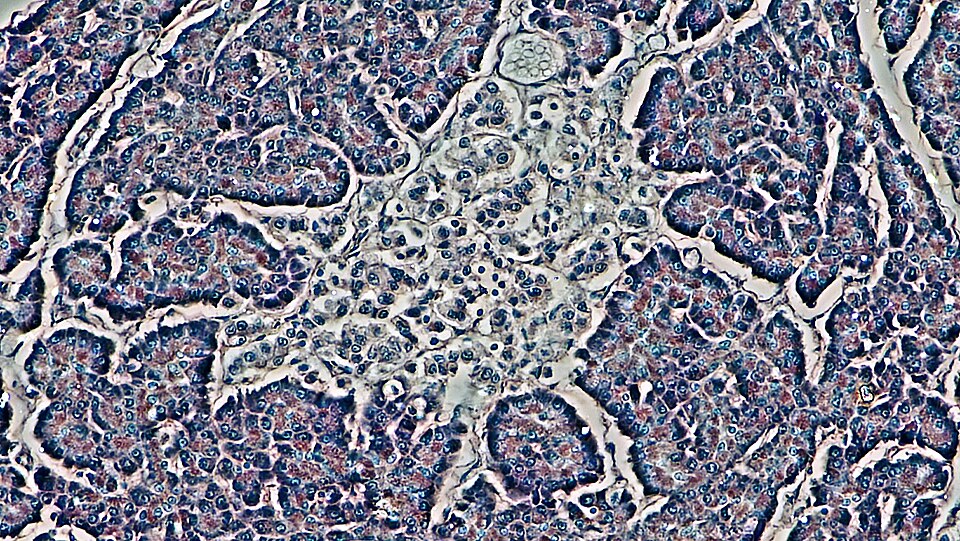
The pancreas is a heterocrine, or mixed, gland — it works as both an exocrine and an endocrine organ. Its exocrine bulk, the acinar tissue, makes pancreatic juice (amylase, lipase, nucleases and the protein-digesting zymogens trypsinogen and chymotrypsinogen, with bicarbonate from the duct cells) and delivers it through the pancreatic duct into the duodenum. Embedded in that bulk, making up only a small fraction of the organ, are about a million islets of Langerhans, the endocrine part, which secrete straight into the bloodstream: beta cells make insulin, alpha cells make glucagon, delta cells make somatostatin. Insulin and glucagon are antagonists, and the balance between them is what holds blood glucose within a narrow range.
This is a 'which organ' question, so the reliable method is to ask which organ makes the hormone that is missing or ineffective, not which organ shows the symptoms. Diabetes is defined by insulin failure; insulin is made only in the pancreatic beta cells; therefore the pancreas. Kidney and liver are in the option set precisely because both are heavily involved downstream — the kidney reveals the disease in urine and later suffers from it, the liver is the main organ that insulin acts upon — and a candidate who reasons from symptoms rather than from causes can be pulled either way. Keep the two Greek-named diseases apart as well: diabetes mellitus (from 'honeyed') is the pancreatic insulin disorder meant here, while diabetes insipidus (from 'tasteless') is a pituitary or renal disorder of antidiuretic hormone producing enormous volumes of dilute urine and no sugar.
- Diabetes mellitus is chronic hyperglycaemia caused by absolute insulin deficiency (Type 1, autoimmune destruction of beta cells) or insulin resistance with relative deficiency (Type 2); insulin is produced only by the beta cells of the islets of Langerhans in the pancreas.
- The pancreas is a heterocrine gland — exocrine acini secrete digestive pancreatic juice into the duodenum, while the endocrine islets secrete insulin (beta cells), glucagon (alpha cells) and somatostatin (delta cells) into the blood.
- Insulin lowers blood glucose; glucagon, from the same organ, raises it. They are antagonistic hormones and both are pancreatic.
- Diabetes insipidus is a different disease altogether — deficiency of, or renal resistance to, antidiuretic hormone (vasopressin), producing large volumes of dilute urine without hyperglycaemia.
- Glycosuria — sugar in the urine — appears only once blood glucose exceeds the renal threshold of about 180 mg/dL, so the kidney is where diabetes is detected, not where it begins.
- Insulin was isolated by Frederick Banting and Charles Best at the University of Toronto in 1921, working with J.J.R. Macleod and J.B. Collip; the 1923 Nobel Prize in Physiology or Medicine went to Banting and Macleod. The islets themselves were described by Paul Langerhans in 1869.
- India has one of the largest populations living with diabetes in the world, and Type 2 diabetes is a central concern of India's National Programme for Prevention and Control of Non-Communicable Diseases.
- Answering from the symptom rather than the cause. Sugar shows up in urine, so 'kidney' feels right; but the kidney only filters what the failing pancreas has allowed to accumulate.
- Choosing the liver because it stores and releases glucose. It is the main organ insulin acts on, not the organ that makes insulin.
- Merging diabetes mellitus with diabetes insipidus. They share a name and almost nothing else — one is pancreatic and about glucose, the other is about antidiuretic hormone and water.
UPPSC asks this area as direct one-liners — which organ, which cell type, which hormone — as it did in 2019 with the mixed endocrine-and-exocrine gland and in 2023 with the beta cells of the islets of Langerhans. UPSC prefers matching lists of glands to hormones, statement-based items on what insulin chemically is, or assertion-reason questions that hinge on telling diabetes mellitus and diabetes insipidus apart.
Which of the following are associated with diabetes mellitus, a common disease in adults? I. Higher sugar level in blood II. Lower sugar level in blood III. Lower insulin level in blood IV. Higher insulin level in blood Select the correct answer using the codes given below:
- (a) I and IV
- (b) I and II
- (c) II and III
- (d) I and III
Answer(d) I and III
The same disease defined by its two signatures — high blood sugar with low effective insulin. That pairing is exactly what points to the insulin-producing organ, the pancreas, as the seat of the disorder.
Match List I (Endocrine glands) with List II (Hormones secreted) and select the correct answer using the codes given below the Lists: List I I. Gonads II. Pituitary III. Pancreas IV. Adrenal List II A) Insulin B) Progesterone C) Growth hormones D) Cortisone Codes:
- (a) I-C, II-B, III-D, IV-A
- (b) I-B, II-C, III-D, IV-A
- (c) I-B, II-C, III-A, IV-D
- (d) I-C, II-B, III-A, IV-D
Answer(c) I-B, II-C, III-A, IV-D
UPSC asked candidates to pair the pancreas with insulin directly. That one pairing is the whole argument for option (d) here — the organ that makes insulin is the organ whose failure is diabetes.
Assertion (A): The person with diabetes insipidus feels thirsty. Reason (R): A person with diabetes insipidus suffers from excess secretion of vasopressin.
- (a) Both A and R are individually true and R is the correct explanation of A
- (b) Both A and R are individually true but R is not the correct explanation of A
- (c) A is true but R is false
- (d) A is false but R is true
Answer(c) A is true but R is false
The other diabetes. It is caused by deficient — not excess — vasopressin and has nothing to do with the pancreas, which is the distinction a candidate must already hold to be sure that 'diabetes' in this 2024 question means the pancreatic disease.
Which of the following hormones is secreted by the Beta cell of Islet of Langerhans of Pancreas?
- (a) Aldosterone
- (b) Adrenalin
- (c) Insulin
- (d) Glucagan
Answer(c) Insulin
UPPSC asked the identical chain one year earlier, only from the cell end: beta cells of the pancreatic islets make insulin. Destroy or overwork those cells and you have diabetes — which is why the organ in 2024 is the pancreas.
Which of the following glands in human body acts both as an endocrine gland as well as an exocrine gland ?
- (a) Adrenal gland
- (b) Lacrimal gland
- (c) Pancreas
- (d) Thyroid
Answer(c) Pancreas
The structural fact behind this question — the pancreas has an endocrine part (the islets) as well as an exocrine part (the acini). Diabetes is a disease of the endocrine half of the very same organ.
- practice — not a real PYQ
Which one of the following pairs is correctly matched?
- (a)Alpha cells of islets of Langerhans – Insulin
- (b)Beta cells of islets of Langerhans – Glucagon
- (c)Alpha cells of islets of Langerhans – Glucagon
- (d)Delta cells of islets of Langerhans – Insulin
Answer(c) Alpha cells of islets of Langerhans – Glucagon. Beta cells secrete insulin, which lowers blood glucose; alpha cells secrete glucagon, which raises it; delta cells secrete somatostatin.
- practice — not a real PYQ
A patient passes very large volumes of dilute urine and is constantly thirsty, but repeated tests show a normal blood glucose level. This condition is most likely due to a disorder of :
- (a)Insulin secretion by the pancreas
- (b)Antidiuretic hormone (vasopressin)
- (c)Thyroxine secretion by the thyroid
- (d)Bile secretion by the liver
Answer(b) Antidiuretic hormone (vasopressin) — this describes diabetes insipidus, in which ADH is deficient or the kidney fails to respond to it, so water is not reabsorbed. Normal blood glucose is what rules out diabetes mellitus and therefore rules out a pancreatic cause.