
The recent global pause during COVID-19 pandemic was caused due to :
- (a)SARS – CoV-1
- (b)H5N1
- (c)SARS – CoV-2
- (d)MERS – CoV-2
Correct — C, SARS-CoV-2. The 'global pause' the question refers to is the worldwide shutdown of travel, workplaces and schooling in 2020, and the organism behind it was Severe Acute Respiratory Syndrome Coronavirus 2. Two names, issued on the same day, are the heart of this item: on 11 February 2020 the Coronavirus Study Group of the International Committee on Taxonomy of Viruses named the virus SARS-CoV-2, because its genome placed it as a sister to the 2003 SARS virus, while the World Health Organization named the disease COVID-19 — coronavirus disease 2019. The virus is an enveloped, positive-sense single-stranded RNA virus of the genus Betacoronavirus; it enters human cells by binding its crown-like spike (S) protein to the ACE2 receptor on the cell surface, a fact UPSC itself tested in 2021. It was first recognised as a cluster of pneumonia of unknown cause in Wuhan, China, at the end of December 2019. WHO declared a Public Health Emergency of International Concern on 30 January 2020 and characterised the outbreak as a pandemic on 11 March 2020; India's nationwide lockdown began on 25 March 2020 — that is the pause. Anchor the wording to the exam: the paper was written for 22 December 2024, by which date the emergency phase was already over — WHO ended the Public Health Emergency of International Concern on 5 May 2023 — and 'recent' means the 2020–22 period, not an ongoing shutdown. As of 2026 the virus still circulates as descendants of the Omicron lineage and is managed as an endemic respiratory infection.
- (a)SARS – CoV-1 — This is the original SARS coronavirus, which caused the outbreak that began in Guangdong province, China, in November 2002 and was contained by July 2003. WHO's final tally was about 8,096 probable cases and 774 deaths across some two dozen countries, and no natural human case has been recorded since 2004. It was the deadlier virus case for case, but far less transmissible, because patients became infectious only after they were visibly ill and could therefore be isolated. SARS-CoV-2 spreads before and without symptoms, which is precisely why one became a contained outbreak and the other a pandemic. Note also the naming order: the 2002 virus was simply 'SARS-CoV' until the 2019 virus arrived and made a numeral necessary.
- (b)H5N1 — Wrong family altogether. H5N1 is a subtype of influenza A — an orthomyxovirus, named for its haemagglutinin and neuraminidase surface proteins — and is the highly pathogenic avian influenza that circulates in wild birds and poultry, causing 'bird flu'. Human infections have been sporadic, almost always after close contact with infected birds, and although the case fatality among those infected has been high, the virus has never achieved sustained human-to-human transmission. It has caused mass culling of poultry in India and elsewhere, but it did not cause COVID-19.
- (d)MERS – CoV-2 — There is no such virus. The real organism is MERS-CoV, the Middle East Respiratory Syndrome coronavirus, first identified in Saudi Arabia in 2012 and linked to dromedary camels as the animal reservoir; it produced clusters of severe illness with a high case fatality, including a large hospital-linked outbreak in South Korea in 2015, but it too never spread efficiently between people. No 'MERS-CoV-2' has ever been designated, so this option is wrong twice over — wrong virus for COVID-19, and a name that does not exist. The suffix '-2' belongs only to SARS-CoV-2, and the option is planted to catch a candidate matching numerals rather than names.
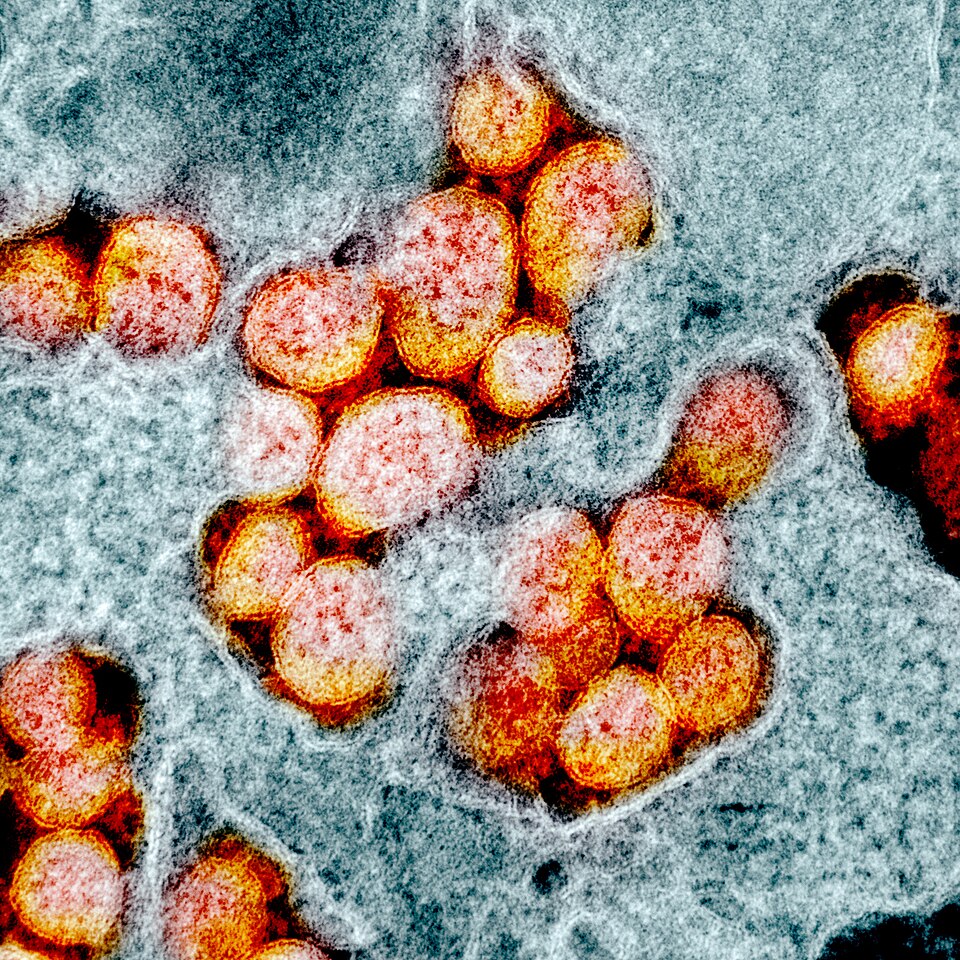
Seven coronaviruses are known to infect humans. Four of them — 229E, NL63, OC43 and HKU1 — circulate endemically and cause ordinary colds. The other three crossed from animals into people within living memory and caused severe outbreaks: SARS-CoV in 2002, MERS-CoV in 2012, and SARS-CoV-2 in 2019. All are enveloped RNA viruses whose surface spike proteins give the particle the crown, or corona, seen under an electron microscope. Only SARS-CoV-2 combined severity with efficient pre-symptomatic transmission, and that combination is what turned an outbreak into a pandemic.
The option set is built out of near-misses rather than nonsense, so the reasoning is about names. Three tests dispose of it. First, family: H5N1 is an influenza virus, not a coronavirus, so it cannot be the cause of a disease whose very name begins with 'corona'. Second, existence: 'MERS-CoV-2' has never been designated by the ICTV — MERS-CoV has no numbered successor. Third, date: SARS-CoV-1 belongs to 2002–03 and was declared contained in 2003, long before any global pause. What remains, and what is independently correct, is SARS-CoV-2. Carry away the general rule the question is really teaching: the virus is named by the International Committee on Taxonomy of Viruses and the disease by the WHO, which is why the pair is SARS-CoV-2 and COVID-19 rather than one name for both — the same distinction as HIV the virus and AIDS the disease.
- COVID-19 is caused by SARS-CoV-2, an enveloped positive-sense single-stranded RNA virus of the genus Betacoronavirus; the virus was named by the ICTV Coronavirus Study Group and the disease named COVID-19 by WHO, both on 11 February 2020.
- WHO declared a Public Health Emergency of International Concern on 30 January 2020, characterised COVID-19 as a pandemic on 11 March 2020, and ended the PHEIC on 5 May 2023 — so at the exam date of 22 December 2024 the emergency phase was already over.
- SARS-CoV-2 enters human cells by binding its spike (S) protein to the ACE2 receptor — the fact UPSC tested in 2021 through the term 'ACE2'.
- SARS-CoV-1 caused the 2002–03 SARS outbreak (WHO tally about 8,096 cases and 774 deaths, contained by July 2003); MERS-CoV emerged in Saudi Arabia in 2012 with dromedary camels as reservoir. There is no virus named 'MERS-CoV-2'.
- H5N1 is an influenza A virus (family Orthomyxoviridae), the cause of highly pathogenic avian influenza — a different family from the coronaviruses entirely.
- WHO's May 2021 scheme labels SARS-CoV-2 variants of concern by Greek letters — Alpha, Beta, Gamma, Delta and Omicron — to avoid naming variants after the countries where they were first detected.
- India: nationwide lockdown from 25 March 2020; the vaccination drive began on 16 January 2021 with Covishield (Serum Institute of India, an adenoviral-vector vaccine) and Covaxin (Bharat Biotech, a whole-virion inactivated vaccine).
- Reading only the numeral. Option (d) offers a '-2' attached to the wrong virus, and 'MERS-CoV-2' does not exist at all.
- Confusing the virus with the disease. The virus is SARS-CoV-2; the disease is COVID-19. UPSC and UPPSC both exploit this by asking for one and offering the other.
- Assuming every recent respiratory outbreak is a coronavirus. H5N1 and H1N1 are influenza A viruses from an entirely different family.
UPPSC has repeatedly used direct one-line recall on the pandemic — which virus, which vaccine platform, which institution — as in its 2023 question on the mRNA vaccine. UPSC does not ask the virus's name directly; it asks around it, testing the cell receptor (ACE2, 2021), the vaccine technology used by each manufacturer (2022), or whether viruses can be grown on artificial media.
The term 'ACE2' is talked about in the context of
- (a) genes introduced in the genetically modified plants
- (b) development of India's own satellite navigation system
- (c) radio collars for wildlife tracking
- (d) spread of viral diseases
Answer(d) spread of viral diseases
The same virus asked at the molecular level — ACE2 is the human cell receptor that the SARS-CoV-2 spike protein binds, which is how the virus of this 2024 question gets into cells in the first place.
In the context of vaccines manufactured to prevent COVID-19 pandemic, consider the following statements: 1. The Serum Institute of India produced COVID-19 vaccine named Covishield using mRNA platform. 2. Sputnik V vaccine is manufactured using vector based platform. 3. COVAXIN is an inactivated pathogen based vaccine. Which of the statements given above are correct?
- (a) 1 and 2 only
- (b) 2 and 3 only
- (c) 1 and 3 only
- (d) 1, 2 and 3
Answer(b) 2 and 3 only
The response to the same pandemic. Knowing that Covishield is a viral-vector vaccine and Covaxin a whole-virion inactivated one completes the picture around the causative agent named here.
Which of the following is mRNA vaccine used against Covid-19 infection?
- (a) Sinovac
- (b) Moderna
- (c) Sputnik
- (d) Novavax
Answer(b) Moderna
UPPSC's own COVID item from the previous year, aimed at the countermeasure rather than the pathogen — the mRNA vaccines deliver instructions for the very spike protein of SARS-CoV-2 that is named in this question.
- practice — not a real PYQ
Which one of the following is the cell-surface receptor that SARS-CoV-2 uses to enter human cells?
- (a)CD4 receptor
- (b)ACE2 receptor
- (c)Insulin receptor
- (d)Toll-like receptor 4
Answer(b) ACE2 receptor — the spike (S) protein of SARS-CoV-2 binds angiotensin-converting enzyme 2 on the host cell membrane. CD4 is the receptor used by HIV, and the other two have no role in coronavirus entry.
- practice — not a real PYQ
Consider the following viruses : 1. SARS-CoV-2 2. MERS-CoV 3. H5N1 Which of the above belong to the coronavirus family?
- (a)1 only
- (b)1 and 2 only
- (c)2 and 3 only
- (d)1, 2 and 3
Answer(b) 1 and 2 only — SARS-CoV-2 and MERS-CoV are both coronaviruses (family Coronaviridae, genus Betacoronavirus). H5N1 is an influenza A virus of the family Orthomyxoviridae and causes avian influenza, not a coronavirus disease.