
Which of the following glands in human body acts both as an endocrine gland as well as an exocrine gland ?
- (a)Adrenal gland
- (b)Lacrimal gland
- (c)Pancreas
- (d)Thyroid
Correct — C, Pancreas. The pancreas is the textbook heterocrine (mixed) gland. The overwhelming bulk of it is exocrine: acinar cells make pancreatic juice — pancreatic amylase, lipase, nucleases and the protein-digesting zymogens trypsinogen and chymotrypsinogen, together with bicarbonate from the duct cells — which drains through the pancreatic duct and is poured into the duodenum, i.e. delivered through a duct onto an epithelial surface. Scattered through that same tissue are the islets of Langerhans, only about 1–2% of the organ's mass, whose alpha cells secrete glucagon, beta cells insulin and delta cells somatostatin directly into the bloodstream with no duct at all. One organ, both modes of secretion — which is exactly what the question asks for.
- (a)Adrenal gland — Purely endocrine and completely ductless. The cortex releases aldosterone, cortisol and small amounts of androgens; the medulla releases adrenaline and noradrenaline — all straight into the blood. It has no secretory duct and no exocrine product.
- (b)Lacrimal gland — Purely exocrine. It produces tears and delivers them through lacrimal ducts onto the surface of the eye. It secretes no hormone into the bloodstream, so it fails the endocrine half of the question.
- (d)Thyroid — Purely endocrine. Follicular cells release thyroxine (T4) and triiodothyronine (T3) and the parafollicular C cells release calcitonin, all into the blood. The colloid held inside the follicles is an internal store, not a duct-borne secretion, so the thyroid is ductless.
Glands are classified by where their product goes. An exocrine gland pours its secretion through a duct onto a body surface or into a cavity (sweat, saliva, tears, digestive juices). An endocrine gland is ductless and releases hormones into the bloodstream. A few organs do both and are called heterocrine or mixed glands — in the human body the pancreas is the standard example, and the liver and the gonads (testis and ovary) also combine the two functions.
The quickest route to the answer is to ask two questions of each option: does it have a duct, and does it release a hormone into blood? The adrenal and the thyroid are ductless (endocrine only); the lacrimal gland has a duct but no hormone (exocrine only); only the pancreas answers yes to both. The trap is that the pancreas is usually first met in the endocrine chapter as the source of insulin, so students forget that over 98% of the organ is digestive acinar tissue.
- Exocrine pancreas: acinar cells → pancreatic juice (amylase, lipase, nucleases, trypsinogen, chymotrypsinogen) → pancreatic duct → duodenum
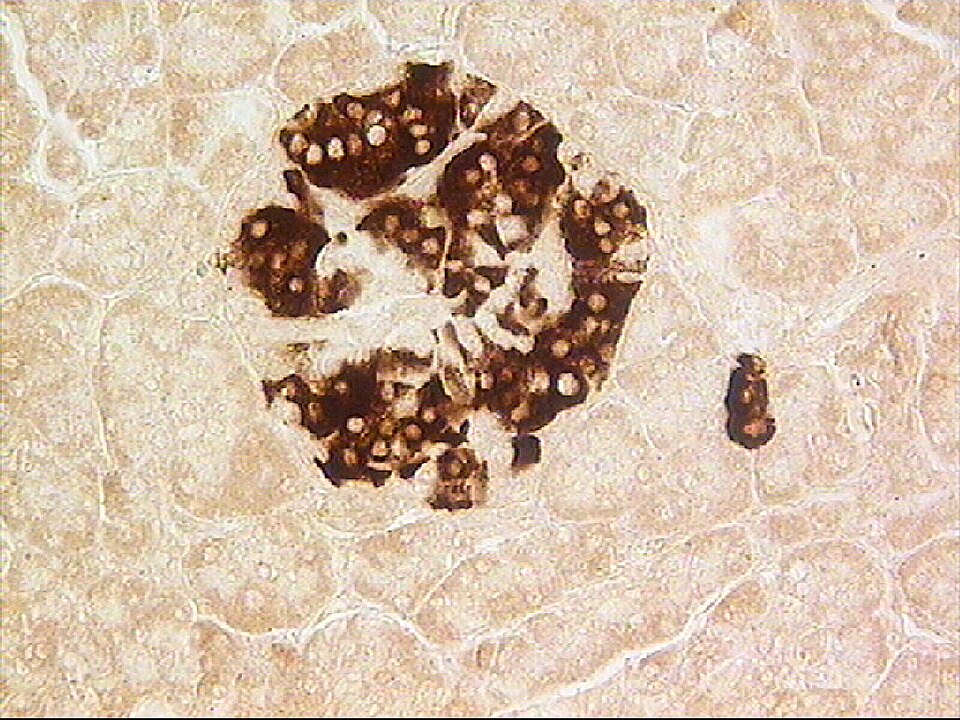
- Endocrine pancreas: islets of Langerhans — alpha cells → glucagon, beta cells → insulin, delta cells → somatostatin — released into the blood
- The islets make up only about 1–2% of the pancreas; the rest is exocrine acinar tissue
- Other mixed (heterocrine) organs in the human body: the liver, and the gonads — testis and ovary
- Adrenal and thyroid are ductless endocrine glands; lacrimal, salivary and sweat glands are duct-bearing exocrine glands
- Calling the pancreas 'endocrine only' because it is taught in the endocrine chapter
- Assuming a gland with a duct cannot also make hormones
- Swapping insulin (beta cells) with glucagon (alpha cells)
UPPSC and UPSC ask this either as a one-liner ('which gland is both endocrine and exocrine') or as a match-list pairing glands with hormones or secretions — so lock the chain gland → cell type → secretion → destination.
Match List I (Endocrine glands) with List II (Hormones secreted) and select the correct answer using the codes given below the Lists: List I I. Gonads II. Pituitary III. Pancreas IV. Adrenal List II A) Insulin B) Progesterone C) Growth hormones D) Cortisone Codes:
- (a) I-C, II-B, III-D, IV-A
- (b) I-B, II-C, III-D, IV-A
- (c) I-B, II-C, III-A, IV-D
- (d) I-C, II-B, III-A, IV-D
Answer(c) I-B, II-C, III-A, IV-D
Same concept from the endocrine side — the pancreas is listed among the endocrine glands because its islets secrete insulin into the blood.
Consider the following statements with reference to the human body: 1. The common bile duct releases its contents into the stomach. 2. The pancreatic duct releases its contents into the duodenum. Which of the statements given above is/are correct?
- (a) 1 only
- (b) 2 only
- (c) Both 1 and 2
- (d) Neither 1 nor 2
Answer(b) 2 only
The other half of the same idea — the pancreatic duct carrying juice into the duodenum is precisely the exocrine function that makes the pancreas a mixed gland.
Which of the following hormones is secreted by the Beta cell of Islet of Langerhans of Pancreas?
- (a) Aldosterone
- (b) Adrenalin
- (c) Insulin
- (d) Glucagan
Answer(c) Insulin
UPPSC returned to the same gland three years later, testing the endocrine half — beta cells of the islets secreting insulin.
- practice — not a real PYQ
The islets of Langerhans of the pancreas release their secretions directly into the
- (a)pancreatic duct
- (b)bloodstream
- (c)duodenum
- (d)common bile duct
Answer(b) bloodstream — the islets are the ductless, endocrine part of the pancreas.
- practice — not a real PYQ
If a person's pancreatic duct were completely blocked while the islets of Langerhans remained healthy, the most direct consequence would be
- (a)diabetes mellitus
- (b)impaired digestion of fats and proteins
- (c)hypothyroidism
- (d)a fall in blood calcium
Answer(b) impaired digestion of fats and proteins — only the exocrine route (lipase, trypsinogen, chymotrypsinogen) is cut off; insulin and glucagon still reach the blood.