
Which of the following reasons caused catastrophic coral bleaching and mass coral deaths in the Andaman and Nicobar Islands ?
- (a)Increased industrial activities in the coastal regions
- (b)Increase of 2° C temperature in the Indian Ocean
- (c)Heavy marine pollution
- (d)Decrease of temperature by 4° C in the Indian Ocean
Correct — B, Increase of 2° C temperature in the Indian Ocean. Mass bleaching in the Andaman and Nicobar reefs is a thermal event. Reef-building corals live in symbiosis with microscopic algae called zooxanthellae that sit inside their tissues and supply most of their food; when the water stays a couple of degrees above the normal summer maximum for even a few days, the symbiosis breaks down, the coral expels the algae, and the white calcium-carbonate skeleton shows through the now-transparent tissue. That is bleaching, and if the heat persists the colony starves and dies. The Andaman event of April–May 2010, studied by scientists of the Central Agricultural Research Institute at Port Blair with satellite data, is the textbook Indian case: the average sea-water temperature in the first week of May 2010 was about 33.8 °C against a normal of roughly 30–31 °C, and the published finding is blunt — a summer sea-surface-temperature rise of 2–3 °C above the normal maximum can kill the corals. Bleaching that season ranged from about 37 to 70 per cent of coral cover across the surveyed sites, with Havelock and South Button worst hit. A rise of the order of 2 °C is therefore exactly the stated cause.
- (a)Increased industrial activities in the coastal regions — The Andaman and Nicobar Islands have very little coastal industry — they are a protected island territory with a small population — and industrial effluent is in any case a local, point-source stressor. It cannot explain simultaneous bleaching across reefs scattered over hundreds of kilometres of open sea, which is what a basin-wide warming episode does.
- (c)Heavy marine pollution — Pollution, sedimentation and nutrient run-off genuinely degrade reefs and slow their recovery, so this is the most tempting wrong answer. But it damages reefs patchily and over years; it does not turn whole reef systems white in a single summer. The 2010 Andaman bleaching tracked the temperature record, not any pollution event.
- (d)Decrease of temperature by 4° C in the Indian Ocean — Cold shock can bleach corals as a physiological matter, but nothing of the kind happened here: the Andaman episodes of 1998, 2002, 2005 and 2010 were all heat events, and a 4 °C cooling of the tropical Indian Ocean is not something the observational record shows. The option inverts the actual mechanism.
Coral bleaching is the loss of the symbiotic algae (zooxanthellae) that live in coral tissue and give the coral both its colour and most of its nutrition. Heat is the dominant trigger: bleaching typically sets in when the summer sea-surface temperature maximum is exceeded by 1–2 °C and stays there for a few days, and reef scientists put the operational threshold in Indian waters at roughly 31 °C sustained for more than about three days. Bleached coral is not automatically dead — if the water cools quickly the algae can be reacquired — but prolonged heat converts bleaching into mass mortality.
The question is really testing whether you can tell a chronic local stressor apart from an acute regional one. Pollution and coastal industry are chronic and local; a marine heatwave is acute and regional, which is why it produces the 'catastrophic', simultaneous bleaching the question describes. India has recorded mass bleaching in 1998 (following the strong El Niño), 2002, 2005, 2010 and 2016, and the Andaman reefs were hit hardest in 1998 and then again in 2010. Note the direction of the number too: an *increase* of about 2 °C is doing the work, so option (d), a decrease of 4 °C, fails on both sign and magnitude.
- Reef corals host symbiotic dinoflagellates (zooxanthellae); thermal stress makes the coral expel them, exposing the white aragonite skeleton — this is bleaching.
- Bleaching in Indian waters generally begins when the summer sea-surface temperature crosses about 31 °C and stays high for more than roughly three days.
- Andaman mass bleaching, April–May 2010: average sea-water temperature in the first week of May was about 33.8 °C against a normal near 30–31 °C, and 37–70 per cent of coral cover bleached across the surveyed sites, Havelock and South Button worst affected.
- The published conclusion of that study is that a summer sea-surface-temperature rise of 2–3 °C above the normal maximum can kill corals.
- Branching Acropora colonies bleached worst; massive Porites colonies were comparatively resistant — a useful indicator of differential vulnerability.
- Earlier Andaman bleaching episodes were recorded in 1998, 2002 and 2005; the 2010 event was the worst since 1998.
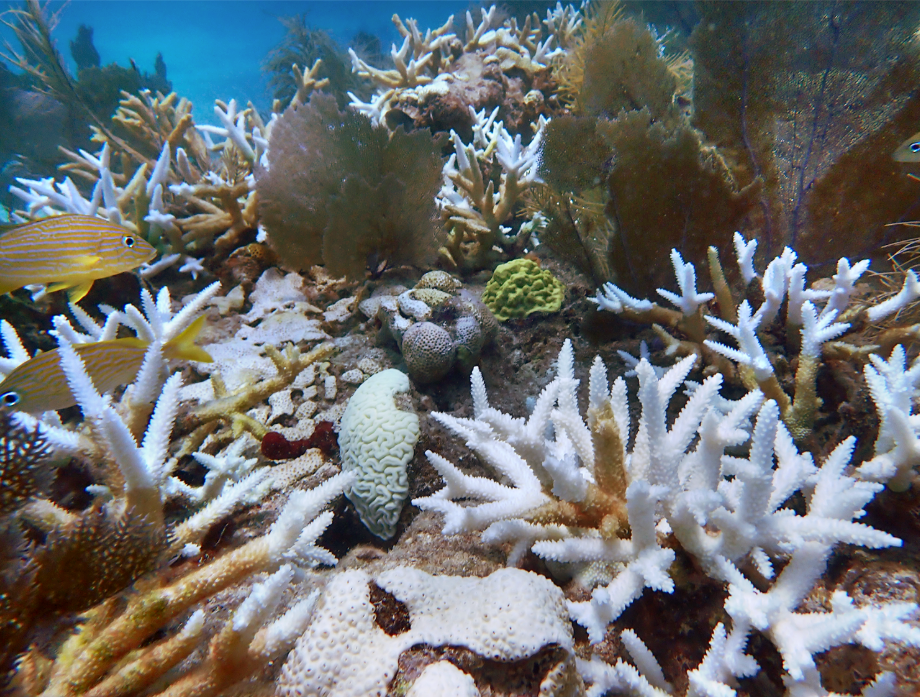
- Treating bleaching and coral death as the same thing. Bleaching is the loss of symbiotic algae and can be reversed if the heat passes quickly; death follows only when the stress is prolonged.
- Blaming pollution for mass bleaching. Pollution is a real and serious reef stressor, but the mass, synchronous bleaching events are driven by marine heatwaves.
- Mixing up bleaching (heat, symbiont loss) with ocean acidification (excess CO2, weakened calcification) — different causes, different remedies.
- The Sunderbans is regularly slipped into lists of Indian coral areas; its turbid, freshwater-laden water cannot support reefs.
UPPSC asks it as a single cause-identification line or inside a 'impacts of global warming' list; UPSC prefers multi-statement items on where reefs occur, what bleaching is, and how reefs are restored.
Which of the following have coral reefs? 1. Andaman and Nicobar Islands 2. Gulf of Kachchh 3. Gulf of Mannar 4. Sunderbans Select the correct answer using the code given below.
- (a) 1, 2 and 3 only
- (b) 2 and 4 only
- (c) 1 and 3 only
- (d) 1, 2, 3 and 4
Answer(a) 1, 2 and 3 only
The same reefs seen from the map side — it fixes the Andaman & Nicobar Islands as one of India's four reef regions, which is the setting of this UPPSC question.
"Biorock technology" is talked about in which one of the following situations?
- (a) Restoration of damaged coral reefs
- (b) Development of building materials using plant residues
- (c) Identification of areas for exploration/extraction of shale gas
- (d) Providing salt licks for wild animals in forests/protected areas
Answer(a) Restoration of damaged coral reefs
The other half of the story: after a bleaching event of the kind described here, mineral-accretion (Biorock) frames are one of the techniques used to regrow the damaged reef.
Which of the following are the impacts of Global Warming? 1. Rise in sea level 2. Melting of glaciers 3. Spread of diseases 4. Bleaching of Coral reefs Select the correct answer using the codes given below. Codes :
- (a) 1, 2 and 3 only
- (b) 2 and 3 only
- (c) 1, 3 and 4 only
- (d) 1, 2, 3 and 4
Answer(d) 1, 2, 3 and 4
UPPSC had already listed coral bleaching among the impacts of global warming in 2020; this 2024 question simply narrows the same idea to one reef system and one number.
- practice — not a real PYQ
Coral bleaching is best described as:
- (a)The expulsion of symbiotic zooxanthellae from coral tissue under stress, chiefly thermal stress
- (b)The chemical dissolution of the coral skeleton by acidified sea water
- (c)The smothering of coral polyps by suspended sediment
- (d)The overgrowth of coral colonies by macroalgae after overfishing
Answer(a) The expulsion of symbiotic zooxanthellae from coral tissue under stress, chiefly thermal stress — the white skeleton then shows through the transparent tissue. The other three are real reef threats but are not bleaching.
- practice — not a real PYQ
Which one of the following Indian coastal areas does NOT support coral reefs?
- (a)Gulf of Mannar
- (b)Gulf of Kachchh
- (c)Sunderbans
- (d)Lakshadweep
Answer(c) Sunderbans — heavy freshwater discharge and high turbidity rule out reef formation there, whereas the Gulf of Mannar, the Gulf of Kachchh, Lakshadweep and the Andaman & Nicobar Islands all have reefs.