Consider the following statements with respect to Ashoka : 1. The definition of Dhamma given by Ashoka is taken from "Rahulovada-sutta". 2. In the 14th year of his coronation, Ashoka appointed a new type of staff, called Dhamma-mahamatras. Which of the above statements is/are correct ?
- (a)Both 1 and 2
- (b)Neither 1 nor 2
- (c)Only 1
- (d)Only 2
Correct — A, both statements 1 and 2 are correct, and both rest on Ashoka's own inscriptions. Statement 1 goes back to the Bhabru edict (also called the Calcutta–Bairat Minor Rock Edict, the stone now in the Indian Museum, Kolkata), which Ashoka addressed to the Buddhist Sangha in Magadha. In it he names seven Buddhist texts that he wishes monks, nuns and lay followers to hear and reflect upon constantly, and one of the seven is Laghulovada — 'the admonition spoken by the Blessed Buddha to Rahula on the subject of false speech', that is, the Ambalatthika-Rahulovada Sutta of the Majjhima Nikaya. Since Ashoka is himself pointing to that sermon as a text carrying the Dhamma he wants propagated, and since truthfulness (sace) is one of the virtues his own Pillar Edict II lists when it answers the question 'what is Dhamma?', standard accounts say his definition of Dhamma is drawn from the Rahulovada-sutta — and the commission's key treats the statement as correct. Statement 2 rests on Major Rock Edict V, which says in so many words that 'in the past there were no officers of Dhamma' and that Ashoka appointed them 'when I had been anointed thirteen years'. Thirteen COMPLETED years counted from the consecration (abhisheka) fall inside the fourteenth regnal year, which is why Indian textbooks — and this question — describe the dhamma-mahamatras as created in the 14th year of his coronation. The two formulations describe the same event; there is no contradiction to resolve.
- (b)Neither 1 nor 2 — Rejecting both statements ignores two explicit inscriptions. The Bhabru edict names the Buddha's admonition to Rahula on false speech among the seven Dhamma texts Ashoka commends, and Major Rock Edict V records in the emperor's own voice that the officers of Dhamma were a new creation of his reign. Neither claim is an inference by modern historians.
- (c)Only 1 — This rejects statement 2, but Rock Edict V is the single most quoted passage on the dhamma-mahamatras and states plainly that no such officers existed before. Students usually reject it because they have memorised the phrase 'thirteen years after my consecration' — but thirteen completed years since the abhisheka IS the fourteenth regnal year, so the statement as worded is right.
- (d)Only 2 — This rejects statement 1. It is true that Ashoka's Dhamma as preached in the Major Rock Edicts is a broad, non-sectarian ethical code rather than a summary of any one Buddhist sermon — but the Bhabru edict is Ashoka's own list of the texts he wants studied, and the Rahulovada is on it, which is the documented basis for the statement and the basis on which the key marks it correct.
Ashoka's Dhamma was a code of social ethics addressed to an empire of many sects, not a statement of Buddhist doctrine. Pillar Edict II puts the definition in the form of a question and answer — 'Dhamma is good; and what is Dhamma? Few faults and many good deeds, compassion (daya), liberality (dana), truthfulness (sace) and purity (socaye)' — and the Major Rock Edicts fill this out with obedience to parents, respect for teachers and elders, generosity towards brahmanas and sramanas, kind treatment of servants, restraint in killing, and above all tolerance between sects (Rock Edict XII). His personal Buddhism is expressed separately, in the Bhabru edict and in the Rummindei and Nigali Sagar pillar inscriptions. To carry the Dhamma into the districts he created an entirely new cadre, the dhamma-mahamatras — officers who worked among all sects and among the frontier peoples, looked after the welfare of prisoners, and were charged with the affairs of the royal households and of women.
The examiner has built the question out of two textbook lines that students half-remember. The first is a claim about the SOURCE of Ashoka's Dhamma, which most candidates have never traced and so guess at; the answer lies in the Bhabru edict, which is precisely the edict where Ashoka speaks as a Buddhist rather than as a non-sectarian emperor. The second looks like a date trap — 'thirteenth year' is drilled into most students — but is not one, because the edict counts thirteen elapsed years from the consecration, which is the fourteenth year of the reign. If you can see that the '13' and the '14' are the same moment counted two ways, both statements stand and (a) follows.
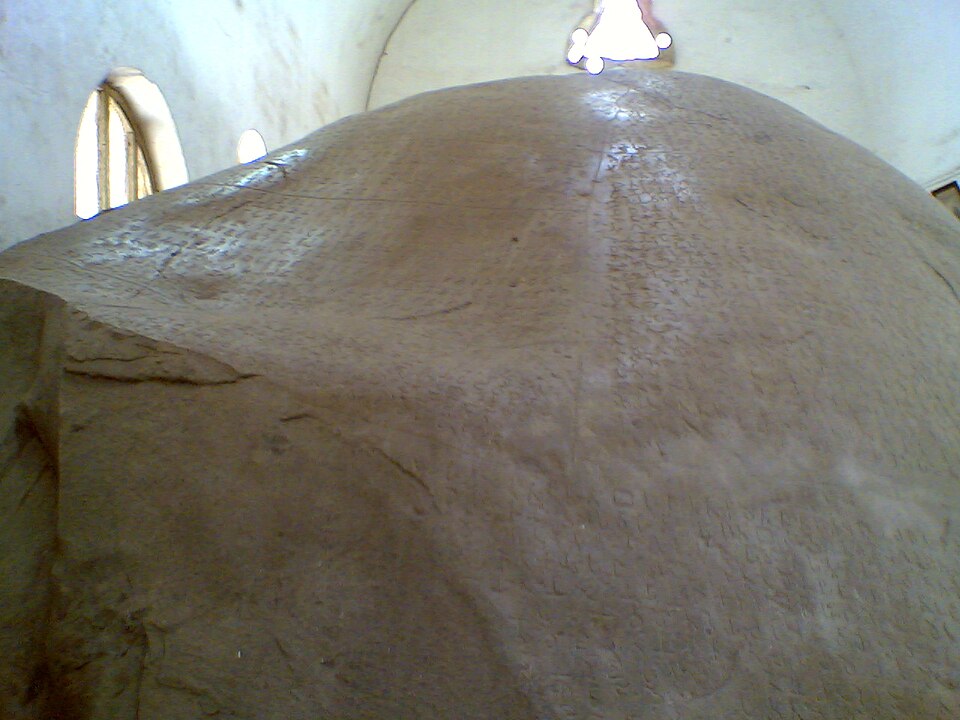
- The Bhabru (Calcutta–Bairat) Minor Rock Edict, addressed to the Sangha at Magadha and now in the Indian Museum, Kolkata, names seven Buddhist texts Ashoka wants monks, nuns and lay followers to study — including Laghulovada, the Buddha's admonition to his son Rahula on false speech (the Ambalatthika-Rahulovada Sutta, Majjhima Nikaya 61).
- Major Rock Edict V records the creation of the officers of Dhamma: 'in the past there were no dhamma-mahamatas… they were appointed by me when I had been anointed thirteen years' — thirteen completed years from the abhisheka, that is, the fourteenth regnal year.
- Pillar Edict II gives Ashoka's own definition of Dhamma as few faults, many good deeds, compassion, liberality, truthfulness and purity — truthfulness being exactly the virtue the Rahulovada Sutta teaches.
- Rock Edict V describes the dhamma-mahamatras as working among all sects and among the frontier peoples — the Yonas, Kambojas and Gandharas among others — and as concerned with the release and welfare of prisoners.
- In his inscriptions Ashoka calls himself 'Devanampiya Piyadasi' (Beloved of the Gods, of Gracious Mien); his personal name appears only in a few minor rock edicts, chiefly at Maski, and also at Gujarra and Nettur.
- Being thrown by 'thirteenth year' versus 'fourteenth year'. Rock Edict V counts thirteen COMPLETED years from the consecration, which is the fourteenth regnal year — the two phrasings mark the same event and both are used in the literature.
- Assuming Ashoka's Dhamma is simply Buddhism. The Dhamma preached in the Major Rock Edicts is a deliberately non-sectarian ethical code; the Bhabru edict, where he speaks to the Sangha and lists Buddhist texts, is the exception and is precisely what statement 1 draws on.
- Confusing the Bhabru edict (list of seven Buddhist texts) with the Schism Edict at Sarnath, Sanchi and Kausambi, which threatens expulsion for monks and nuns who divide the Sangha.
UPPSC treats the edicts as documents and asks which edict says what, and in which regnal year, so the Bhabru, Kalinga and Schism edicts must be known individually; UPSC has preferred to test how Ashoka names himself in the inscriptions, which edict carries his personal name, and who first read the script.
Assertion (A): According to Asoka's edicts, social harmony among the people was more important than religious devotion. Reason (R): He spread ideas of equity instead of promotion of religion.
- (a) Both A and R are true, and R is the correct explanation of A
- (b) Both A and R are true, but R is NOT a correct explanation of A
- (c) A is true, but R is false
- (d) A is false, but R is true
Answer(a) Both A and R are true, and R is the correct explanation of A
The same subject — what Ashoka's Dhamma actually consisted of — read straight off the edicts. It is the necessary companion to statement 1 here: the Dhamma of the Major Rock Edicts is an ethical and social code, while the Buddhist textual root shows up in the Bhabru edict.
Which one of the following edicts mentions the personal name of Asoka?
- (a) Kalsi
- (b) Rummindei
- (c) Special Kalinga Edict
- (d) Maski
Answer(d) Maski
The same skill this UPPSC question demands — knowing which individual Ashokan edict carries which specific piece of information, rather than treating the edicts as one undifferentiated body of text.
The official 'Agronomai' during Mauryan age was related with which of the following field ?
- (a) Weight and measurement
- (b) Administrative management
- (c) Construction of roads
- (d) Revenue management
Answer(c) Construction of roads
The same corner of the syllabus — named categories of Mauryan officials and what each was for. The dhamma-mahamatras of statement 2 are the best-known of these cadres and the only one Ashoka says he invented himself.
With reference to the Puranas, which one of the following statements is correct? (1) Information about the Mauryan dynasty is found in the Vishnu Puran. (2) Vayu Puran throws light on the Gupta's governance system.
- (a) Both 1 and 2
- (b) Only 1
- (c) Only 2
- (d) Neither 1 nor 2
Answer(a) Both 1 and 2
UPPSC's habitual angle on the Mauryas — which text tells us what. This question asks it of the Puranas; the 2024 question asks it of a Buddhist sutta and of Ashoka's own rock edicts.
- practice — not a real PYQ
Ashoka's Bhabru (Calcutta–Bairat) edict is chiefly notable because it :
- (a)records the emperor's remorse after the Kalinga war
- (b)names Buddhist texts that Ashoka commends to monks, nuns and lay followers
- (c)prohibits the killing of animals in the royal kitchen
- (d)threatens expulsion of monks and nuns who divide the Sangha
Answer(b) names Buddhist texts that Ashoka commends to monks, nuns and lay followers — seven of them, including the admonition to Rahula on false speech. The Kalinga remorse is Rock Edict XIII, the royal kitchen is Rock Edict I, and the threat of expulsion is the Schism Edict at Sarnath, Sanchi and Kausambi.
- practice — not a real PYQ
The creation of a new cadre of officers called dhamma-mahamatras is recorded in which one of the following ?
- (a)Major Rock Edict I
- (b)Major Rock Edict V
- (c)Major Rock Edict XII
- (d)The Rummindei Pillar Inscription
Answer(b) Major Rock Edict V — it states that no such officers existed before and that they were appointed thirteen years after the consecration; Pillar Edict VII later reviews their work. Rock Edict I deals with animal slaughter, Rock Edict XII with tolerance between sects, and the Rummindei pillar with Ashoka's visit to the Buddha's birthplace.