
Which of the following statements is not true ?
- (a)Chromosomes are composed of DNA and Protein.
- (b)Nucleus of a cell does not play a role in cellular reproduction.
- (c)Chromosomes contain information for inheritance.
- (d)Functional segment of DNA is called genes.
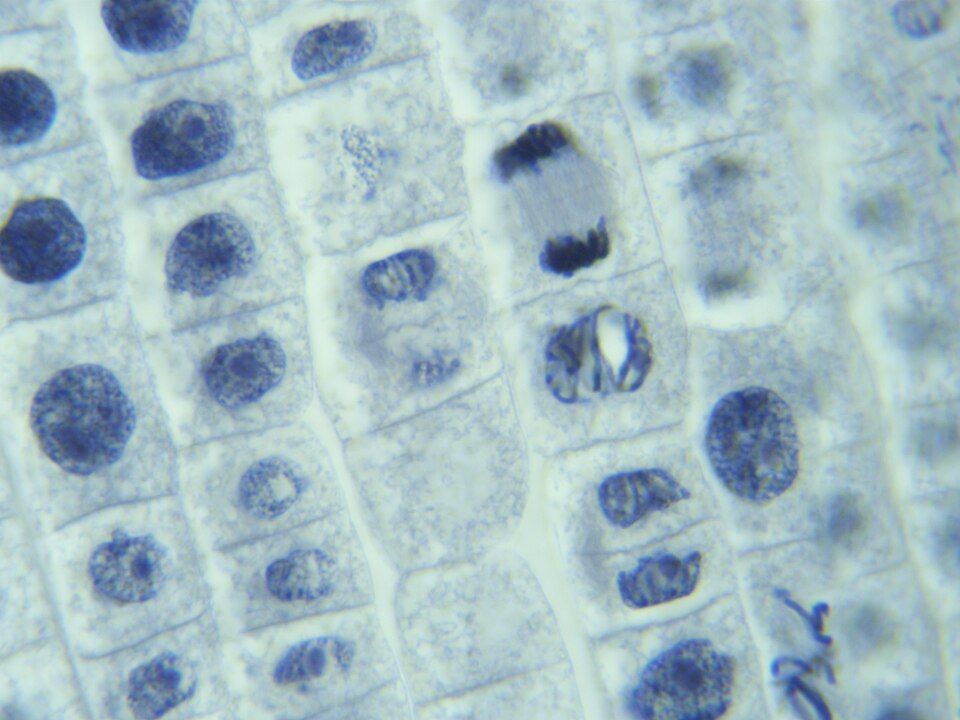
Correct — B, 'Nucleus of a cell does not play a role in cellular reproduction.' This is the one false statement in the set, and it is false in the strongest possible way: the nucleus is not merely involved in cell reproduction, it is the part of the cell whose division defines the event. In a eukaryotic cell the hereditary material sits inside the nucleus as chromatin, and when the cell divides that chromatin condenses into visible chromosomes, the nuclear envelope breaks down, the spindle pulls one copy of every chromosome to each pole, and two daughter nuclei re-form. Biologists give this nuclear division its own name — karyokinesis — and it precedes the division of the cytoplasm, cytokinesis. Remove the nucleus and the cell stops dividing: an enucleated Amoeba survives for a while but cannot reproduce, and a mammalian mature red blood cell, which extrudes its nucleus as it matures, can never divide again. Statement (b) therefore inverts the truth, and inverting a true statement is exactly how a 'which is NOT true' item is built.
- (a)Chromosomes are composed of DNA and Protein. — True, so it cannot be the answer. A chromosome is chromatin in its condensed, transport-ready form, and chromatin is a DNA–protein complex: the DNA double helix is wound roughly twice around an octamer of histone proteins to make a nucleosome, the 'beads-on-a-string' unit, and further non-histone (acidic) proteins organise the fibre into the compact rod seen at metaphase. The name itself records how they were found — Wilhelm Waldeyer coined 'chromosome' in 1888 from the Greek chroma (colour) and soma (body), because these bodies took up basic dyes strongly during staining.
- (c)Chromosomes contain information for inheritance. — True, and it is the central claim of the chromosome theory of inheritance advanced by Walter Sutton and Theodor Boveri in 1902–03: Mendel's factors behave exactly as chromosomes do during gamete formation, so the factors must be carried on the chromosomes. Human somatic cells carry 46 chromosomes in 23 pairs — one of each pair from each parent — and it is this DNA, packaged in chromosomes, that is copied and handed on. Note that a small amount of DNA also sits outside the nucleus, in mitochondria and in plant plastids, but that is an addition to the statement, not a contradiction of it.
- (d)Functional segment of DNA is called genes. — True, and it is the standard school-textbook definition: a gene is the functional segment or functional unit of DNA — the stretch that carries the instruction for one polypeptide or one functional RNA. Long tracts of a chromosome are non-coding (regulatory sequences, introns, repeats), which is precisely why the definition has to specify a *functional* segment rather than 'any' segment. The wording of the option is loose English ('is called genes'), but the biology it states is correct, so it is not the statement the question is hunting for.
In a eukaryotic cell the genetic material is DNA, and DNA does not float free — it is wrapped around histone proteins to form chromatin, which is housed inside the nucleus behind a double nuclear envelope. When the cell prepares to divide, chromatin coils tightly into discrete chromosomes, one for each DNA molecule, each already duplicated into two sister chromatids joined at the centromere. A gene is a functional stretch of that DNA. So the hierarchy a candidate must hold in the head is: nucleus contains chromosomes → a chromosome is one long DNA molecule plus its proteins → a gene is a functional segment of that DNA. Every one of the four options in this question is a sentence about one link in that chain, and only option (b) breaks it.
The examiner has taken three uncontroversial textbook sentences and slipped in a fourth that reads like a textbook sentence but carries a negative. The single word doing the work in option (b) is 'not'. Under time pressure candidates skim the option, recognise the familiar vocabulary — nucleus, cellular reproduction — and tick it as safe. The defence is mechanical: in a 'which is NOT true' item, read every option for a negation or a reversal before judging the content, because that is where the falsehood is almost always planted. On the biology itself, the nucleus was named the 'control centre' of the cell for two reasons, and cell division is the more fundamental of them. Robert Brown identified the nucleus in orchid cells in 1831; the classic demonstrations that it governs the cell — enucleation experiments on Amoeba, and Joachim Hämmerling's grafting experiments on the single-celled alga Acetabularia, in which the cap that regenerated matched the nucleus and not the cytoplasm — established that the nucleus directs both the cell's inherited characteristics and its reproduction.
- A chromosome is a DNA–protein complex: DNA wound around histone octamers to form nucleosomes, plus non-histone proteins. 'Chromosome' was coined by Wilhelm Waldeyer in 1888 from Greek chroma (colour) + soma (body), after the way these bodies took up stain.
- Nuclear division is called karyokinesis and precedes cytokinesis, the division of the cytoplasm. Mitosis yields two daughter cells with the same chromosome number as the parent; meiosis halves it and produces gametes.
- The chromosome theory of inheritance (Walter Sutton and Theodor Boveri, 1902–03) established that Mendel's hereditary factors are carried on chromosomes; human somatic cells have 46 chromosomes in 23 pairs.
- A gene is the functional segment of DNA — the unit coding for one polypeptide or one functional RNA. Much of chromosomal DNA is non-coding, which is why the definition specifies 'functional'.
- Cells that lose their nucleus lose the ability to divide: a mature mammalian red blood cell has no nucleus and never divides again, and an enucleated Amoeba survives briefly but cannot reproduce. Prokaryotes have no true nucleus — their DNA lies in a nucleoid — and divide by binary fission instead of mitosis.
- The nucleus was first described by Robert Brown in 1831; Joachim Hämmerling's grafting experiments on the alga Acetabularia showed the regenerated cap follows the nucleus, not the cytoplasm.
- Missing the negation. In a 'which is NOT true / which is incorrect' item the false option is usually a true sentence with 'not' inserted — scan for the negative word first.
- Assuming all cellular DNA is nuclear. Mitochondria (and plant plastids) carry their own DNA, so 'DNA is found only in the nucleus' is false — but that does not make 'chromosomes carry hereditary information' false.
- Confusing chromatin, chromosome and chromatid. Chromatin is the uncondensed DNA–protein fibre in a non-dividing nucleus; a chromosome is its condensed form; a chromatid is one of the two identical copies of a duplicated chromosome, joined at the centromere.
UPPSC keeps this area at the definition level — 'which statement is not true', 'change in the base sequence within a gene is called', 'which organelle contains DNA' — while UPSC layers an application on top, asking what gene mapping or a named technique makes possible; either way, secure the chain nucleus → chromosome → DNA → gene first.
Which organelle in the cell, other than nucleus, contains DNA?
- (a) Centriole
- (b) Golgi apparatus
- (c) Lysosome
- (d) Mitochondrion
Answer(d) Mitochondrion
The same nucleus-and-DNA relationship read from the other side: it asks which organelle apart from the nucleus carries DNA, so together the two items fix that the nucleus is the main but not the sole home of cellular DNA.
Which of the following features of DNA makes it uniquely suited to store and transmit genetic information from generation to generation?
- (a) Complementarity of the two strands
- (b) Double helix
- (c) Number of base pairs per turn
- (d) Sugar phosphate backbone
Answer(a) Complementarity of the two strands
Underwrites option (c). Chromosomes can 'contain information for inheritance' only because complementary base pairing lets each DNA strand template an exact copy — the mechanism by which the information survives every cell division.
Change in the base sequence within a gene is called
- (a) Mutation
- (b) Cloning
- (c) Fusion
- (d) Breeding
Answer(a) Mutation
Tests option (d) from the inside — it treats a gene as a readable base sequence within DNA and asks what a change in that sequence is called, which is only meaningful if a gene is indeed a functional segment of DNA.
- practice — not a real PYQ
The division of the nucleus during cell division is termed:
- (a)Cytokinesis
- (b)Karyokinesis
- (c)Cytolysis
- (d)Karyogamy
Answer(b) Karyokinesis — the division of the nucleus, which precedes cytokinesis, the division of the cytoplasm. Karyogamy is the fusion of two nuclei during fertilisation, and cytolysis is the bursting of a cell.
- practice — not a real PYQ
Which one of the following human cells is unable to divide because it lacks a nucleus?
- (a)Mature red blood cell
- (b)Neutrophil
- (c)Osteocyte
- (d)Hepatocyte
Answer(a) Mature red blood cell — the mammalian erythrocyte extrudes its nucleus as it matures, which maximises space for haemoglobin but leaves the cell unable to divide or repair itself; it therefore survives about 120 days. Neutrophils, osteocytes and liver cells all retain nuclei.