
Which of the following is a correct relationship between Fahrenheit (°F) and Celsius (°C) degrees ?
- (a)°C = (9/5) °F + 32
- (b)°C = °F – 273·15
- (c)°F = (9/5) °C + 32
- (d)°F = °C – 273·15
Correct — C, °F = (9/5) °C + 32. The relation between two linear temperature scales is fixed entirely by two reference points. At standard atmospheric pressure water freezes at 0 °C and 32 °F, and boils at 100 °C and 212 °F. So the same interval that is 100 degrees wide on the Celsius scale is 212 − 32 = 180 degrees wide on the Fahrenheit scale, which makes one Celsius degree equal to 180/100 = 9/5 = 1.8 Fahrenheit degrees. That ratio 9/5 is the multiplier, and because Fahrenheit's zero sits 32 of its own degrees below the freezing point of water, 32 must be added afterwards. Putting the two together gives °F = (9/5) °C + 32, which is option (c) and the marked answer. Check it against both anchors: put °C = 0 and you get 32 °F, the freezing point; put °C = 100 and you get 180 + 32 = 212 °F, the boiling point. Rearranging the same equation gives the inverse, °C = (5/9)(°F − 32) — note that the 32 is subtracted first and only then scaled, which is the step candidates most often get wrong. Two arithmetic checkpoints are worth memorising because they let you verify any version of this formula in seconds: normal human body temperature is 37 °C = 98.6 °F, and the two scales cross at −40, where −40 °C is exactly −40 °F.
- (a)°C = (9/5) °F + 32 — The right formula written backwards — it has the correct multiplier and the correct constant but swaps which scale is being converted into which. Test it on a known point and it collapses at once: the freezing point of water is 32 °F, and substituting °F = 32 gives °C = (9/5)(32) + 32 = 57.6 + 32 = 89.6 °C, whereas water plainly freezes at 0 °C. The genuine inverse is °C = (5/9)(°F − 32); going from Fahrenheit to Celsius you must subtract the 32 first and then multiply by 5/9, not multiply by 9/5 and then add. This is the most attractive wrong option in the set, because a candidate who has memorised the shape of the formula without memorising its direction has no way to choose between (a) and (c).
- (b)°C = °F – 273·15 — This is the Celsius-to-Kelvin relation with the wrong scale written into it. The number 273.15 belongs to the absolute or Kelvin scale: K = °C + 273.15, so °C = K − 273.15. Fahrenheit has nothing to do with 273.15; its corresponding absolute scale is the Rankine scale, whose offset is 459.67. Test the option on the boiling point of water, 212 °F, and it gives °C = 212 − 273.15 = −61.15 °C, when the correct value is 100 °C. The option works as a distractor only on a candidate who remembers the figure 273.15 but not which pair of scales it connects.
- (d)°F = °C – 273·15 — The same misuse of 273.15 as option (b), simply written in the other direction, and it fails just as fast. Substituting the freezing point of water, °C = 0, gives °F = −273.15, whereas water freezes at 32 °F. It is also wrong in a way that should be visible without any arithmetic: any correct Celsius-to-Fahrenheit formula must contain a scaling factor, because the two scales have different degree sizes, and this option has none at all — it only shifts the number without stretching it.
A temperature scale is defined by choosing a zero point and a degree size, so converting between any two linear scales always takes the same two-step form: multiply by the ratio of the degree sizes, then shift by the difference in zeros. Celsius fixes 0 at the freezing point and 100 at the boiling point of water at standard atmospheric pressure. Fahrenheit puts those same two points at 32 and 212, so it has 180 degrees where Celsius has 100 and its degree is only 5/9 as large. Kelvin, the SI base unit of thermodynamic temperature, keeps the Celsius degree size but moves the zero down to absolute zero, so K = °C + 273.15 with no multiplier at all. Recognising which conversions need a multiplier and which need only an offset is what separates the correct option here from the two that misuse 273.15.
The four options are built as a two-by-two grid, and seeing that structure is the fastest route through the question. Two options use the factor 9/5 and the constant 32, which is the correct Fahrenheit-Celsius pairing, and differ only in direction; the other two use 273.15, which belongs to the Kelvin scale and is simply out of place in a Fahrenheit-Celsius conversion. So the first move is to discard (b) and (d) on sight — a Fahrenheit-to-Celsius formula that contains no scaling factor cannot be right, because the two scales have different degree sizes. That leaves (a) against (c), and one substitution settles it: at the freezing point of water, only °F = (9/5)(0) + 32 = 32 gives an answer that matches reality. One note on the printed paper is worth recording. The official Series D booklet prints options (a) and (c) with the 9/5 factor exactly as reproduced above; some widely circulated typed reproductions of this paper drop that factor and print (c) as '°F = °C + 32', which would make the marked answer arithmetically wrong. The booklet's own wording is what is reproduced here, and on it the key is entirely coherent.
- °F = (9/5) °C + 32, and rearranged, °C = (5/9)(°F − 32). The factor 9/5 = 1.8 comes from the 180 Fahrenheit degrees that span the same range as 100 Celsius degrees; the 32 comes from Fahrenheit placing the freezing point of water at 32 rather than 0.
- The fixed points at standard atmospheric pressure: water freezes at 0 °C = 32 °F = 273.15 K and boils at 100 °C = 212 °F = 373.15 K. Normal human body temperature, 37 °C, is 98.6 °F.
- The two scales read the same number at exactly one temperature, −40: −40 °C = −40 °F. This is the quickest single check of any proposed conversion formula.
- Kelvin is the SI base unit of thermodynamic temperature and shares the Celsius degree size, so K = °C + 273.15 with no multiplier. Absolute zero is 0 K = −273.15 °C = −459.67 °F. The absolute scale built on the Fahrenheit degree is the Rankine scale.
- Daniel Gabriel Fahrenheit, a German-born instrument maker working in the Dutch Republic, proposed his scale in 1724; Anders Celsius, the Swedish astronomer, proposed his in 1742 with 0 as the boiling point and 100 as the freezing point, and it was inverted to the modern arrangement shortly afterwards. The name 'degree Celsius' formally replaced 'centigrade' by international agreement in 1948.
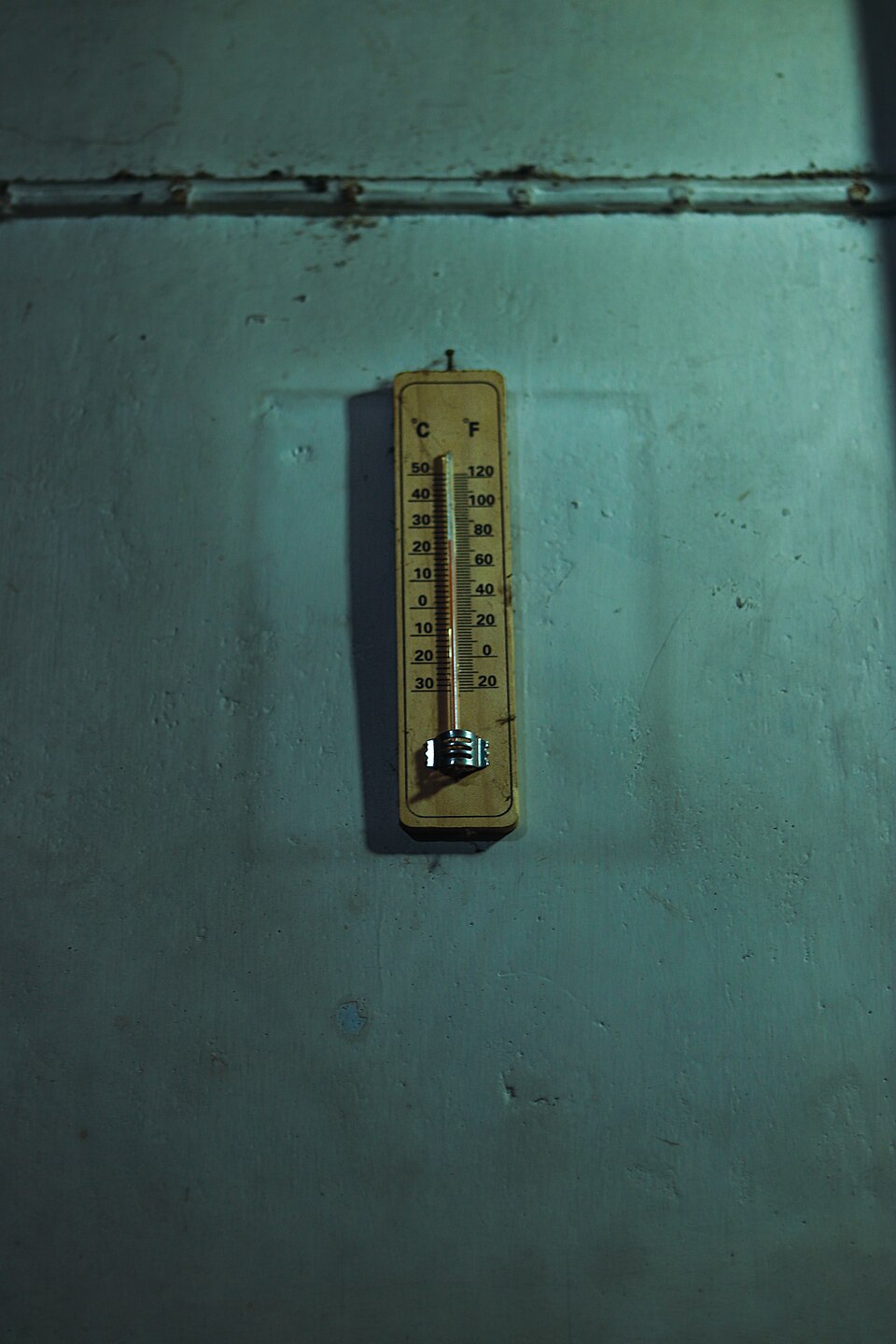
- Reversing the direction of the formula. °F = (9/5) °C + 32 going one way; °C = (5/9)(°F − 32) coming back. Both the factor and the order of operations flip.
- In the reverse conversion, multiplying before subtracting. You must subtract 32 first and only then multiply by 5/9.
- Bringing 273.15 into a Fahrenheit conversion. That number belongs to the Celsius-Kelvin relation; the Fahrenheit-based absolute scale is Rankine, with an offset of 459.67.
- Accepting an option that shifts the temperature without scaling it. Because a Celsius degree and a Fahrenheit degree are different sizes, any correct conversion between them must contain a multiplier.
State PCS papers ask this either as the bare formula, as here, or as a numerical conversion — 'a temperature of 104 °F equals how many °C' — and occasionally as the trick question about the temperature at which both scales read alike, which is −40. UPSC has asked the neighbouring conversion, from Celsius to Kelvin, in the form of ordinary human body temperature expressed on the Kelvin scale.
107. The normal temperature of human body on the Kelvin scale is
- (a) 280
- (b) 290
- (c) 300
- (d) 310
Answer(d) 310
The same skill on the neighbouring pair of scales — converting a temperature between Celsius and Kelvin instead of Celsius and Fahrenheit. It rewards knowing that the Kelvin conversion needs only the offset 273, no multiplier, which is exactly the distinction that kills options (b) and (d) here.
- practice — not a real PYQ
At which temperature do the Celsius and Fahrenheit scales show the same numerical reading?
- (a)0 degrees
- (b)−40 degrees
- (c)−273.15 degrees
- (d)32 degrees
Answer(b) −40 degrees — setting °F = °C = x in °F = (9/5) °C + 32 gives x = (9/5)x + 32, so −(4/5)x = 32 and x = −40. Hence −40 °C is exactly −40 °F, the single point at which the two scales agree.
- practice — not a real PYQ
A patient's temperature is recorded as 104 °F. What is this on the Celsius scale?
- (a)36 °C
- (b)38 °C
- (c)40 °C
- (d)42 °C
Answer(c) 40 °C — apply °C = (5/9)(°F − 32): (5/9)(104 − 32) = (5/9)(72) = 40 °C. Subtract the 32 first and only then multiply by 5/9; multiplying first is the standard error.