
The content of computer memory which is non-volatile, even when the power goes off is :
- (a)REM
- (b)RAM
- (c)ROM
- (d)None of the above
Correct — C, ROM, Read-Only Memory. 'Volatile' in computing means the stored contents survive only as long as the power supply does. ROM is non-volatile: whatever is written into it stays written when the machine is switched off, which is exactly why it is the memory chosen to hold the instructions a computer needs before it has loaded anything from disk. In an ordinary personal computer the ROM (or its modern flash-based equivalent) holds the firmware — the BIOS or UEFI and the bootstrap loader — the small program that runs the moment power arrives, tests the hardware and then loads the operating system into RAM. If that program lived in volatile memory it would vanish every time the machine was switched off and the computer could never start itself, so the boot firmware must be non-volatile by design. ROM is also the reason a washing machine, a calculator or a microwave remembers what to do without any disk at all: the whole program sits permanently in ROM. That is the property the question is naming, so (c) is the marked answer.
- (a)REM — There is no computer memory called REM. The letters are put there as a near-miss for ROM and RAM, and they are recognisable from elsewhere — REM is Rapid Eye Movement, a stage of sleep, and 'roentgen equivalent man', an old unit of radiation dose. In programming, REM is the keyword that begins a comment line in BASIC and in MS-DOS batch files, which is doubtless where the examiner found it, but a comment keyword is not a kind of memory. Rejecting a plausible-looking three-letter abbreviation that does not actually exist is a standard prelims skill.
- (b)RAM — RAM, Random Access Memory, is the opposite of what the question asks for: it is volatile. It is the computer's working memory, holding the operating system, the running programs and the data being worked on, and its contents are lost the instant power is removed — which is precisely why unsaved work disappears in a power cut. Dynamic RAM, the type used for main memory, must in fact be electrically refreshed thousands of times a second merely to hold its contents while the machine is on. RAM is the most tempting wrong answer because it is the memory people actually shop for and talk about, but the question is asking which memory survives the power going off, and RAM does not.
- (d)None of the above — Wrong because one of the listed options is correct. ROM is a genuine and precisely defined category of non-volatile computer memory, so there is no need to fall back on 'none of the above'. This option only becomes attractive to a candidate who has talked themselves out of ROM by over-thinking the fact that modern ROM chips can be rewritten — an interesting nuance, but not one that changes the classification.
Computer memory is divided first into primary memory, which the processor can address directly, and secondary storage such as hard disks, solid-state drives, optical discs and flash drives. Primary memory itself splits into two families defined by volatility. RAM is volatile read-write memory and forms the working space where running programs and their data live. ROM is non-volatile memory whose contents are fixed at or near the time of manufacture and are read during normal operation; it carries the firmware, the bootstrap loader and, in embedded appliances, the whole control program. Cache memory and the processor's registers are small, extremely fast and also volatile. The distinction the question tests — volatile against non-volatile — is the single most examined idea in this part of the syllabus.
Answer this by translating the word 'non-volatile' into the plain question 'what does the computer still know before anything has been loaded from disk?' The answer is its start-up firmware, and that lives in ROM. A second useful anchor is the pairing of properties: RAM is read-and-write, volatile, large and fast; ROM is read-mostly, non-volatile, small and permanent. Two honest nuances are worth knowing so that a harder version of this question does not catch you out. First, the name 'read-only' is now partly historical — PROM, EPROM, EEPROM and flash memory are all classed as ROM but can be written or rewritten under the right conditions, which is how a computer's BIOS can be updated; they remain non-volatile, which is the property that matters here. Second, secondary storage such as a hard disk or a pen drive is also non-volatile, but it is storage rather than primary memory, and a question phrased as 'computer memory' in the sense used here is asking about the RAM-versus-ROM pair.
- ROM, Read-Only Memory, is non-volatile primary memory: its contents survive when power is removed. It holds the firmware and bootstrap loader that start the machine, and in embedded devices the entire control program.
- RAM, Random Access Memory, is volatile read-write primary memory holding the operating system, running programs and working data; contents are lost when power is removed. Its two main types are DRAM, used for main memory and needing constant electrical refresh, and SRAM, faster and used for cache.
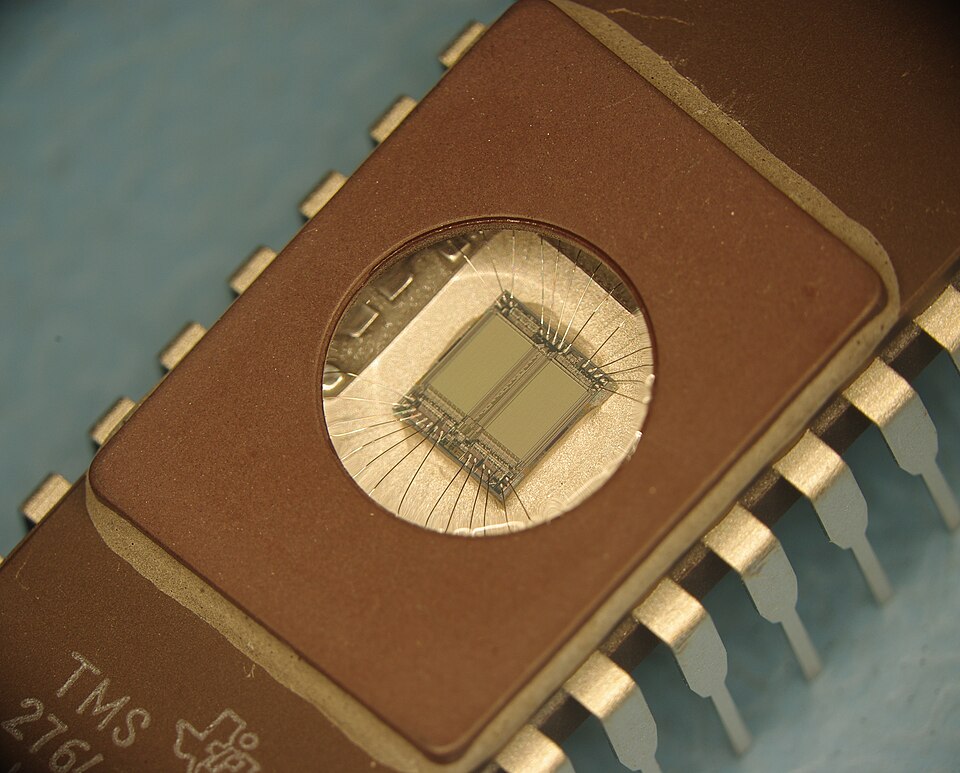
- The ROM family, in order of how it is written: mask ROM, fixed during chip manufacture; PROM, programmable once by the user; EPROM, erasable by ultraviolet light through a quartz window; EEPROM, erasable electrically; and flash memory, an EEPROM-derived technology that today carries most firmware and all pen drives and SSDs. All are non-volatile.
- 'REM' is not a category of computer memory. It is the comment keyword in BASIC and in MS-DOS batch files, and outside computing it stands for Rapid Eye Movement sleep and for an older unit of radiation dose.
- Volatility is not the same as being secondary storage. Hard disks, SSDs, optical discs and pen drives are all non-volatile, but they are secondary storage that the processor reaches through an interface, not primary memory it addresses directly.
- Picking RAM because it is the memory people know best. The question asks which memory survives the power going off, and RAM is the one that does not.
- Being fooled by an invented abbreviation. REM looks like it belongs beside ROM and RAM, but no such memory exists.
- Concluding that ROM cannot be the answer because modern ROM can be rewritten. EPROM, EEPROM and flash are all still ROM and all still non-volatile; rewritability and volatility are different properties.
- Confusing non-volatile with permanent or with secondary storage. A hard disk is non-volatile too, but it is storage, not primary memory.
UPPSC keeps a handful of computer-awareness questions in General Studies Paper-I and pitches them at this level — expand the abbreviation, name the volatile or non-volatile one, classify the device. Expect the same idea flipped, as in 'which of the following is volatile memory' or 'which memory stores the bootstrap loader', and expect a fictitious abbreviation planted among the options. UPSC's General Studies Paper-I does not test computer literacy at this level.
No directly related past PYQ was found.
- practice — not a real PYQ
Which one of the following types of memory loses its contents when the computer is switched off?
- (a)ROM
- (b)EPROM
- (c)RAM
- (d)Flash memory
Answer(c) RAM — Random Access Memory is volatile working memory whose contents vanish when power is removed. ROM, EPROM and flash memory are all non-volatile and retain what is stored in them with the power off.
- practice — not a real PYQ
In a personal computer, the bootstrap loader that runs the moment the machine is switched on is stored in:
- (a)RAM
- (b)ROM or its flash firmware equivalent
- (c)Cache memory
- (d)The processor's registers
Answer(b) ROM or its flash firmware equivalent — the start-up program must survive a power-off, so it is held in non-volatile memory. RAM, cache and registers are all volatile and hold nothing before the machine has booted.