
Which one of the following is correctly matched ?
- (a)Uttar Pradesh – Jute
- (b)Assam – Wheat
- (c)Gujarat – Tea
- (d)Kerala – Rubber
Answer
Why
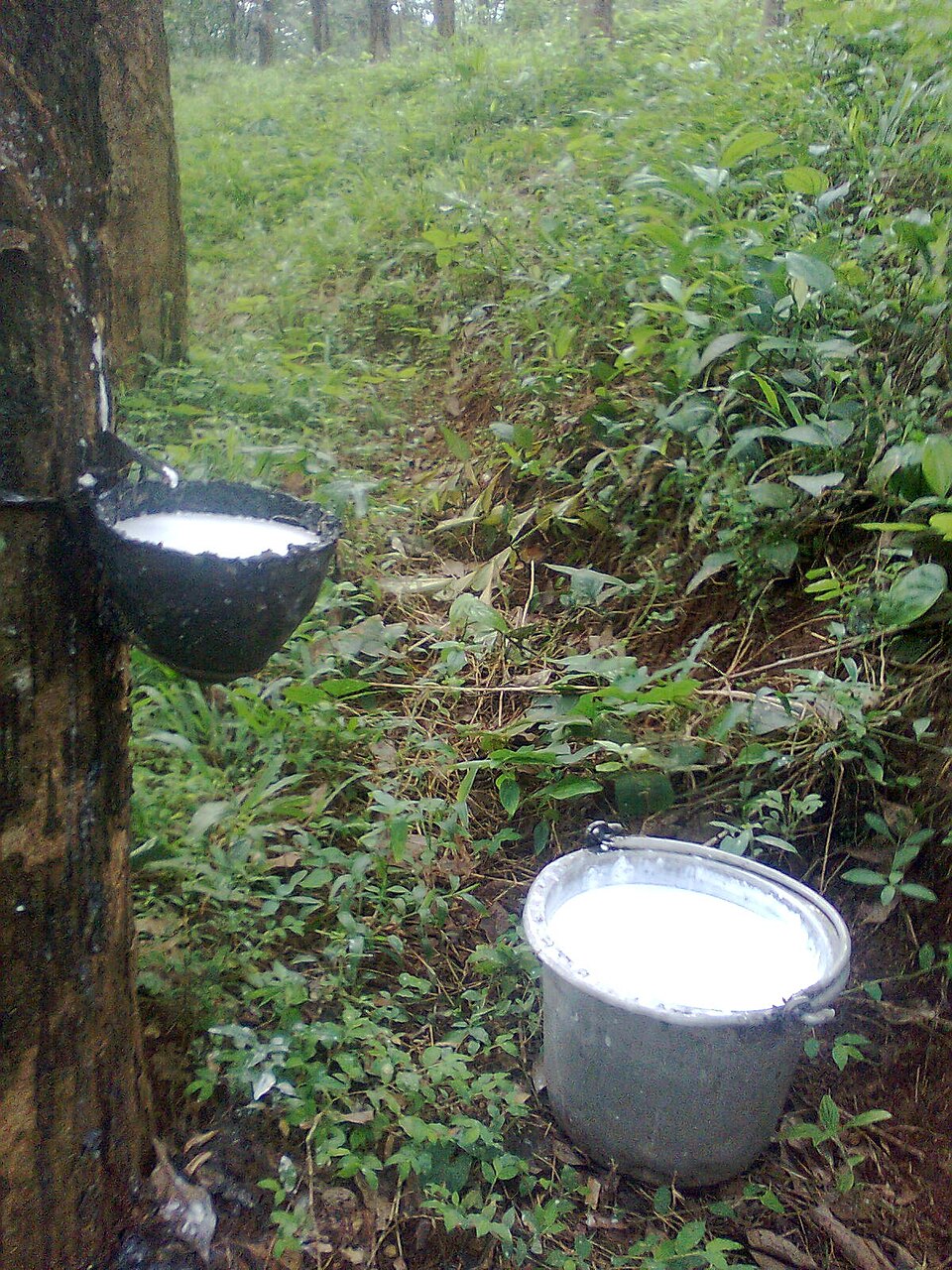
Correct — D, Kerala – Rubber. Kerala is India's natural rubber State: the great majority of the country's natural rubber comes from Kerala, overwhelmingly from the central Travancore belt around Kottayam, and the Rubber Board, the statutory body for the crop, is headquartered at Kottayam for exactly that reason. The pairing is not accidental — the rubber tree, Hevea brasiliensis, needs high and well-distributed rainfall, a hot and humid climate with no cold season, and deep, well-drained laterite soils on gently sloping ground, which is a description of Kerala's midland belt. None of the other three pairs survives even a rough climatic test, so this is a one-answer question once you match each crop to the conditions it needs.
Why the others are wrong
- (a)Uttar Pradesh – Jute — Jute is a crop of the Ganga–Brahmaputra delta and its neighbourhood — West Bengal above all, with Bihar, Assam and Odisha — because it needs heavy rainfall, high humidity and the annually renewed alluvium of a flood plain, plus running water for retting the stems. Uttar Pradesh's leading crops are sugarcane, wheat, rice and potato, not jute.
- (b)Assam – Wheat — Wheat is a rabi crop of the cool, dry winter of the north-west — Uttar Pradesh, Punjab, Madhya Pradesh and Haryana are the leading States. Assam has a warm, extremely wet climate with no proper cold dry season, and its characteristic crops are rice and tea, not wheat.
- (c)Gujarat – Tea — Tea needs heavy rainfall, high humidity and well-drained sloping land, so it is grown in Assam, West Bengal's Darjeeling and Dooars, the Nilgiris in Tamil Nadu, and Kerala's high ranges. Gujarat is a semi-arid State whose signature crops are cotton and groundnut; it grows no tea of any consequence.
Concept
Crop-to-State matching questions are really questions about climate and soil. Four conditions do most of the work. Rubber requires a hot, humid equatorial-type climate with heavy, well-distributed rainfall and deep laterite soils — hence Kerala, and then Tripura — the second-largest producer, where the rubber belt was built up deliberately from the 1960s — followed by Karnataka, Tamil Nadu and the rest of the north-east. Tea requires heavy rain, humidity and sloping ground so water does not stagnate at the roots — hence Assam, north Bengal, the Nilgiris and Kerala's high ranges. Jute requires the humid, flood-renewed alluvium of a delta plus water for retting — hence West Bengal, Bihar, Assam and Odisha. Wheat requires a cool growing season and a warm, dry ripening period — hence the north-western plains. Fix those four requirements and most matching questions on Indian crops answer themselves.
In a 'which one is correctly matched' item the fastest route is elimination on climate rather than recall of production tables. Jute in Uttar Pradesh, wheat in Assam and tea in Gujarat each place a crop in a State whose climate is wrong for it — dry-winter plains for a delta fibre, a wet tropical State for a cool-season cereal, and a semi-arid State for a wet-hill plantation crop. That leaves Kerala–Rubber, which is not only correct but is the textbook pairing for the crop. A useful cross-check is where the commodity board sits: the Rubber Board is at Kottayam in Kerala, the Tea Board at Kolkata, the Coffee Board at Bengaluru and the Tobacco Board at Guntur — the boards were sited in their crops' heartlands, so they double as a memory aid.
Key facts
- Kerala accounts for the great majority of India's natural rubber production, concentrated in the central Travancore belt around Kottayam; Tripura is the second-largest producer, with Karnataka and Tamil Nadu behind it.
- Rubber (Hevea brasiliensis) needs a hot, humid climate, heavy and well-distributed rainfall and deep, well-drained laterite soils on gently sloping land.
- Jute is a crop of the Ganga–Brahmaputra delta and adjoining plains — West Bengal, Bihar, Assam and Odisha — needing humid heat, fresh alluvium and water for retting.
- Wheat is a rabi crop of the north-western plains, led by Uttar Pradesh, Punjab, Madhya Pradesh and Haryana; Assam's climate is unsuited to it.
- Tea is grown in Assam, north Bengal (Darjeeling and the Dooars), the Nilgiris and Kerala's high ranges; Gujarat, a semi-arid cotton and groundnut State, grows none.
- The Rubber Board is headquartered at Kottayam in Kerala, the Tea Board at Kolkata, the Coffee Board at Bengaluru and the Tobacco Board at Guntur.
Study next
Common traps
- Answering from a half-remembered production ranking instead of testing the pair against climate — every wrong option here fails a simple rainfall or temperature test.
- Assuming a crop grown somewhere in a State makes the pair 'correct'; the question intends the State characteristically associated with the crop.
- Mixing up Assam's actual crops. Assam is rice and tea; the wheat States are Uttar Pradesh, Punjab, Madhya Pradesh and Haryana.
This area is asked as one-line 'correctly matched' or 'not correctly matched' pairs at UPPSC, and as statement-based or pair-based questions on cropping conditions and leading producers at UPSC; in both, climate requirements are the reliable discriminator.
Related PYQs
Match List-I with List-II and select the correct answer using the code given below the Lists: List-I (Board) A. Coffee Board B. Rubber Board C. Tea Board D. Tobacco Board List-II (Headquarters) 1. Bengaluru 2. Guntur 3. Kottayam 4. Kolkata Code:
- (a) A-2 B-4 C-3 D-1
- (b) A-1 B-3 C-4 D-2
- (c) A-2 B-3 C-4 D-1
- (d) A-1 B-4 C-3 D-2
Answer(b) A-1 B-3 C-4 D-2
The same crop-to-region association tested through the commodity boards — the Rubber Board at Kottayam is the institutional expression of the Kerala–rubber pairing.
Assertion (A): India does not export natural rubber. Reason (R): About 97 % of India's demand for natural rubber is met from domestic production.
- (a) Both A and R are individually true and R is the correct explanation of A
- (b) Both A and R are individually true but R is not the correct explanation of A
- (c) A is true but R is false
- (d) A is false but R is true
Answer(d) A is false but R is true
Extends the same crop into its economics — India's natural rubber output, grown mostly in Kerala, met almost all domestic demand and was also exported.
With reference to 'Uttar Pradesh', which of the following statements is/are correct ? 1. Uttar Pradesh is the leading producer of potato in the country. 2. Government of India has approved for establishment of South Asia Regional Centre of International Potato Centre at Aligarh. Select the correct answer from the code given below : Code :
- (a) Only 2
- (b) Both 1 and 2
- (c) Neither 1 nor 2
- (d) Only 1
Answer(d) Only 1
The same crop-to-State association tested for Uttar Pradesh itself — useful here, because knowing that UP's signature crops are sugarcane, wheat and potato is what kills the 'Uttar Pradesh – Jute' option.
Given below are two statements, one is labelled as Assertion (A) and the other as Reason (R). Assertion (A) : Jute is an indigenous plant of India. Reason (R) : Jute is a Kharif crop sown from February to June and harvested from July to October. Select the correct answer from the codes given below :
- (a) Both (A) and (R) are true and (R) is the correct explanation of (A).
- (b) (A) is false, but (R) is true.
- (c) Both (A) and (R) are true, but (R) is not the correct explanation of (A).
- (d) (A) is true, but (R) is false.
Answer(c) Both (A) and (R) are true, but (R) is not the correct explanation of (A).
Goes deeper into jute — the crop wrongly paired with Uttar Pradesh in option (a) here — testing its season and growing requirements.
Practice
- practice — not a real PYQ
The headquarters of the Rubber Board of India is located at
- (a)Kochi
- (b)Kottayam
- (c)Thiruvananthapuram
- (d)Kozhikode
Answer(b) Kottayam — the Board sits in the central Travancore rubber belt of Kerala, the country's main producing tract. - practice — not a real PYQ
Which one of the following sets of conditions is most suitable for the cultivation of natural rubber?
- (a)Cool winters, moderate rainfall and heavy black soil
- (b)Hot humid climate, heavy well-distributed rainfall and deep well-drained laterite soil
- (c)Dry summers, winter rainfall and sandy loam soil
- (d)Cold climate, sloping terrain and acidic peaty soil
Answer(b) Hot humid climate, heavy well-distributed rainfall and deep well-drained laterite soil — the combination found in Kerala's midland belt.