
In which of the following stupas, the features of a plateform with 'Aryak-Pillars' are found ?
- (a)Ghantshal
- (b)Bodhgaya
- (c)Nagarjunikonda
- (d)Amaravati
Correct — D, Amaravati. The commission's key marks Amaravati, and Amaravati is indeed the type-site of the tradition in question: its Mahachaitya on the Krishna is the monument that gives the Andhra school of stupa architecture its name, and the ayaka platform is that school's signature. An ayaka platform, or ayaka-vedika, is a rectangular offset projecting from the drum of the stupa at each of the four cardinal points, carrying a row of five free-standing ayaka pillars. But the question as printed is defective, and a student should be told so plainly rather than taught something false to justify the key. The ayaka platform is NOT peculiar to Amaravati — it is the common feature of the stupas of the lower Krishna valley as a group, and it occurs at Nagarjunakonda and Ghantasala as well, both of which are printed here as options. Nagarjunakonda's ayaka platforms are especially well documented, from the third-century renovations financed by the Ikshvaku princess Chamtisiri. Of the four options only Bodhgaya is genuinely excluded. So three of the four could be defended, the key marks Amaravati as the type-site, and the takeaway a student should carry away is the feature and the region rather than a single site.
- (a)Ghantshal — Marked wrong by the key, but not actually excluded by the feature. Ghantasala, in the lower Krishna valley of Andhra Pradesh, belongs to the same school of stupa building as Amaravati and shares its ayaka platforms. It is a weaker choice only in the sense that Amaravati is the famous type-site of the school; it is not a site from which ayaka pillars are absent, and no honest explanation should say that it is.
- (b)Bodhgaya — The one option that is genuinely wrong, and the only sound elimination in the question. Bodhgaya in Bihar is the place of the Buddha's Enlightenment, and its monuments are of an entirely different character — the Mahabodhi temple with its tall pyramidal tower, the Bodhi tree and the Vajrasana — rather than a drum-and-dome stupa of the Andhra type. It lies far outside the lower Krishna valley in which the ayaka platform developed.
- (c)Nagarjunikonda — Marked wrong by the key, but a defensible answer on the evidence. Nagarjunakonda, the Ikshvaku capital in the Krishna valley, has ayaka platforms that are among the best recorded anywhere, described in the excavation literature as rectangular offsets carrying the customary row of five pillars. Do not learn this option as a site without ayaka pillars. Learn instead that a candidate who chose it was reasoning correctly and was defeated by the way the question was framed.
A stupa is a solid hemispherical mound raised over relics, built up from a drum (medhi), a dome (anda), a railed enclosure (harmika) at the summit carrying the mast and umbrellas, a circumambulatory path and a surrounding railing pierced by gateways. The stupas of the lower Krishna valley in Andhra added one element found nowhere else: at each of the four cardinal points a rectangular platform was thrown out from the drum, and on it stood a row of five free-standing pillars, the ayaka pillars. The five are conventionally read as the five great events of the Buddha's life — his Birth, the Great Renunciation, the Enlightenment, the First Sermon, and the Mahaparinirvana. On stone-faced stupas these platforms carried the richest carving on the monument and served as altars for offerings.
The reasoning this question really tests is regional rather than site-specific: ayaka pillars mean Andhra, the lower Krishna valley, the Satavahana and Ikshvaku period. Once that is fixed, Bodhgaya falls away at once and the remaining three all belong to the same family — which is exactly why the question is unsound and why a student should hold the FEATURE and the REGION in memory rather than a single monument. If a paper forces the choice, Amaravati is the defensible pick because it is the type-site: its Mahachaitya is the monument the school is named after, the largest and best known of the group, and the source of the carved limestone slabs now divided between the museum collections in Chennai and London. Amaravati is also the ancient Dhanyakataka, a major Buddhist centre on the Krishna in Guntur district, Andhra Pradesh.
- An ayaka platform is a rectangular offset at each of the four cardinal points of a stupa's drum, carrying a row of five free-standing ayaka pillars
- The five pillars are conventionally read as the five great events of the Buddha's life — Birth, Great Renunciation, Enlightenment, First Sermon and Mahaparinirvana
- The feature belongs to the stupas of the lower Krishna valley in Andhra as a group — Amaravati, Nagarjunakonda, Jaggayyapeta, Ghantasala and Goli — not to any single site
- Amaravati, the ancient Dhanyakataka, stands on the Krishna in Guntur district, Andhra Pradesh, and is the type-site of that school
- Nagarjunakonda's ayaka platforms date from third-century renovations financed by the Ikshvaku princess Chamtisiri
- Bodhgaya, in Bihar, is the site of the Enlightenment, dominated by the Mahabodhi temple and the Bodhi tree, and lies outside this architectural tradition
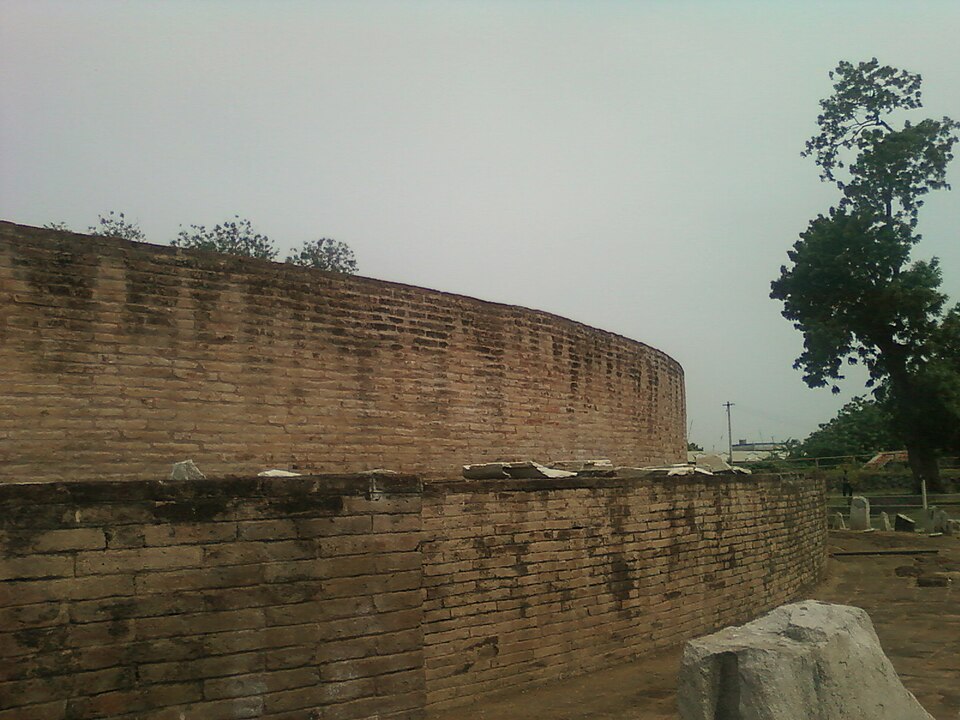
- Learning ayaka pillars as belonging to one site; they are the mark of the lower Krishna valley school as a whole, which is what makes this particular question defective
- Expecting ayaka platforms at Sanchi or Bharhut — the northern stupas do not have them
- Treating Bodhgaya's Mahabodhi temple as a stupa of the same type; it is a temple over the seat of the Enlightenment, not an Andhra-style relic mound
UPPSC asks for the site by name, as here, and it is worth knowing that the honest answer is a region. UPSC has approached the same ground obliquely and more safely — asking in which region Dhanyakataka lay (2023) and whether the Ikshvaku rulers patronised Buddhism (2006) — so prepare Amaravati and Nagarjunakonda as a pair, tied to Andhra, the Krishna and the Satavahana-Ikshvaku centuries.
In which one of the following regions was Dhanyakataka, which flourished as a prominent Buddhist centre under the Mahasanghikas, located?
- (a) Andhra
- (b) Gandhara
- (c) Kalinga
- (d) Magadha
Answer(a) Andhra
Dhanyakataka is Amaravati, and UPSC asked for its region rather than its name — which is precisely the safer way to test this material. Attempt it alongside the 2022 question and the lesson lands: what you must own is the association of ayaka pillars with Andhra and the Krishna valley, not a single monument.
Which one of the following pairs is correctly matched?
- (a) Vikramsila Monastery : Uttar Pradesh
- (b) Hemkund Gurudwara : Himachal Pradesh
- (c) Udayagiri Caves : Maharashtra
- (d) Amaravati Buddhist Stupa : Andhra Pradesh
Answer(d) Amaravati Buddhist Stupa : Andhra Pradesh
The same monument placed on the map. Amaravati stands on the Krishna in Guntur district, Andhra Pradesh, and locating it there is the first step in recognising the ayaka platform as an Andhra feature rather than a pan-Indian one.
Consider the following statements: 1. The Ikshvaku rulers of southern India were antagonistic towards Buddhism. 2. The Pala rulers of Eastern India were patrons of Buddhism. Which of the statements given above is/are correct?
- (a) 1 only
- (b) 2 only
- (c) Both 1 and 2
- (d) Neither 1 nor 2
Answer(b) 2 only
The patronage behind the other great ayaka site. The Ikshvakus of the Krishna valley financed the stupas and monasteries of Nagarjunakonda — its ayaka platforms come from third-century renovations paid for by the Ikshvaku princess Chamtisiri — so this question supplies the dynastic context for the option UPPSC marked wrong.
- practice — not a real PYQ
The 'ayaka' pillars, set in a row of five on a platform projecting from the drum at each of the four cardinal points, are a distinctive feature of
- (a)the stupas of the lower Krishna valley in Andhra
- (b)the stupas of Sanchi and Bharhut in central India
- (c)the Gandharan stupas of the north-west
- (d)the rock-cut chaitya halls of the Western Ghats
Answer(a) the stupas of the lower Krishna valley in Andhra — Amaravati, Nagarjunakonda, Jaggayyapeta, Ghantasala and Goli all carry them, and no stupa outside that region does.
- practice — not a real PYQ
The five pillars standing on each ayaka platform of an Andhra stupa are conventionally interpreted as symbolising
- (a)the five Dhyani Buddhas
- (b)the five great events of the Buddha's life
- (c)the five precepts of the Panchsheel
- (d)the five aggregates or skandhas
Answer(b) the five great events of the Buddha's life — his Birth, the Great Renunciation, the Enlightenment, the First Sermon and the Mahaparinirvana.