
Which of the following is used in fire alarm ?
- (a)Photo cell
- (b)Water
- (c)Solar cell
- (d)None of the above
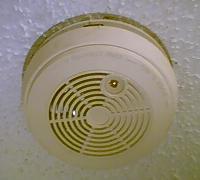
Correct — A, a photo cell. A photoelectric smoke detector — the commonest type of fire alarm sensor — houses a light source (an LED) and a light-sensitive photo cell set at an angle to it. In clean air no light reaches the cell; when smoke from a fire enters the chamber it scatters the light onto the photo cell, the cell's output changes and the alarm is triggered. The photo cell (a photodetector such as a photoresistor/photodiode) is therefore the sensing element that 'uses' light to detect a fire.
- (b)Water — Water is the extinguishing agent released by a sprinkler system to put out a fire — it does not detect the fire, so it is not what a fire alarm (the detector) uses to sense one.
- (c)Solar cell — A solar cell (photovoltaic cell) is designed to convert sunlight into electrical power, not to sense the small amount of scattered light in a smoke chamber; it is a power-generation device, not a smoke-detection sensor.
- (d)None of the above — Incorrect, because a photo cell is in fact the sensor used in photoelectric fire/smoke alarms — so option (a) is valid and this cannot be the answer.
A photoelectric (optical) smoke detector works on light scattering. A photo cell is a component whose electrical behaviour changes when light falls on it (photoconductive cells/photoresistors lower their resistance under light; photodiodes/phototransistors produce a current). Pairing a light source with a photo cell lets a device 'see' smoke: smoke particles scatter light onto the cell and change its signal, tripping the alarm.
The trap is the family resemblance of the three light-related terms. 'Solar cell' also responds to light, so it is tempting — but its job is generating power from sunlight, not sensing smoke. Reason from function: a fire alarm must DETECT a fire, and the detecting element that reacts to scattered light is the photo cell, not a power cell (solar) and not the water used to fight the fire.
- Photoelectric smoke detector = LED light source + a photo cell (photodetector)
- Smoke scatters the light onto the photo cell → its output changes → alarm sounds
- Photo cell senses light; solar cell generates power from light — different purposes
- Water is the extinguishing agent (sprinklers), not the detection sensor
- Choosing 'solar cell' because it also responds to light — but it generates power, it does not sense smoke
- Confusing the detector (fire alarm) with the extinguisher (water sprinkler)
UPPSC/UPSC ask which device or component is used in a given everyday application (alarms, street lights, cameras), testing whether you can match a sensor/component (here the photo cell) to its real-world use.
- practice — not a real PYQ
A light dependent resistor (LDR) is commonly used in which of the following?
- (a)Automatic street lights
- (b)Electric heater
- (c)Ceiling fan regulator
- (d)Electric kettle
Answer(a) Automatic street lights — the LDR's resistance falls in daylight and rises at night, switching the lamp on/off automatically. - practice — not a real PYQ
A solar cell converts:
- (a)Heat energy into electrical energy
- (b)Light energy into electrical energy
- (c)Electrical energy into light energy
- (d)Chemical energy into electrical energy
Answer(b) Light energy into electrical energy — a photovoltaic cell generates electricity directly from sunlight.