
The atmosphere of Saturn contains which one of the following gas in large quantity ?
- (a)Carbon monoxide
- (b)Nitrogen
- (c)Sulphur dioxide
- (d)Methane
Answer
Why
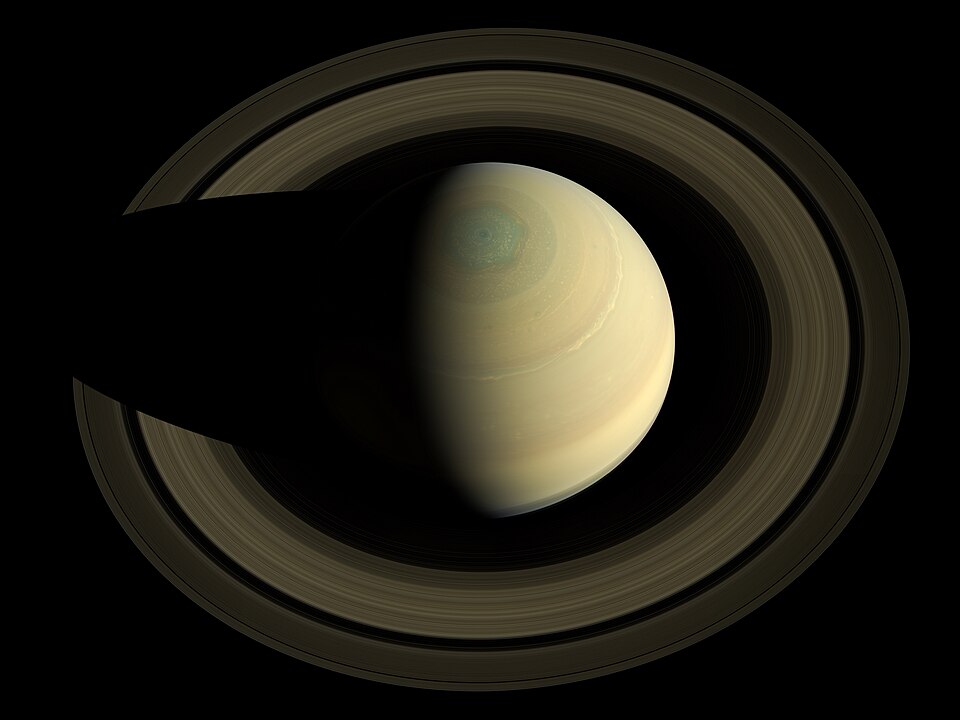
Correct — D, Methane. Saturn is a gas giant, and like Jupiter it is made overwhelmingly of the two lightest elements: its atmosphere is roughly 96 per cent molecular hydrogen and about 3 per cent helium by volume. Everything else is a minor constituent — and among those minor constituents methane is the principal one, alongside ammonia, ethane, phosphine and water ice. That is why methane is the answer here: read the question as 'which of these four is actually present in Saturn's atmosphere in any appreciable quantity', because the other three are not there in any meaningful amount at all. Methane also does visible work on the outer planets. It absorbs red light strongly, so a methane-bearing atmosphere reflects the blue end of the spectrum — the reason Uranus and Neptune, where methane is proportionally far more abundant, appear blue-green, while on Saturn the ammonia haze dominates the pale-gold colour we see.
Why the others are wrong
- (a)Carbon monoxide — Carbon monoxide has been detected in the outer planets only in traces. In a hydrogen-rich, chemically reducing atmosphere such as Saturn's, carbon is held overwhelmingly in its fully hydrogenated form — methane — rather than as an oxide, so carbon monoxide cannot be a bulk constituent.
- (b)Nitrogen — The most tempting wrong answer, because nitrogen is indeed the dominant gas in a nearby atmosphere — that of Titan, Saturn's largest moon, whose thick nitrogen envelope with a few per cent methane is one of the most studied in the solar system. But Titan is a moon, not the planet. On Saturn itself the nitrogen present is bound up mainly as ammonia, and free nitrogen is not a major component.
- (c)Sulphur dioxide — Sulphur dioxide belongs to volcanic and oxidising settings — the clouds of Venus and the plumes of Jupiter's moon Io are the standard examples. It is not a constituent of a cold, hydrogen-dominated giant-planet atmosphere, where sulphur appears in reduced forms if at all.
Concept
The solar system splits into two families of atmosphere. The inner rocky planets could not hold on to hydrogen and helium, so their atmospheres are secondary and heavy — carbon dioxide on Venus and Mars, nitrogen and oxygen on Earth. The outer giants, Jupiter and Saturn, were massive enough and cold enough to keep the nebular gas they formed from, so their atmospheres are still overwhelmingly hydrogen and helium, essentially the composition of the Sun. In such a reducing, hydrogen-saturated environment the lighter elements combine with hydrogen rather than with oxygen: carbon becomes methane, nitrogen becomes ammonia, oxygen becomes water. Naming the minor gases of a giant planet is therefore not memorisation — it follows from the chemistry.
The examiner is not claiming methane is abundant in absolute terms; it is a fraction of a per cent of Saturn's atmosphere. The question is comparative, and it works because the other three options are all gases from a different chemical regime — an oxidising one. Carbon monoxide and sulphur dioxide need oxygen that a hydrogen-rich giant does not make available, and free nitrogen belongs to Titan rather than to Saturn. If a candidate keeps in mind that the giants are reducing and the inner planets oxidising, the elimination takes seconds. The one genuine confusion to guard against is Saturn versus its moon Titan: the nitrogen answer is right for the moon and wrong for the planet.
Key facts
- Saturn's atmosphere is roughly 96 per cent molecular hydrogen and about 3 per cent helium by volume; methane, ammonia, ethane, phosphine and water ice make up the remainder.
- In the reducing chemistry of a giant planet, carbon appears as methane (CH4) and nitrogen as ammonia (NH3), not as oxides.
- Titan, Saturn's largest moon, has a dense atmosphere dominated by nitrogen with a few per cent methane — the source of the nitrogen distractor.
- Methane absorbs red light, which is why methane-rich Uranus and Neptune look blue-green; Saturn's pale-gold appearance comes chiefly from ammonia cloud haze.
- The Cassini-Huygens mission, a NASA-ESA-ASI project, orbited Saturn and landed the Huygens probe on Titan — the source of most modern data on both atmospheres.
Study next
Common traps
- Attributing Titan's nitrogen atmosphere to Saturn itself — the commonest error on this question
- Reading 'large quantity' as absolute abundance; on Saturn the bulk gases are hydrogen and helium, and methane is 'large' only relative to the other options offered
- Importing oxidised gases such as carbon monoxide or sulphur dioxide into a hydrogen-rich giant planet where the chemistry is reducing
UPPSC asks planetary atmospheres as a one-line 'which gas' question. UPSC prefers the consequence — an assertion-reason on why life is improbable on Venus given its carbon dioxide, or a spacecraft-to-destination match that turns on knowing Cassini-Huygens went to Saturn. Learn each planet as a pair: dominant gas plus the effect it produces.
Related PYQs
Assertion (A): Existence of human life on Venus is highly improbable. Reason (R): Venus has extremely high level of carbon dioxide in its atmosphere.
- (a) Both A and R are individually true and R is the correct explanation of A
- (b) Both A and R are individually true but R is not the correct explanation of A
- (c) A is true but R is false
- (d) A is false but R is true
Answer(a) Both A and R are individually true and R is the correct explanation of A
The same idea from the inner solar system: name the dominant gas of a planet's atmosphere and you can predict the conditions on it. Venus is carbon dioxide and a runaway greenhouse; Saturn is hydrogen and helium with methane among the traces.
Which of the following pairs is/are correctly matched? Spacecraft : Purpose 1. Cassini-Huygens : Orbiting the Venus and transmitting data to the Earth 2. Messenger : Mapping and investigating the Mercury 3. Voyager 1 and 2 : Exploring the outer solar system Select the correct answer using the code given below.
- (a) 1 only
- (b) 2 and 3 only
- (c) 1 and 3 only
- (d) 1, 2 and 3
Answer(b) 2 and 3 only
Turns on the same planet: pair 1 fails precisely because Cassini-Huygens was sent to Saturn, not to Venus. That mission is where nearly all current knowledge of Saturn's atmosphere and of Titan's nitrogen envelope comes from.
Practice
- practice — not a real PYQ
The atmosphere of Titan, the largest moon of Saturn, is composed predominantly of
- (a)Carbon dioxide
- (b)Nitrogen
- (c)Hydrogen
- (d)Oxygen
Answer(b) Nitrogen — Titan has a dense, largely nitrogen atmosphere with a few per cent methane, unlike Saturn itself, which is hydrogen and helium. - practice — not a real PYQ
The blue-green colour of Uranus and Neptune is chiefly caused by the presence of which gas in their atmospheres?
- (a)Helium
- (b)Ammonia
- (c)Methane
- (d)Sulphur dioxide
Answer(c) Methane — it absorbs strongly in the red part of the spectrum, so the light scattered back is dominated by blue and green.