
Who among the following have signed the agreement to resolve Assam – Meghalaya border dispute in March 2022 ?
- (a)Home Secretary of India and Director Generals of Police of Assam and Meghalaya
- (b)Union Home Minister, Chief Ministers of Assam and Meghalaya
- (c)Home Secretary of India and Chief Secretaries of Assam and Meghalaya
- (d)Chief Ministers of Assam and Meghalaya
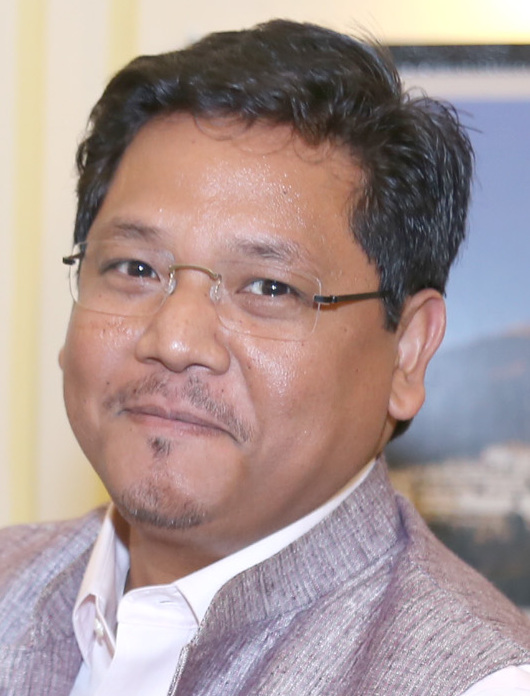
Correct — D, Chief Ministers of Assam and Meghalaya. The memorandum of understanding was signed in New Delhi on 29 March 2022 by Himanta Biswa Sarma for Assam and Conrad Sangma for Meghalaya — the two Chief Ministers, and only them. Union Home Minister Amit Shah was present at the signing and the agreement was concluded under the Centre's good offices, but he was a witness to it, not a party. That distinction is the entire question: a boundary between two States is a matter between those two States, and the Union cannot sign away a State's territorial claim on its behalf. The memorandum settled six of the twelve stretches along the boundary where the two States' claims differ, leaving the remainder for later rounds. Note the date anchor — the question is about the position as of the June-2022 exam, and it should not be read as saying the whole dispute was closed.
- (a)Home Secretary of India and Director Generals of Police of Assam and Meghalaya — Wrong on every count. This is the composition of a law-and-order coordination meeting, not of a territorial settlement. Police chiefs manage flashpoints along a disputed boundary; they have no authority to redraw one, and the Union Home Secretary is an official, not a party to an inter-State agreement.
- (b)Union Home Minister, Chief Ministers of Assam and Meghalaya — This is the trap, and it is a good one, because Amit Shah was genuinely in the room. He hosted and witnessed the signing in New Delhi and the Centre had pushed both sides toward it. But the memorandum was a bilateral instrument between two States and carries two signatures, not three. Being present at a signing and being a signatory are different things — a distinction the question is built to test.
- (c)Home Secretary of India and Chief Secretaries of Assam and Meghalaya — Chief Secretaries and the Union Home Secretary staffed the process — the regional committees that examined the disputed stretches worked through officials at that level — but a settlement of territory is a political decision, and it was signed at the level of the Chief Ministers, not the bureaucracy.
Meghalaya was carved out of Assam — first as an autonomous State in 1970 and then as a full State on 21 January 1972 — and the boundary drawn at that time was never agreed on the ground. Meghalaya disputed the alignment inherited from the reorganisation law, and twelve stretches along the border remained in contention, several of them the scene of recurring violence. The March 2022 memorandum was the first substantial breakthrough in five decades: the two States set up regional committees which examined each disputed stretch against five agreed criteria and recommended settlements, and the Chief Ministers signed off on six of the twelve. Constitutionally, any change so agreed still has to be given effect by Parliament, since altering the boundaries of States is Parliament's power under Article 3 and touches the First Schedule.
This is a current-affairs recall item, but the options are designed so that the constitutional logic gets you there even if you have forgotten the news. Ask who has the standing to give up or accept territory: not a police chief, not a secretary, but the elected head of the State government. Then ask whether the Union should appear as a signatory, and the answer is no — the Centre convenes, mediates and later legislates, but a boundary between two States is settled between those two States. Option (b) survives that test only until you separate 'present at the signing' from 'signed'.
- Signed in New Delhi on 29 March 2022 by Himanta Biswa Sarma, Chief Minister of Assam, and Conrad Sangma, Chief Minister of Meghalaya
- Union Home Minister Amit Shah was present as a witness; the Centre convened and facilitated but was not a signatory
- The memorandum covered six of the twelve stretches where the two States' boundary claims differ
- Meghalaya was separated from Assam and became a full State on 21 January 1972; the boundary drawn then has been disputed ever since
- Under Article 3, altering the boundaries of a State is done by Parliament by law, on the President's recommendation and after seeking the views of the State legislature concerned
- Treating a dignitary present at a signing as a signatory — the Union Home Minister witnessed this memorandum, he did not sign it
- Assuming the March 2022 agreement closed the dispute; it covered six of twelve disputed stretches
- Confusing inter-State boundary disputes (Article 3, Parliament) with inter-State river water disputes (Article 262, tribunals)
UPPSC asks recent inter-State and Centre–State events as who-did-what recall, with the near-miss option built around a well-known name that was in the news alongside the real answer. UPSC asks the constitutional machinery instead — which Schedule must be amended to create a State, whether the State legislature's view binds Parliament, which bodies are constitutional and which are not.
If a new State of the Indian Union is to be created, which one of the following Schedules of the Constitution must be amended?
- (a) First
- (b) Second
- (c) Third
- (d) Fifth
Answer(a) First
The constitutional machinery that created this dispute in the first place. Meghalaya was carved out of Assam by exactly this route — a parliamentary law amending the First Schedule — and the boundary that law drew is what the 2022 memorandum was renegotiating.
Given below are two statements, one is labelled as Assertion (A) and other as Reason (R) – Assertion (A) – The President can recommend to the Parliament to change the boundary of any state after seeking views of the concerned Legislature of that state on the subject within specified period. Reason (R) – It is not mandatory for the President to accept the proposal of the concerned State Legislature. Select the correct answer using the code given below –
- (a) Both (A) and (R) are true and (R) is correct explanation of (A)
- (b) Both (A) and (R) are true but (R) is not correct explanation of (A)
- (c) (A) is false but (R) is true
- (d) (A) is true but (R) is false
Answer(b) Both (A) and (R) are true but (R) is not correct explanation of (A)
What has to happen after two Chief Ministers shake hands. A boundary change agreed between States still needs Parliament to enact it, on the President's recommendation and after the State legislature's views are sought — views that Parliament is free not to accept.
On the recommendation of which Commission/Committee, the Inter-state Council was set up in India ?
- (a) Punchhi Commission
- (b) Rajmannar Committee
- (c) Kothari Committee
- (d) Sarkaria Commission
Answer(d) Sarkaria Commission
The standing forum for exactly this kind of quarrel. The Inter-State Council under Article 263, set up on the Sarkaria Commission's recommendation, exists to investigate and advise on disputes between States — the institutional backdrop to a bilateral settlement brokered by the Centre.
- practice — not a real PYQ
Under the Constitution of India, the power to alter the boundaries of an existing State rests with
- (a)the President, by executive order
- (b)Parliament, by law
- (c)the Inter-State Council, by resolution
- (d)the legislatures of the States concerned, by agreement
Answer(b) Parliament, by law — under Article 3, on the recommendation of the President and after the views of the State legislature concerned have been sought, though those views do not bind Parliament.
- practice — not a real PYQ
Meghalaya attained full statehood, separating from Assam, in which year?
- (a)1963
- (b)1969
- (c)1972
- (d)1987
Answer(c) 1972 — Meghalaya became a full State on 21 January 1972, the same day as Manipur and Tripura; the boundary inherited from that separation is what the 2022 memorandum was trying to settle.