
Tappa style of music was refined and developed in which of the following Mughal Emperor's Court?
- (a)Jahangir
- (b)Akbar
- (c)Shahjahan
- (d)Muhammad Shah
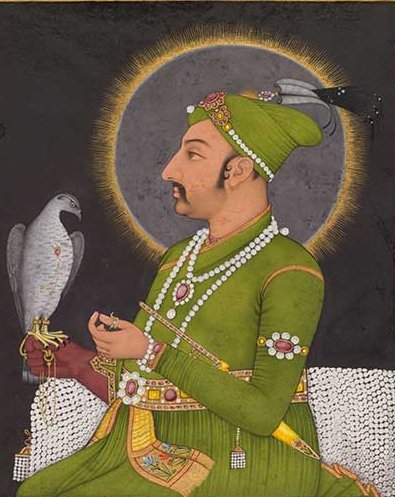
Correct — D, Muhammad Shah. Tappa is a semi-classical Hindustani vocal form that grew out of the folk songs of the camel-riders of Punjab and was refined into court music in the reign of the Mughal emperor Muhammad Shah 'Rangila' (r. 1719-1748), whose court was a great centre of Hindustani music. It was later carried forward and popularised by Mian Ghulam Nabi Shori ('Shori Miyan') under the Nawab of Awadh. Tappa is known for its fast, subtle, 'knotty' ornamentation (rapid taans/zamzama).
- (a)Jahangir — Jahangir's court is celebrated for the zenith of Mughal miniature painting, not for the refinement of Tappa music.
- (b)Akbar — Akbar's court is famed for Tansen and the Dhrupad tradition; Tappa is a later development associated with Muhammad Shah's era, not Akbar's.
- (c)Shahjahan — Shah Jahan is remembered mainly as a patron of architecture (the Taj Mahal); the Tappa form is not linked to his court.
Tappa is one of the semi-classical genres of Hindustani (North Indian) vocal music, alongside Thumri and Dadra. It is distinguished by its rapid, intricate melodic runs. Its roots lie in the folk songs of camel-drivers of the north-west, and it was 'classicised' in the 18th century — first taking shape in Muhammad Shah's court and later refined by Ghulam Nabi Shori.
Match-the-emperor art-and-culture questions reward a mental map of what each Mughal court is known for: Akbar - Dhrupad/Tansen, Jahangir - painting, Shah Jahan - architecture, Muhammad Shah 'Rangila' - the refinement of Hindustani vocal music (Khayal via Sadarang/Adarang, and Tappa). Placing music-refinement under Muhammad Shah gives the answer.
- Tappa = semi-classical Hindustani vocal form with fast, ornate melodic runs.
- Origin: folk songs of camel-riders of Punjab, later refined into court music.
- Refined in the court of Mughal emperor Muhammad Shah 'Rangila' (r. 1719-1748).
- Later developed and popularised by Mian Ghulam Nabi Shori under the Nawab of Awadh.
- Defaulting to Akbar for any Mughal-music question (Akbar = Dhrupad/Tansen, not Tappa).
- Confusing Tappa (fast, knotty) with Thumri (romantic, lyrical) and Khayal (imaginative elaboration).
UPSC/UPPSC ask 'which court/patron' for a music or art form, or 'match the form to its exponent' — link Tappa to Muhammad Shah and to Ghulam Nabi Shori.
Match List I (musicians) with List II (contributions) and select the correct answer using the codes given below the Lists: I. Pandit Vishnu Digambar Paluskar II. Venkatamakhin III. Shyama Shastri IV. Amir Khusrau — A. Introduced the scheme of Raga classification of Indian music B. Proponent of Carnatic music C. Proponent of the Khayal form of Hindustani music D. Wrote the music for the song 'Vande Mataram'
- (a) I-D, II-A, III-C, IV-B
- (b) I-D, II-A, III-B, IV-C
- (c) I-A, II-D, III-C, IV-B
- (d) I-A, II-D, III-B, IV-C
Answer(b) I-D, II-A, III-B, IV-C
Same concept — Indian classical/vocal music forms and the figures who shaped them (Khayal, raga classification, Carnatic), the family of Hindustani genres that Tappa belongs to.
- practice — not a real PYQ
Tappa, a form of Indian semi-classical vocal music, is believed to have originated from the folk songs of the:
- (a)Boatmen of Bengal
- (b)Camel-riders of Punjab
- (c)Shepherds of the Deccan
- (d)Fishermen of Kerala
Answer(b) Camel-riders of Punjab — later refined into court music.
- practice — not a real PYQ
The Khayal form of Hindustani music was notably popularised in the court of Muhammad Shah 'Rangila' by which pair of musicians?
- (a)Tansen and Baiju Bawra
- (b)Sadarang and Adarang
- (c)Amir Khusrau and Gopal Nayak
- (d)Swami Haridas and Tansen
Answer(b) Sadarang (Niyamat Khan) and Adarang — court musicians of Muhammad Shah.