
Which of the following material is bio-degradable ?
- (a)Plastic cups
- (b)Wool
- (c)Glass bottle
- (d)Aluminium foil
Answer
Why
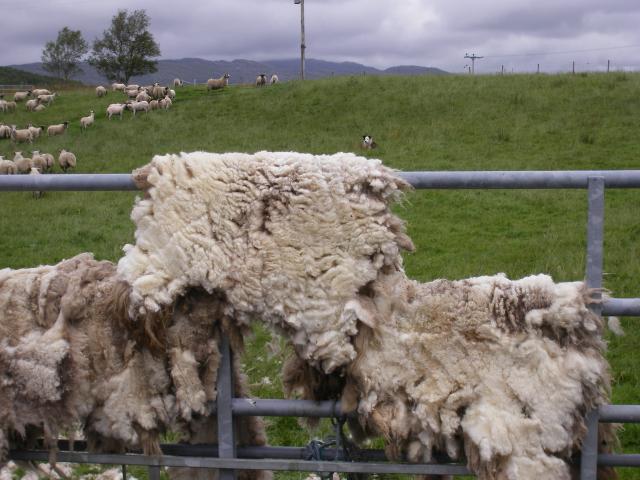
Correct — B, Wool. Biodegradation is the breakdown of organic matter by micro-organisms such as bacteria and fungi, so the test for any material is simple: is it organic matter that microbes have the enzymes to take apart? Wool is. It is a natural animal fibre made of keratin, a protein — a chain of amino acids with a carbon-nitrogen backbone that soil and water micro-organisms readily attack with proteolytic enzymes, releasing the carbon, nitrogen and sulphur back into the nutrient cycle. Indicative figures for degradation in a marine environment put wool gloves at about a year, against roughly a century for a plastic bottle, about two centuries for aluminium cans and effectively indefinite persistence for glass. (Treat those timelines as orders of magnitude, not constants — published figures vary widely with the environment.) The other three options fail the test for two different reasons. Glass and aluminium are inorganic — a silicate and a metallic element — so there is no carbon skeleton for a microbe to feed on at all; biodegradation does not apply to elements. Conventional plastics do have carbon backbones, but the bonds and chain structures are synthetic, and micro-organisms have not evolved enzymes that break them at any useful rate, which is why plastic fragments and weathers rather than decomposing.
Why the others are wrong
- (a)Plastic cups — Conventional plastics are the standard textbook example of a non-biodegradable pollutant. Although they are carbon-based, their polymer chains are synthetic and micro-organisms lack enzymes that can cleave them at any meaningful rate; sunlight and abrasion break the item into ever smaller fragments — ultimately microplastics — rather than mineralising it. Indicative marine figures run to about a hundred years for a plastic bottle.
- (c)Glass bottle — Glass is a chemically inert silicate — an inorganic solid with no carbon skeleton and no nutritional value to any micro-organism. It does not biodegrade at all; it only breaks mechanically into smaller pieces. Glass is highly recyclable, but recyclability and biodegradability are different properties and the question asks for the second.
- (d)Aluminium foil — Aluminium is a metallic element, and biodegradation does not apply to elements — there is no organic molecule for microbes to metabolise. Aluminium corrodes and oxidises, but that is chemistry, not biological decomposition; indicative marine estimates for aluminium cans run to around two hundred years. Like glass, it is valuable to recycle and useless to compost.
Concept
Biodegradable substances are those that decomposer organisms — chiefly bacteria and fungi — can break down into simpler substances that re-enter natural nutrient cycles. The working criterion is whether the material is organic matter built on carbon-hydrogen chains that existing microbial enzymes can attack: plant and animal products such as paper, cotton, wool, leather, food waste, faecal matter, urine, jute and wood all qualify. Non-biodegradable substances are either inorganic (glass, metals, ceramics) or synthetic organics whose bonds no common enzyme fits (most plastics, synthetic fibres such as nylon and polyester, DDT and many pesticides). The distinction matters for waste management because biodegradable waste is the compostable, wet fraction that can be returned to soil, while the non-biodegradable fraction accumulates — and a few non-biodegradable organics are worse still, because being fat-soluble and persistent they biomagnify up the food chain.
The reasoning route is to sort the four options by origin before thinking about time. Two of them — glass and aluminium — are inorganic, so they are out immediately whatever the exposure period; microbes cannot eat a silicate or a metal. That leaves plastic and wool, both carbon-based, and now the question becomes natural versus synthetic. Wool is a protein made by an animal, so decomposers that have been dismantling proteins for billions of years handle it routinely. Plastic is a laboratory polymer with no evolutionary precedent, so it persists. That two-step test — inorganic first, then natural-versus-synthetic — answers almost every biodegradability question a state PCS can set. Beware the common confusion between 'biodegradable' and 'recyclable': glass and aluminium score very highly on recycling and zero on biodegradation, and the two properties are often deliberately mixed in options.
Key facts
- Biodegradation is the breakdown of organic matter by micro-organisms such as bacteria and fungi; it does not apply to elements, so metals such as aluminium do not biodegrade.
- Wool is a keratin protein fibre — organic animal matter — which soil and water micro-organisms metabolise; indicative marine estimates put wool gloves at about one year.
- Indicative marine persistence for the non-biodegradable options: a plastic bottle about 100 years, aluminium cans about 200 years, and glass bottles effectively indefinite. These are order-of-magnitude figures and vary widely by source and environment.
- Glass is an inert silicate and aluminium a metallic element — neither offers a carbon skeleton for microbes; conventional plastics do have carbon backbones but bonds that microbes have not evolved to attack.
- Common biodegradable wastes: food waste, paper, cotton, jute, wool, leather, wood, faecal matter and urine. Common non-biodegradable ones: plastics, synthetic fibres, glass, metals, and persistent pesticides such as DDT.
Study next
Common traps
- Confusing 'biodegradable' with 'recyclable' — glass and aluminium are highly recyclable and completely non-biodegradable
- Assuming every carbon-based material biodegrades; plastics are carbon-based and do not, because their bonds are synthetic
- Reading slow physical breakdown — plastic crumbling into microplastics, aluminium corroding — as biological decomposition
UPPSC asks this as a one-line 'which is / is not biodegradable' with a mixed list of natural and synthetic materials, and has done so in more than one year. UPSC asks the same chemistry indirectly — through microplastics, extended producer responsibility, bioremediation or persistent pollutants — but the underlying test never changes: natural organic matter decomposes, synthetic and inorganic material does not.
Related PYQs
Consider the following statements : Statement-I : Many chewing gums found in the market are considered a source of environmental pollution. Statement-II : Many chewing gums contain plastic as gum base. Which one of the following is correct in respect of the above statements ?
- (a) Both Statement-I and Statement-II are correct and Statement-II explains Statement-I
- (b) Both Statement-I and Statement-II are correct, but Statement-II does not explain Statement-I
- (c) Statement-I is correct, but Statement-II is incorrect
- (d) Statement-I is incorrect, but Statement-II is correct
Answer(a) Both Statement-I and Statement-II are correct and Statement-II explains Statement-I
The same principle from the other side. UPSC's item works because a synthetic polymer base is what makes a product persist in the environment — the very property that puts plastic cups in the non-biodegradable column here and leaves wool as the only material microbes can consume.
Which of the following is not a biodegradable polluter?
- (a) Faecal matter
- (b) Urine
- (c) Domestic waste
- (d) Pesticide
Answer(d) Pesticide
The same classification asked in the negative a year later. There the three natural organic wastes biodegrade and the synthetic chemical does not; here the one natural fibre biodegrades and the synthetic and inorganic materials do not. Same rule, inverted stem.
Practice
- practice — not a real PYQ
Which one of the following pairs of materials is correctly classified?
- (a)Jute — non-biodegradable; Nylon — biodegradable
- (b)Cotton — biodegradable; Polyester — non-biodegradable
- (c)Leather — non-biodegradable; Paper — non-biodegradable
- (d)Wood — non-biodegradable; Aluminium — biodegradable
Answer(b) Cotton — biodegradable; Polyester — non-biodegradable. Cotton is a natural cellulose fibre that decomposers break down; polyester is a synthetic polymer that they cannot. Jute, leather, paper and wood are all biodegradable, and aluminium never is. - practice — not a real PYQ
Which one of the following best explains why most conventional plastics are non-biodegradable?
- (a)They contain no carbon atoms
- (b)They are too dense for micro-organisms to penetrate
- (c)Micro-organisms lack enzymes that can break their synthetic polymer bonds
- (d)They dissolve in water before microbes can act on them
Answer(c) Micro-organisms lack enzymes that can break their synthetic polymer bonds — plastics are carbon-based, but the chains are man-made and have no evolutionary precedent, so decomposers cannot metabolise them at any useful rate.