
The first airport powered by solar energy in India is
- (a)Cochin
- (b)New Delhi
- (c)Chennai
- (d)Ahmedabad
Answer
Why
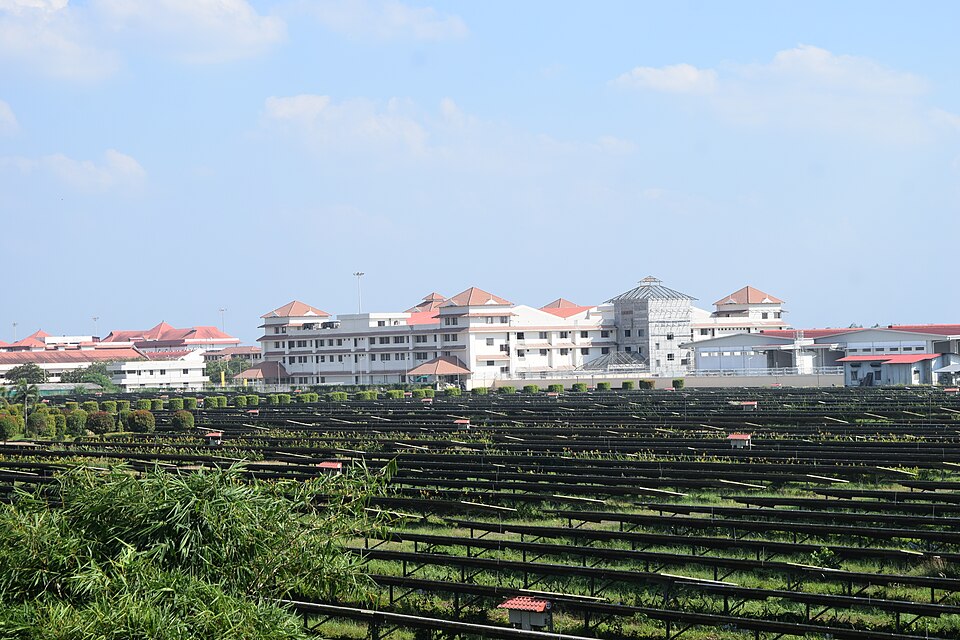
Correct — A, Cochin. Cochin International Airport at Nedumbassery in Ernakulam district, Kerala, became not merely India's but the world's first airport to run fully on solar power. A small 1.1 MW installation was commissioned in 2013, and the dedicated solar plant that took the airport's entire operation onto solar generation was inaugurated on 18 August 2015; the CIAL solar project reached about 15 MW at that point and kept growing — roughly doubling within a couple of years — laid out on the airport's own land, including the ground between and beside the runways and later on canals and reservoirs. The plant produces enough over a year to cover the airport's consumption, which is what the 'fully solar-powered' claim rests on. In July 2018 the airport was selected for the Champions of the Earth award, the highest environmental honour instituted by the United Nations, specifically for this achievement. No other Indian airport reached that position first, so the answer is Cochin.
Why the others are wrong
- (b)New Delhi — Indira Gandhi International Airport is India's busiest and has since added on-site solar generation and pursued carbon-neutrality certification, but it did not get there first. Its sheer scale of consumption also makes it the least likely candidate for the record: covering an airport's whole demand from its own land is far easier at Cochin's size than at Delhi's.
- (c)Chennai — Chennai International Airport, run by the Airports Authority of India, has no claim to this particular first. It is a plausible-looking option only because Tamil Nadu is a leading renewable-energy State — but the State's strength there is chiefly wind, and in any case a State's energy profile is not the same as an airport's power supply.
- (d)Ahmedabad — This is the trap the question is built around. Gujarat's prominence in solar power — the State was an early mover on solar policy and hosts large solar parks — makes Ahmedabad feel like the natural answer to any question with 'solar' and 'first' in it. But the record here belongs to a single airport's own generation, and that airport is Cochin, in Kerala.
Concept
Cochin International Airport is unusual twice over. It was the first airport in India to be built through a public-private partnership, and it is owned by a public limited company, Cochin International Airport Limited, with the Kerala government as the largest shareholder alongside a wide base of non-resident Indian and public investors; it was inaugurated by President K. R. Narayanan on 25 May 1999. That ownership model gave it the freedom to invest in generation of its own. The solar project began small in 2013 and was scaled up in 2015 until annual generation matched annual consumption, which is what 'fully solar-powered' means in practice — the airport stays connected to the grid, exporting when the sun is up and drawing when it is not, so the claim is about net annual energy, not about being islanded from the grid. That distinction is worth holding, because examiners occasionally probe it.
Questions on renewable-energy 'firsts' are among the most repeated in both papers, and they reward a small stock of precise anchors rather than general awareness. The traps are almost always geographical: the candidate reasons from the State that is famous for solar power rather than from the specific installation named. Gujarat and Rajasthan dominate India's solar capacity, so an option from either feels right, and the correct answer here is a Kerala airport. Note also how tightly this fact travelled between the two examinations: UPSC's own 2022 prelims, held around the same season, tested the identical proposition as a statement — 'Kerala has a fully solar powered International Airport' — and it was the only correct statement in that item. A candidate who had prepared for one paper had, without knowing it, prepared for the other.
Key facts
- Cochin International Airport (CIAL) at Nedumbassery, Kerala, became the world's first fully solar-powered airport; the plant that achieved this was inaugurated on 18 August 2015, following a 1.1 MW installation in 2013.
- The CIAL solar project reached about 15 MW on commissioning in 2015 and has expanded well beyond that since, built on the airport's own land; the airport's annual generation covers its annual consumption.
- In July 2018 the airport was selected for the Champions of the Earth award, the highest environmental honour instituted by the United Nations.
- CIAL was the first airport in India built through a public-private partnership and is owned by a public limited company; it was inaugurated on 25 May 1999 by President K. R. Narayanan.
- UPSC set the same proposition in its 2022 prelims, where 'Kerala has a fully solar powered International Airport' was the only correct statement in the item.
Study next
Common traps
- Reasoning from the State famous for solar power rather than from the named installation — Gujarat and Rajasthan lead on capacity, but this particular first belongs to a Kerala airport
- Reading 'fully solar-powered' as disconnected from the grid; it means annual generation matches annual consumption, with the grid used to balance day and night
- Confusing the largest solar park (Bhadla in Rajasthan, as of the 2022 exam) with the first solar-powered airport, or with the largest floating solar project
Both papers ask renewable-energy questions as single-fact 'firsts' — first solar airport, first solar Union Territory, first treaty-based organisation headquartered in India — or fold the same fact into a three-statement item where one geography is quietly switched. UPPSC adds a State layer, asking where in Uttar Pradesh a named plant was built and with which foreign partner.
Related PYQs
Consider the following statements: 1. Gujarat has the largest solar park in India. 2. Kerala has a fully solar powered International Airport. 3. Goa has the largest floating solar photovoltaic project in India. Which of the statements given above is/are correct?
- (a) 1 and 2
- (b) 2 only
- (c) 1 and 3
- (d) 3 only
Answer(b) 2 only
The same fact in the same year, set by UPSC as one of three statements — and the only one of the three that holds. The largest solar park was Bhadla in Rajasthan, not Gujarat, and the largest floating solar project was at Ramagundam in Telangana, not Goa. Between them the two 2022 papers show how completely a single well-anchored fact can be reused.
Which one of the following airports in India is the first to be owned by a public limited company?
- (a) Dabolim Airport, Goa
- (b) Cochin airport
- (c) Hyderabad airport
- (d) Bangalore airport
Answer(b) Cochin airport
The other Cochin first, and the one that made the solar project possible. CIAL was the first Indian airport built under a public-private partnership and the first owned by a public limited company, which gave it the commercial freedom to invest in its own generation seventeen years later.
The First Union Territory of India to run 100 percent on solar energy is
- (a) Andaman-Nicobar
- (b) Chandigarh
- (c) Diu
- (d) Puducherry
Answer(c) Diu
The same question type from the same family of facts — a solar 'first' attached to a specific place, with three familiar names offered as decoys. Diu for the first fully solar Union Territory and Cochin for the first fully solar airport are best learned as a pair, because UPPSC has now asked both.
In which of the following districts of U.P. a major solar power plant was established in collaboration with France in 2018 ?
- (a) Agra
- (b) Ballia
- (c) Deoria
- (d) Mirzapur
Answer(d) Mirzapur
The State-level version of the same topic, which is where UPPSC most often takes solar energy. The paper expects a candidate to know not only the national firsts but which Uttar Pradesh district hosts a named plant and who built it — so pair every national solar fact with its UP counterpart.
Practice
- practice — not a real PYQ
Cochin International Airport was selected in 2018 for which international honour, in recognition of its solar power project?
- (a)The Earthshot Prize
- (b)The Champions of the Earth award of the United Nations
- (c)The Goldman Environmental Prize
- (d)The Global 500 Roll of Honour
Answer(b) The Champions of the Earth award of the United Nations — the highest environmental honour instituted by the UN, for which the airport was selected in July 2018 on the strength of its solar installation. - practice — not a real PYQ
As of the 2022 examination, India's largest solar park was located in which State?
- (a)Gujarat
- (b)Karnataka
- (c)Rajasthan
- (d)Andhra Pradesh
Answer(c) Rajasthan — the Bhadla Solar Park in Jodhpur district was India's largest as of the 2022 exam, which is why 'Gujarat has the largest solar park in India' was marked incorrect in UPSC's own 2022 paper.