
The most biodiversity rich area in India is
- (a)Gangetic plain
- (b)Trans Himalayas
- (c)Western Ghats
- (d)Central India
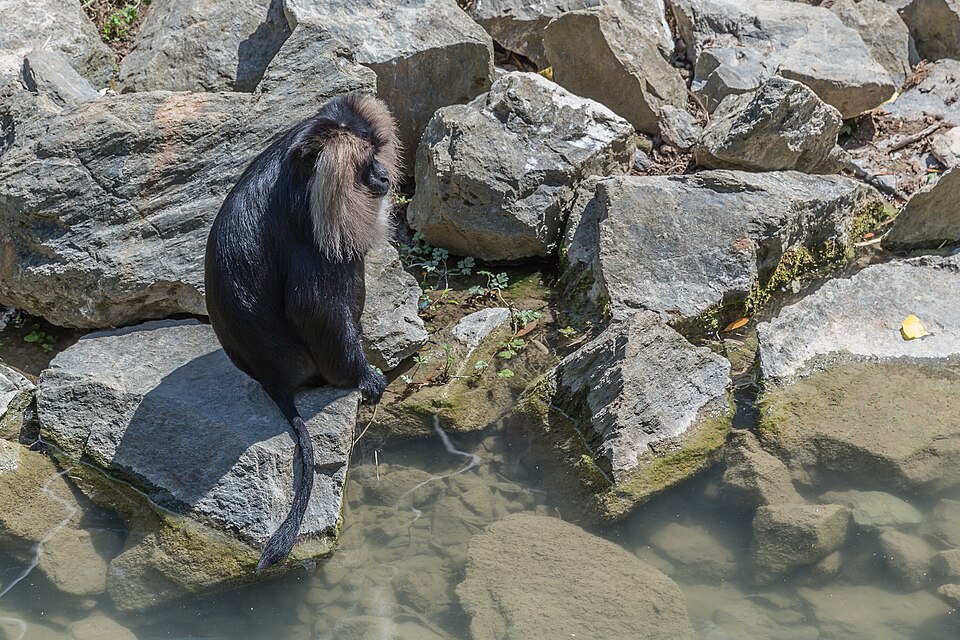
Correct — C, Western Ghats. The Ghats, called the Sahyadri in the north, run about 1,600 km down India's west coast through Gujarat, Maharashtra, Goa, Karnataka, Kerala and Tamil Nadu, rising to Anamudi (2,695 m) in Kerala, the highest point in India south of the Himalaya. They form a wall across the path of the south-west monsoon, wringing very heavy rainfall out of it on the windward side and creating tropical evergreen rainforest that has persisted, in fragments, for tens of millions of years. That combination of high rainfall, steep altitudinal gradients and long isolation has produced endemism found nowhere else in the country: documented counts run to about 7,402 species of flowering plants of which roughly 1,273 are endemic, and — most strikingly — about 121 amphibian species of which some 94 occur only here. Endemic mammals include the lion-tailed macaque, the Nilgiri tahr and the Nilgiri langur. This is why the Western Ghats, together with Sri Lanka, are recognised as one of the world's biodiversity hotspots, meeting Norman Myers's twin test of at least 1,500 endemic vascular plant species and the loss of at least 70 per cent of original primary vegetation; and why, in 2012, 39 serial sites of the Ghats in seven clusters were inscribed on the UNESCO World Heritage List. No other option in this question is a global hotspot at all.
- (a)Gangetic plain — India's most fertile and most densely populated region — and that is exactly the problem. Millennia of intensive cultivation, irrigation and settlement have converted the alluvial plain into an almost wholly human-modified landscape with very little natural forest left and negligible endemism. Agricultural productivity and biological diversity are different things, and this option trades on confusing them.
- (b)Trans Himalayas — The cold desert north of the Great Himalayan range — Ladakh, the Spiti and Lahaul valleys, northern Sikkim. It holds superbly adapted specialist fauna such as the snow leopard, the kiang, the Tibetan antelope and the black-necked crane, but extreme cold, thin air and rainfall of only a few hundred millimetres a year keep total species richness low. Note the deliberate near-miss: the EASTERN Himalaya belongs to the Himalaya biodiversity hotspot, but the Trans-Himalaya does not.
- (d)Central India — The Satpura-Maikal and Deccan belt carries India's great tiger landscapes — Kanha, Pench, Bandhavgarh, Satpura — and extensive teak and sal forest, so it is genuinely rich in large mammals. But its vegetation is tropical dry and moist DECIDUOUS forest, which supports far fewer species and far less endemism than evergreen rainforest, and no part of it qualifies as a global biodiversity hotspot. Charismatic megafauna is not the same as biodiversity.
A biodiversity hotspot, as defined by Norman Myers in 1988 and revised in 2000, is a region that satisfies two conditions simultaneously: it contains at least 1,500 species of endemic vascular plants — more than half a per cent of the world's total — and it has already lost at least 70 per cent of its original primary vegetation. Endemism plus threat, in other words, not raw species count. Thirty-six such zones are recognised worldwide, and they occupy a small fraction of the land surface while holding a disproportionate share of the planet's species. Four of them extend into India: the Himalaya, Indo-Burma, the Western Ghats and Sri Lanka, and the Nicobar Islands as part of Sundaland.
The reasoning is a hotspot check, not a guess about which region 'feels' greener. Of the four options only the Western Ghats appear on the global hotspot list, so the question resolves the moment that list is recalled. Each wrong option is built on a different confusion: the Gangetic plain substitutes fertility for diversity, Central India substitutes famous wildlife reserves for diversity, and the Trans-Himalaya exploits the fact that a NEIGHBOURING Himalayan region is a hotspot while this one is not. Note also what 'richest' rests on — endemism. India has more total mammal species outside the Ghats, but nowhere else does such a large fraction of the local flora and fauna exist only there.
- Hotspot criteria (Norman Myers, 1988; revised 2000): at least 1,500 endemic species of vascular plants AND loss of at least 70 per cent of the original primary vegetation. Thirty-six hotspots are recognised worldwide.
- Four hotspots cover India: the Himalaya, Indo-Burma, the Western Ghats-Sri Lanka, and the Nicobar Islands as part of Sundaland.
- The Western Ghats run about 1,600 km through Gujarat, Maharashtra, Goa, Karnataka, Kerala and Tamil Nadu; the highest peak is Anamudi (2,695 m) in Kerala.
- Amphibian endemism is extraordinary — roughly 94 of about 121 recorded amphibian species occur nowhere else. Endemic mammals include the lion-tailed macaque, the Nilgiri tahr and the Nilgiri langur.
- In 2012, 39 serial sites of the Western Ghats in seven clusters were inscribed on the UNESCO World Heritage List; conservation policy for the range rests on the Gadgil Committee report (Western Ghats Ecology Expert Panel, 2011) and the Kasturirangan Committee report (High-Level Working Group, 2013).
- Confusing the Trans-Himalaya (cold desert, not a hotspot) with the Eastern Himalaya, which is part of the Himalaya hotspot.
- Equating agricultural productivity or population density with biodiversity — the Gangetic plain is India's richest farmland and one of its most altered natural landscapes.
- Assuming hotspots must be tropical, or must top the charts on absolute species numbers. The defining tests are endemism and habitat loss, which is why several hotspots lie in temperate latitudes.
UPSC has attacked this area from every side — the criteria that make a hotspot (2011), which Indian regions qualify (2009, 2010) and the committee reports on protecting the Ghats (2016) — while UPPSC prefers the single-line 'which region is richest'. Learn the two criteria and India's four hotspots and every version is covered.
Which one of the following regions of India is now regarded as an 'ecological hot spot'?
- (a) Western Himalayas
- (b) Eastern Himalayas
- (c) Western Ghats
- (d) Eastern Ghats
Answer(c) Western Ghats
Practically the same question with the same answer, twenty-three years earlier — proof that this is a permanent-value fact rather than a current-affairs item.
Three of the following criteria have contributed to the recognition of Western Ghats-Sri Lanka and Indo-Burma regions as hotspots of biodiversity: 1. Species richness 2. Vegetation density 3. Endemism 4. Ethno-botanical importance 5. Threat perception 6. Adaptation of flora and fauna to warm and humid conditions Which three of the above are correct criteria in this context?
- (a) 1, 2 and 6
- (b) 2, 4 and 6
- (c) 1, 3 and 5
- (d) 3, 4 and 6
Answer(c) 1, 3 and 5
The reasoning behind this answer, asked directly: species richness, endemism and threat are what make the Western Ghats a hotspot, and therefore what makes them India's richest biodiversity region.
Consider the following statements : 1. Biodiversity hotspots are located only in tropical regions. 2. India has four biodiversity hotspots i.e., Eastern Himalayas, Western Himalayas, Western Ghats and Andaman and Nicobar Islands. Which of the statements given above is/are correct ?
- (a) 1 only
- (b) 2 only
- (c) Both 1 and 2
- (d) Neither 1 nor 2
Answer(d) Neither 1 nor 2
The precise naming of India's four hotspots — Himalaya, Indo-Burma, Western Ghats-Sri Lanka and the Nicobar Islands within Sundaland — and the reminder that hotspots are not confined to the tropics.
Which of the following factor is the most important factor for the lost of biodiversity?
- (a) Control of predators
- (b) Destruction of natural habitat
- (c) Pest control
- (d) Genetic assimilation
Answer(b) Destruction of natural habitat
The threat half of the hotspot definition — habitat destruction is both the leading cause of biodiversity loss and the second qualifying criterion that puts the Western Ghats on the hotspot list.
- practice — not a real PYQ
Which one of the following is NOT among the biodiversity hotspots that extend into India?
- (a)Himalaya
- (b)Indo-Burma
- (c)Western Ghats and Sri Lanka
- (d)Eastern Ghats
Answer(d) Eastern Ghats — India is covered by four hotspots: the Himalaya, Indo-Burma, the Western Ghats-Sri Lanka, and the Nicobar Islands as part of Sundaland. The Eastern Ghats, a discontinuous and far drier range, is not one of them.
- practice — not a real PYQ
Anamudi, the highest peak of the Western Ghats and the highest point in India south of the Himalaya, lies in which State?
- (a)Karnataka
- (b)Kerala
- (c)Tamil Nadu
- (d)Maharashtra
Answer(b) Kerala — Anamudi rises to 2,695 m in the Anaimalai Hills of Kerala, at the junction of the Anaimalai, Palani and Cardamom hills.