
Black-hole is
- (a)a flight recorder in aeroplane
- (b)a spot on the sun
- (c)a place in Antarctica
- (d)a collapsed star
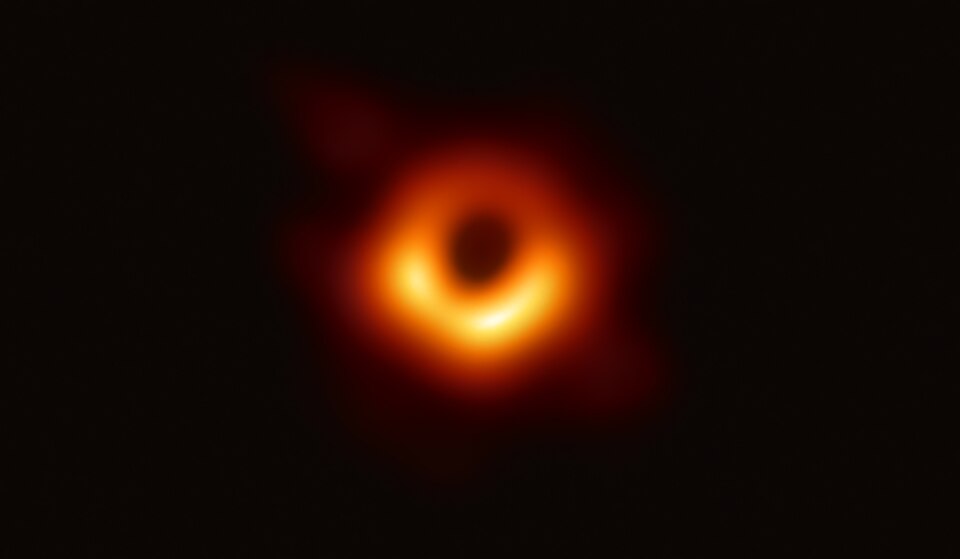
Correct — D, a collapsed star. A star shines because the outward pressure of nuclear fusion in its core balances the inward pull of its own gravity. When the fuel runs out that balance fails and the core collapses. What it collapses into depends on the mass left behind: below about 1.44 times the mass of the Sun — the Chandrasekhar limit — electron degeneracy pressure halts the collapse and a white dwarf survives; above that, the electrons are crushed into the protons and neutron degeneracy pressure holds up a neutron star; and beyond roughly three solar masses no known force can stop the fall at all. The matter contracts past the point where the escape velocity equals the speed of light, and the object becomes a black hole — a region bounded by an event horizon of radius equal to the Schwarzschild radius, from which not even light can escape, which is why it is 'black'. The physicist John Wheeler popularised the name in 1967. The topic was live current affairs when this paper was set: on 10 April 2019, eight months before the exam, the Event Horizon Telescope collaboration released humanity's first image of a black hole — M87*, the supermassive black hole about 6.5 billion times the Sun's mass at the centre of the galaxy Messier 87, some 55 million light-years away.
- (a)a flight recorder in aeroplane — That is the black BOX — actually two devices, the flight data recorder and the cockpit voice recorder — and despite the nickname it is painted bright orange so that searchers can find it in wreckage or water. Pure word-association bait: 'black hole' and 'black box' share one word and nothing else.
- (b)a spot on the sun — That is a sunspot: a region of the solar photosphere where an intense magnetic field suppresses convection, leaving it around 3,800 K against the surrounding 5,800 K, so it merely LOOKS dark by contrast. Sunspots wax and wane on the roughly eleven-year solar cycle and are a surface magnetic phenomenon, not a gravitational collapse.
- (c)a place in Antarctica — No such place exists. The phrase half-remembered here is the 'Black Hole of Calcutta' — the 1756 incident in the fort at Calcutta, in present-day Kolkata — which is Indian history, not Antarctic geography, and nothing to do with astrophysics either.
A black hole is the end state of gravitational collapse. Its defining boundary is the event horizon, the surface at which the escape velocity reaches the speed of light; inside it, every path leads inward, so no matter or radiation can leave. The horizon's radius is the Schwarzschild radius, which depends only on mass. Black holes come in classes — stellar-mass ones, of a few to a few tens of solar masses, formed from collapsing massive stars, and supermassive ones of millions to billions of solar masses, which sit at the centres of galaxies including our own. They are not detected directly but by their gravitational effect on nearby stars and gas, by the X-rays from superheated infalling material, and by the gravitational waves emitted when two of them merge.
The question is a plain definition item, and the three wrong options are all colloquial phrases that share the word 'black'. The reasoning is therefore lexical before it is scientific: separate the black BOX (aviation), the sunSPOT (solar physics) and the Black Hole of CALCUTTA (history) from the astrophysical black hole, and only one option survives. It is also worth knowing why a black hole is not a cosmic vacuum cleaner: at a safe distance its gravity is exactly that of any other body of the same mass, so if the Sun were replaced by a black hole of one solar mass, the Earth's orbit would not change — it would simply go dark.
- A black hole forms when a massive star exhausts its fuel and its core collapses past the point where the escape velocity exceeds the speed of light; the boundary is the event horizon and its radius is the Schwarzschild radius.
- Chandrasekhar limit: a stellar remnant below about 1.44 solar masses ends as a white dwarf; heavier remnants become neutron stars, and the heaviest collapse into black holes. Subrahmanyan Chandrasekhar shared the 1983 Nobel Prize in Physics, and NASA's Chandra X-ray Observatory is named after him.
- The term 'black hole' was popularised by the physicist John Wheeler in 1967.
- On 10 April 2019 the Event Horizon Telescope collaboration released the first image of a black hole — M87*, roughly 6.5 billion solar masses, at the centre of the galaxy Messier 87.
- The first direct detection of gravitational waves, announced in February 2016 by LIGO, came from the merger of two stellar-mass black holes; that work won the 2017 Nobel Prize in Physics.
- Confusing the black hole with the aircraft 'black box', which is not black at all but bright orange.
- Confusing it with the Black Hole of Calcutta (1756) — a historical incident that has appeared in modern-history questions and shares only the phrase.
- Believing that black holes 'suck in' everything around them. At a distance their gravity is identical to that of any body of the same mass; only inside the event horizon does escape become impossible.
UPSC has asked the black hole from the physics side — why radiation cannot escape (2000) and who established the 1.44-solar-mass limit (2009) — while UPPSC keeps the item at the definition level. Learn the collapse sequence with the Chandrasekhar limit attached and both styles are covered.
A ‘black hole’ is a body in space which does not allow any radiation to come out. This property is due to its
- (a) very small size
- (b) very large size
- (c) very high density
- (d) very low density
Answer(c) very high density
The same object, asked for its mechanism rather than its identity — collapse compresses the star's mass into a tiny volume, and it is that extreme density that pushes the escape velocity past the speed of light.
Who of the following scientists proved that the stars with mass less than 1·44 times the mass of the Sun end up as White Dwarfs when they die ?
- (a) Edwin Hubble
- (b) S. Chandrashekhar
- (c) Stephen Hawking
- (d) Steven Weinberg
Answer(b) S. Chandrashekhar
The other end of the same collapse sequence — the Chandrasekhar limit is precisely the threshold that decides whether a dying star stops at a white dwarf or keeps falling towards a black hole.
- practice — not a real PYQ
The upper mass limit of about 1.44 times the mass of the Sun, beyond which a stellar remnant cannot remain a white dwarf, is named after
- (a)Meghnad Saha
- (b)Subrahmanyan Chandrasekhar
- (c)C. V. Raman
- (d)Homi Jehangir Bhabha
Answer(b) Subrahmanyan Chandrasekhar — he derived the limit as a young researcher, later shared the 1983 Nobel Prize in Physics, and NASA's Chandra X-ray Observatory is named in his honour.
- practice — not a real PYQ
The first-ever image of a black hole, released in April 2019, was produced by which one of the following?
- (a)Hubble Space Telescope
- (b)Event Horizon Telescope
- (c)Chandra X-ray Observatory
- (d)AstroSat
Answer(b) Event Horizon Telescope — a global network of radio observatories linked by very-long-baseline interferometry into an Earth-sized virtual telescope, which imaged M87* and published the picture on 10 April 2019.