
Which one of the following nitrogen oxides may dimerize?
- (a)N2O
- (b)NO2
- (c)N2O3
- (d)N2O5
Answer
Why
Correct — B, NO2. Nitrogen dioxide has an odd number of valence electrons, leaving one unpaired electron on the molecule (it is a free radical). Two such molecules pair their unpaired electrons by forming a nitrogen-nitrogen bond, joining into colourless dinitrogen tetroxide, N2O4. This 2 NO2 to N2O4 equilibrium is the classic example of dimerisation among the nitrogen oxides.
Why the others are wrong
- (a)N2O — Dinitrogen oxide (laughing gas) is a stable, even-electron molecule with no unpaired electron, so it has no radical to pair up and does not dimerise.
- (c)N2O3 — Dinitrogen trioxide already contains two nitrogen atoms and has an even electron count; it tends to dissociate into NO and NO2 rather than dimerise into a larger unit.
- (d)N2O5 — Dinitrogen pentoxide is the even-electron anhydride of nitric acid; with no unpaired electron it does not dimerise (as a solid it is actually ionic, NO2+ NO3-).
Concept
Dimerisation is the joining of two identical molecules into one. Molecules with an unpaired electron (odd-electron species or free radicals) are prone to it because pairing the lone electrons forms a new bond and lowers the energy. Among the common nitrogen oxides only NO2 is a stable odd-electron molecule.
Count the valence electrons: NO2 has an odd total, so it is a radical and dimerises to N2O4; the others (N2O, N2O3, N2O5) are even-electron molecules that do not. Watching for the odd-electron molecule is the quickest route to the answer.
Key facts
- NO2 is an odd-electron molecule (a free radical) with one unpaired electron.
- Two NO2 molecules dimerise to colourless N2O4 (2 NO2 to N2O4).
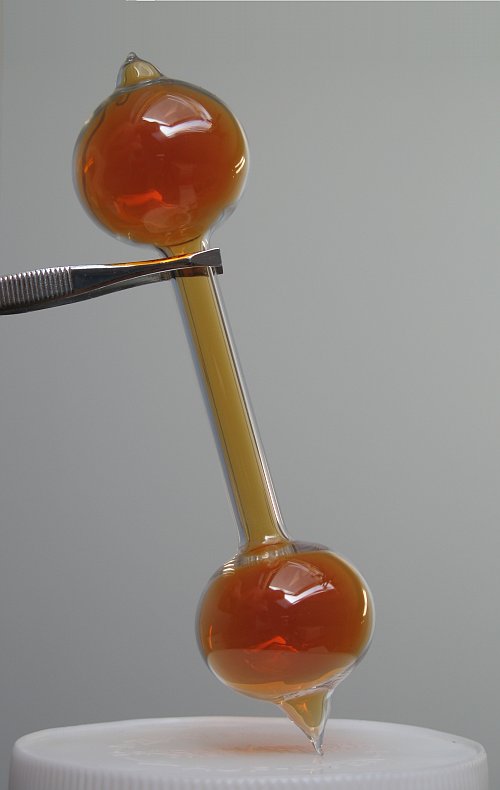
- Cooling favours the N2O4 dimer; heating shifts it back to brown NO2.
- N2O, N2O3 and N2O5 are even-electron molecules and do not dimerise.
Study next
Common traps
- Assuming any nitrogen oxide can dimerise.
- Forgetting NO2 is a radical because of its odd electron count.
- Confusing dimerisation with dissociation (as N2O3 undergoes).
NDA/UPSC ask which nitrogen oxide dimerises or which is an odd-electron molecule — the answer is NO2 joining to N2O4.
Related PYQs
No directly related past PYQ was found.
Practice
- practice — not a real PYQ
The dimer of nitrogen dioxide (NO2) is
- (a)N2O
- (b)N2O3
- (c)N2O4
- (d)N2O5
Answer(c) N2O4 — two NO2 radicals pair up to form dinitrogen tetroxide. - practice — not a real PYQ
Nitrogen dioxide dimerises readily because it is
- (a)an even-electron molecule
- (b)an odd-electron (radical) molecule
- (c)an ionic solid
- (d)a noble gas
Answer(b) an odd-electron (radical) molecule — its unpaired electron pairs with another NO2 to form N2O4.