
The length of a simple pendulum is increased four times to its previous value while the mass is doubled. What is the ratio of the new and previous time period of the pendulum?
- (a)3 : 1
- (b)2 : 5
- (c)2 : 1
- (d)3 : 2
Answer
Why
Correct — C, 2 : 1. The time period of a simple pendulum is T = 2.pi.sqrt(L/g), so T is proportional to sqrt(L) and does not depend on the bob's mass. Increasing the length four times gives T_new/T_old = sqrt(4L/L) = sqrt(4) = 2, i.e. 2 : 1; doubling the mass has no effect.
Why the others are wrong
- (a)3 : 1 — A ratio of 3 : 1 would require the length to increase nine-fold, because T is proportional to sqrt(L), not four-fold.
- (b)2 : 5 — A ratio of 2 : 5 would mean the pendulum swings faster after being lengthened. T is proportional to sqrt(L), so quadrupling the length can only lengthen the period — here to exactly twice its old value, 2 : 1. Doubling the mass does not enter the period at all.
- (d)3 : 2 — Incorrect ratio; sqrt(4) = 2 gives 2 : 1, and the bob's mass is irrelevant.
Concept
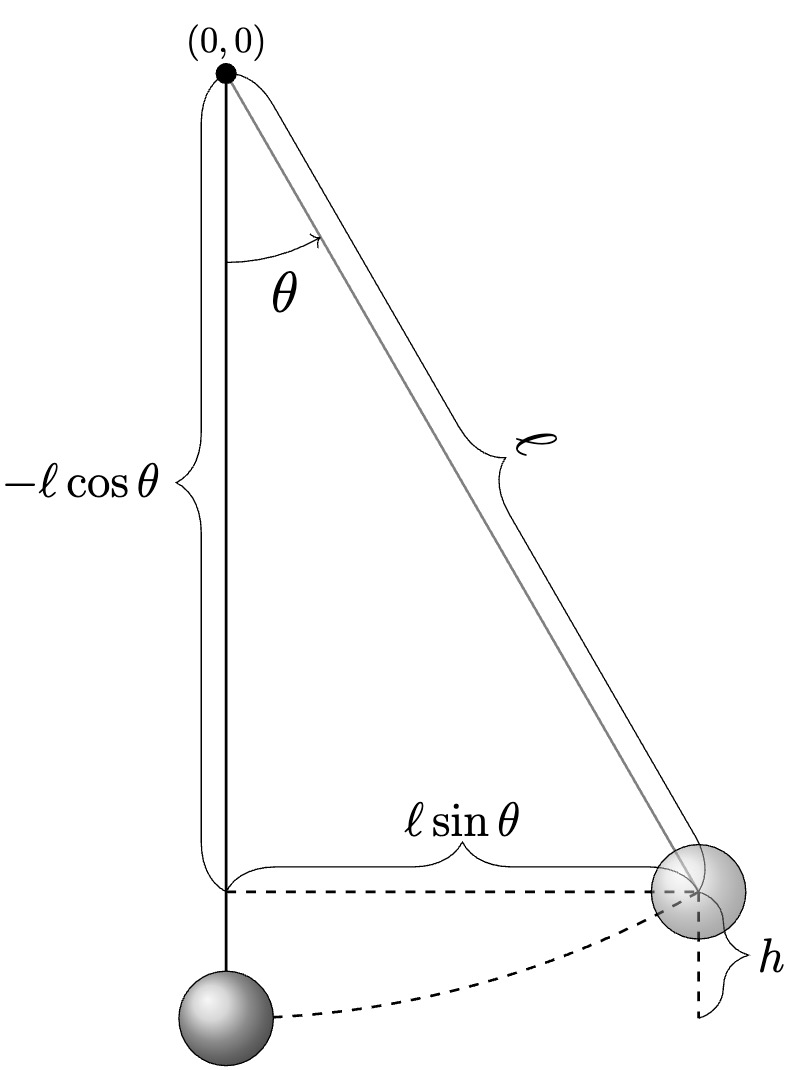
A simple pendulum's time period depends only on its length and the local acceleration due to gravity: T = 2.pi.sqrt(L/g). It is independent of the mass of the bob and, for small swings, of the amplitude. So changing the mass changes nothing, while quadrupling the length doubles the period.
The distractor is the doubled mass — a decoy, because mass drops out of T = 2.pi.sqrt(L/g). Only the length matters: T is proportional to sqrt(L), so L to 4L gives T to 2T, a 2 : 1 ratio.
Key facts
- Time period of a simple pendulum: T = 2.pi.sqrt(L/g).
- T is independent of the bob's mass and, for small angles, of the amplitude.
- Length increased four times gives a period sqrt(4) = 2 times larger — a ratio of 2 : 1.
- T depends on g, so a pendulum runs slower where g is smaller (for example, on the Moon).
Study next
Common traps
- The bob's mass does not affect the period — ignore the 'mass doubled' decoy.
- T is proportional to sqrt(L), so four times the length gives twice the period, not four times.
Asks how the period changes when the length, mass or g changes, using T = 2.pi.sqrt(L/g).
Related PYQs
Consider the following statements: A simple pendulum is set into oscillation. Then I. The acceleration is zero when the bob passes through the mean position. II. In each cycle the bob attains a given velocity twice. III. Both acceleration and velocity of the bob are zero when it reaches its extreme position during its oscillation. IV. The amplitude of oscillation of the simple pendulum decreases with time. Which of these statements are correct?
- (a) I and II
- (b) III and IV
- (c) I, II and IV
- (d) II, III and IV
Answer(c) I, II and IV — at the mean position acceleration is zero, each speed is reached twice per cycle, and a real pendulum's amplitude decays with time.
UPSC prelims tested the motion of a simple pendulum directly — the same oscillation concept behind this time-period problem.
Which one of the following statements regarding simple pendulum is correct? Simple pendulum has a time period independent of amplitude:
- (a) only for small amplitudes because then the net force on its bob is independent of its displacement.
- (b) for any amplitude because the net force on the bob is always proportional to its displacement.
- (c) for any amplitude because the net force on the bob is independent of its displacement.
- (d) only for small amplitudes because then the net force on its bob is proportional to its displacement.
Answer(d) only for small amplitudes because then the net force on its bob is proportional to its displacement.
A previous NDA GAT item on the properties of a simple pendulum (its amplitude-independent time period) — the identical concept.
Practice
- practice — not a real PYQ
The time period of a simple pendulum depends on
- (a)the mass of the bob
- (b)the amplitude for large swings
- (c)its length and the acceleration due to gravity
- (d)the material of the string
Answer(c) its length and the acceleration due to gravity — T = 2.pi.sqrt(L/g). - practice — not a real PYQ
To double the time period of a simple pendulum, its length must be made
- (a)two times
- (b)four times
- (c)three times
- (d)half
Answer(b) four times — since T is proportional to sqrt(L).