
The magnetic field inside a long straight solenoid carrying current
- (a)is zero
- (b)decreases as we move towards its end
- (c)increases as we move towards its end
- (d)is uniform inside the solenoid
Answer
Why
Correct — D, is uniform inside the solenoid. Inside a long, straight, current-carrying solenoid the magnetic field lines run parallel to the axis and are equally spaced, giving a strong, uniform field of magnitude B = mu0.n.I (n = turns per unit length). The solenoid behaves like a bar magnet, with a nearly uniform field throughout its interior.
Why the others are wrong
- (a)is zero — The field inside is strong — that is the very purpose of a solenoid or electromagnet — not zero.
- (b)decreases as we move towards its end — Through the interior the field is uniform; it weakens only right at the extreme ends, so 'decreases as we move towards its end' is not the correct general statement for a long solenoid.
- (c)increases as we move towards its end — The field does not grow towards the ends; it is uniform inside and falls off sharply outside.
Concept
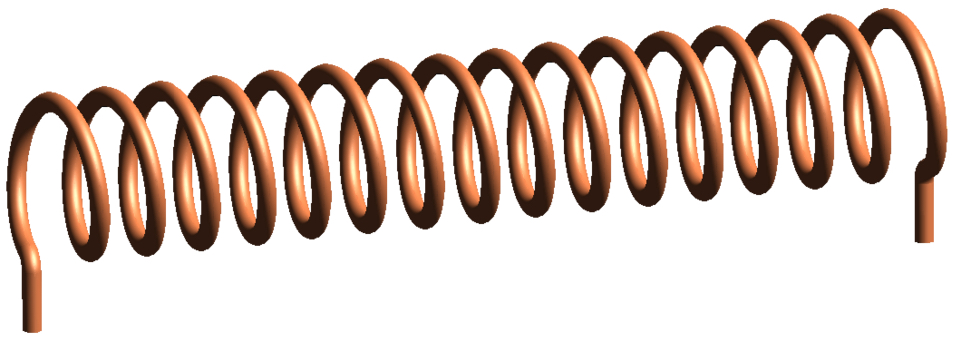
A solenoid is a long coil of insulated wire. When current flows, the field of each turn adds so that inside a long solenoid the contributions combine into a uniform axial field, B = mu0.n.I, independent of position away from the ends. Outside a long solenoid the field is very weak. This makes solenoids the basis of electromagnets and inductors.
The distinguishing idea is uniformity: like the field between the poles of a horseshoe magnet, a long solenoid's interior field is constant in strength and direction. Options about the field being zero or changing along the length misstate this defining property.
Key facts
- Inside a long solenoid the magnetic field is uniform: B = mu0.n.I.
- The field lines are parallel to the axis; the solenoid acts like a bar magnet with a north and a south pole.
- The field outside a long solenoid is negligibly weak.
- Uniform interior fields make solenoids useful as electromagnets and inductors.
Study next
Common traps
- The interior field is uniform — not zero, and not increasing towards the ends.
- Outside a long solenoid the field is nearly zero; do not confuse inside with outside.
Tests the nature (uniform and strong) and direction of the magnetic field inside a solenoid, or its formula B = mu0.n.I.
Related PYQs
The magnetic field inside a current-carrying very long solenoid is
- (a) Uniform
- (b) Non-uniform
- (c) Zero
- (d) Highest at mid-point
Answer(a) Uniform
A previous NDA GAT item asking directly about the magnetic field inside a current-carrying very long solenoid — the identical concept.
Practice
- practice — not a real PYQ
The magnetic field inside a long current-carrying solenoid depends on
- (a)only the current
- (b)the number of turns per unit length and the current
- (c)the length of the wire only
- (d)the diameter of the coil only
Answer(b) the number of turns per unit length and the current — B = mu0.n.I. - practice — not a real PYQ
A current-carrying solenoid behaves like a
- (a)capacitor
- (b)bar magnet
- (c)resistor
- (d)transformer
Answer(b) bar magnet — with a north and a south pole at its ends.