
An object is placed between infinity and the pole (P) of a convex mirror. The position of the image is
- (a)between pole (P) and the focus (F), behind the mirror
- (b)between the focus (F) and infinity, behind the mirror
- (c)between the pole (P) and the infinity, in front of the mirror
- (d)at the focus (F), behind the mirror
Answer
Why
Correct — A, between pole (P) and the focus (F), behind the mirror. A convex mirror is a diverging mirror: for a real object placed anywhere between infinity and the pole, it always forms an image that is virtual, erect and diminished, lying behind the mirror between the pole and the principal focus.
Why the others are wrong
- (b)between the focus (F) and infinity, behind the mirror — The image of a convex mirror never lies beyond the focus; as the object moves from infinity to the pole, the image only shifts within the narrow band from P to F.
- (c)between the pole (P) and the infinity, in front of the mirror — A convex mirror forms a virtual image behind the mirror, not a real image in front of it.
- (d)at the focus (F), behind the mirror — The image sits exactly at the focus only in the limiting case of an object at infinity; for an object between infinity and the pole it lies between P and F, not at F.
Concept
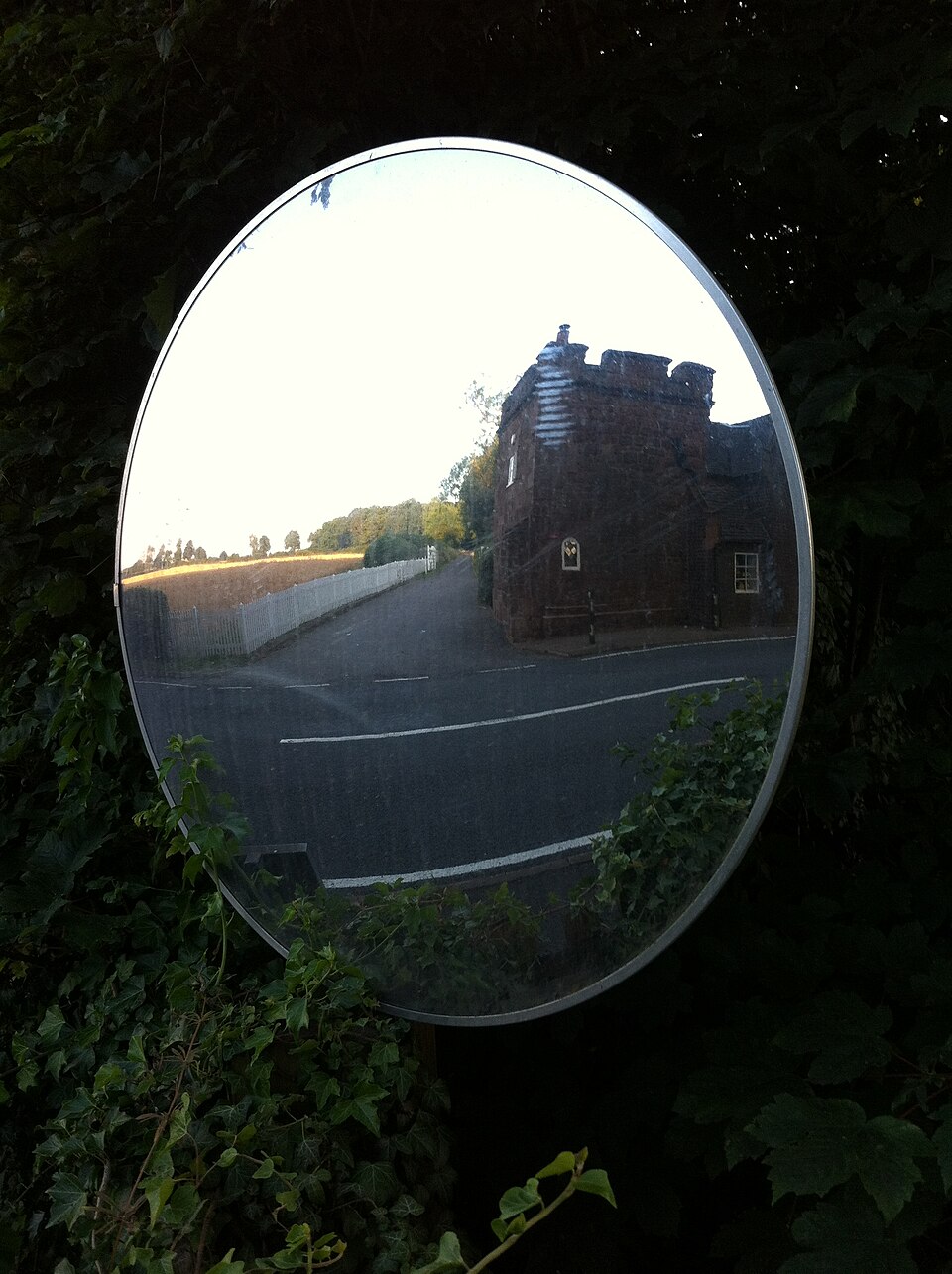
A convex mirror bulges towards the object and reflects parallel rays as though they diverge from a virtual focus behind the mirror. Because of this, every real object produces the same kind of image — virtual, upright and smaller than the object — located between the pole and the focus. This always-reduced, wide field of view is why convex mirrors serve as vehicle rear-view mirrors and road-safety mirrors.
The trap is to apply concave-mirror reasoning, where the image's position and nature change with object distance. For a convex mirror the answer is fixed regardless of object position: the image is between P and F, behind the mirror; only its exact spot within that band shifts as the object moves.
Key facts
- A convex mirror always forms a virtual, erect, diminished image of a real object.
- The image lies behind the mirror, between the pole (P) and the principal focus (F).
- An object at infinity gives a point image at F; an object at the pole gives an image at the pole.
- Convex mirrors give a wider field of view, so they are used as side/rear-view and blind-corner safety mirrors.
Study next
Common traps
- Do not use concave-mirror rules — a convex mirror's image is always virtual, erect and diminished.
- The image is behind the mirror (virtual), never a real image formed in front of it.
Asks for the position or nature of the image formed by a convex or concave mirror for a given object position, testing ray-diagram reasoning.
Related PYQs
A point object is placed at the centre of curvature of a spherical concave mirror. Which one among the following would be the correct location of image formed?
- (a) At infinity
- (b) At the centre of curvature
- (c) At the focal point
- (d) Between the focal point and the centre of curvature
Answer(b) At the centre of curvature
A previous NDA GAT item on spherical-mirror image formation (a point object at the centre of curvature of a concave mirror) — the same ray-optics concept.
Practice
- practice — not a real PYQ
The image formed by a convex mirror of a real object is always
- (a)real and inverted
- (b)virtual and erect
- (c)real and magnified
- (d)virtual and magnified
Answer(b) virtual and erect (and diminished) — true for any position of a real object. - practice — not a real PYQ
Which type of mirror is commonly used as a rear-view (wing) mirror in vehicles?
- (a)Concave mirror
- (b)Plane mirror
- (c)Convex mirror
- (d)Cylindrical mirror
Answer(c) Convex mirror — its wider field of view shows more of the road behind.