
A pumpkin weighs 7.5 N. On submerging it completely in water, ¾ L of water gets displaced. The acceleration due to gravity at the place where the pumpkin was weighed is 10 m/s². Which one of the following is the correct value of the density of the pumpkin?
- (a)10 kg/m³
- (b)100 kg/m³
- (c)1000 kg/m³
- (d)10000 kg/m³
Correct — C, 1000 kg/m³. Weight W = 7.5 N and g = 10 m/s², so mass m = W/g = 7.5/10 = 0.75 kg. Because the pumpkin is FULLY submerged, its volume equals the volume of water displaced = ¾ L = 0.75 L = 0.75 × 10⁻³ m³ = 7.5 × 10⁻⁴ m³. Density = mass ÷ volume = 0.75 ÷ (7.5 × 10⁻⁴) = 1000 kg/m³.
- (a)10 kg/m³ — Off by a factor of 100 — it comes from mishandling the litre-to-cubic-metre conversion (1 L = 10⁻³ m³).
- (b)100 kg/m³ — Off by a factor of 10 — again a unit-conversion slip in the displaced volume.
- (d)10000 kg/m³ — Ten times too large; it would require a volume of 7.5 × 10⁻⁵ m³ (0.075 L), not 0.75 L.
Density = mass ÷ volume. Here the mass comes from the weight via m = W/g, and the volume comes from Archimedes' principle: a fully submerged body displaces a volume of fluid equal to its own volume. The only pitfall is unit conversion — 1 litre = 10⁻³ m³. Numerically the pumpkin's density works out equal to that of water, 1000 kg/m³.
Two sub-steps: get mass from weight (m = W/g), and get volume from the displaced water (full submergence means pumpkin volume = displaced volume). Stay in SI units — convert ¾ L to 7.5 × 10⁻⁴ m³ before dividing. The distractors are all powers-of-ten traps from bungling that conversion.
- Density ρ = mass / volume; SI unit kg/m³.
- Mass from weight: m = W/g = 7.5/10 = 0.75 kg.
- A fully submerged body displaces its own volume of fluid (Archimedes): V = 0.75 L = 7.5 × 10⁻⁴ m³.
- 1 litre = 10⁻³ m³; water's density ≈ 1000 kg/m³.
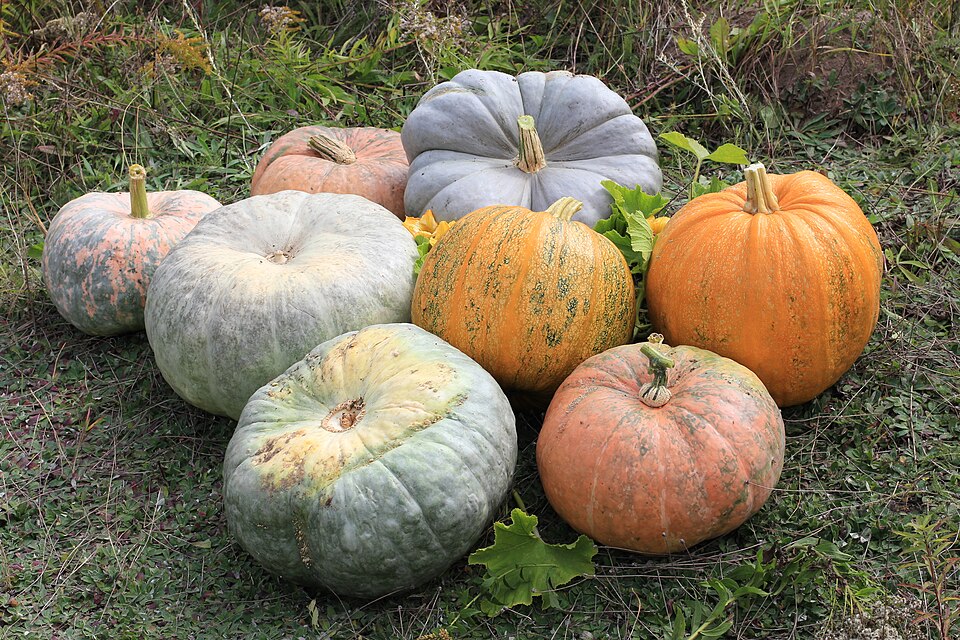
- Litre-to-cubic-metre conversion errors (1 L = 10⁻³ m³) — the source of every wrong option here.
- Using weight (in N) directly as mass instead of dividing by g.
Asked as a numerical: find density/relative density from weight and displaced volume, or predict floating vs sinking.
The clouds float in the atmosphere because of their low
- (a) temperature
- (b) velocity
- (c) pressure
- (d) density
Answer(d) density
Same core concept — density and buoyancy govern floating. Here density is computed from weight and displaced volume; there, low density explains why clouds stay suspended (upward buoyant force balances weight).
- practice — not a real PYQ
An object of mass 2 kg has a volume of 0.002 m³. Its density is
- (a)100 kg/m³
- (b)500 kg/m³
- (c)1000 kg/m³
- (d)4000 kg/m³
Answer(c) 1000 kg/m³ — density = 2 / 0.002.
- practice — not a real PYQ
A body fully submerged in water displaces 500 mL of water. The volume of the body is
- (a)5 × 10⁻⁴ m³
- (b)5 × 10⁻³ m³
- (c)0.5 m³
- (d)500 m³
Answer(a) 5 × 10⁻⁴ m³ — 500 mL = 0.5 L = 5 × 10⁻⁴ m³.