
Organisms of which of the following phylum are called sponges?
- (a)Coelenterata
- (b)Platyhelminthes
- (c)Porifera
- (d)Echinodermata
Correct — C, Porifera. Sponges are the animals of the phylum Porifera (Latin porus = pore + ferre = to bear, i.e. 'pore-bearers'). Their bodies are studded with tiny pores (ostia) through which water is drawn into a system of canals, letting these sessile, aquatic, mostly marine animals filter-feed. They are the simplest multicellular animals, with no true tissues or organs.
- (a)Coelenterata — Coelenterata (Cnidaria) contains hydra, jellyfish, sea anemones and corals — animals with stinging cells and a central body cavity, not sponges.
- (b)Platyhelminthes — Platyhelminthes are the flatworms (e.g. planaria, liver fluke, tapeworm) — bilaterally symmetrical, flat-bodied worms, not sponges.
- (d)Echinodermata — Echinodermata are spiny-skinned marine animals such as starfish, sea urchins and sea cucumbers — not sponges.
Porifera are the most primitive multicellular animals. They are sessile (fixed), aquatic and largely marine, with a porous body wall, a water-canal system driven by flagellated collar cells (choanocytes), and a skeleton of spicules or spongin fibres. They lack true tissues, organs, a nervous system and definite symmetry (mostly asymmetrical).
The question tests the one-line identity of each animal phylum. Only Porifera = sponges. Anchor an example to each of the others (Cnidaria = jellyfish/hydra, Platyhelminthes = flatworms, Echinodermata = starfish) and Porifera is left as the pore-bearing sponges.
- Sponges belong to phylum Porifera — the 'pore-bearing' animals.
- They are the simplest multicellular animals, lacking true tissues and organs.
- Water enters through many pores (ostia) and leaves via a large opening (osculum); feeding is by filtration.
- The body is supported by spicules (calcareous or siliceous) or by spongin fibres.
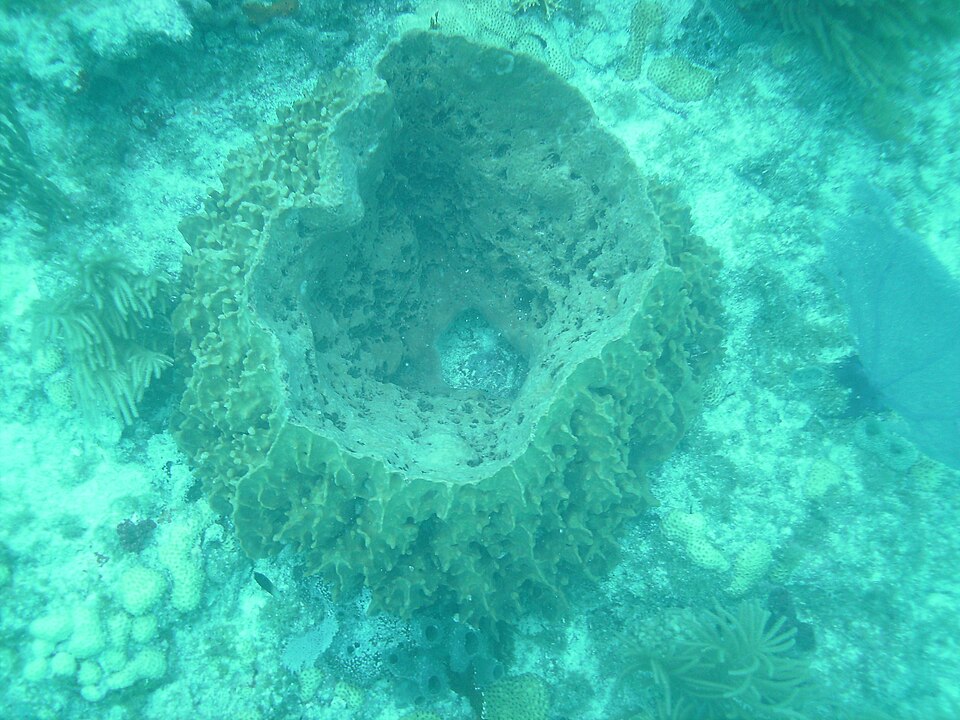
- Mixing up Coelenterata (jellyfish/corals) with Porifera (sponges) — both aquatic, but only cnidarians sting.
- Assuming 'sponge' means the synthetic bath sponge — the phylum refers to the living animal.
Animal phyla are asked as 'which phylum do sponges/jellyfish/starfish belong to' or as match-the-phylum-to-its-example.
No directly related past PYQ was found.
- practice — not a real PYQ
Animals of the phylum Coelenterata (Cnidaria) are exemplified by
- (a)Sponges
- (b)Jellyfish and Hydra
- (c)Flatworms
- (d)Starfish
Answer(b) Jellyfish and Hydra — cnidarians with stinging cells.
- practice — not a real PYQ
Which one of the following is the simplest multicellular animal, lacking true tissues?
- (a)Earthworm
- (b)Sponge (Porifera)
- (c)Starfish
- (d)Hydra
Answer(b) Sponge (Porifera) — the most primitive multicellular animals.