
The lowest part of most bolsons is occupied by a landform called playa. Which category of landform formation does it represent?
- (a)Fluvial landforms
- (b)Arid landforms
- (c)Glacial landforms
- (d)Periglacial landforms
Answer
Why
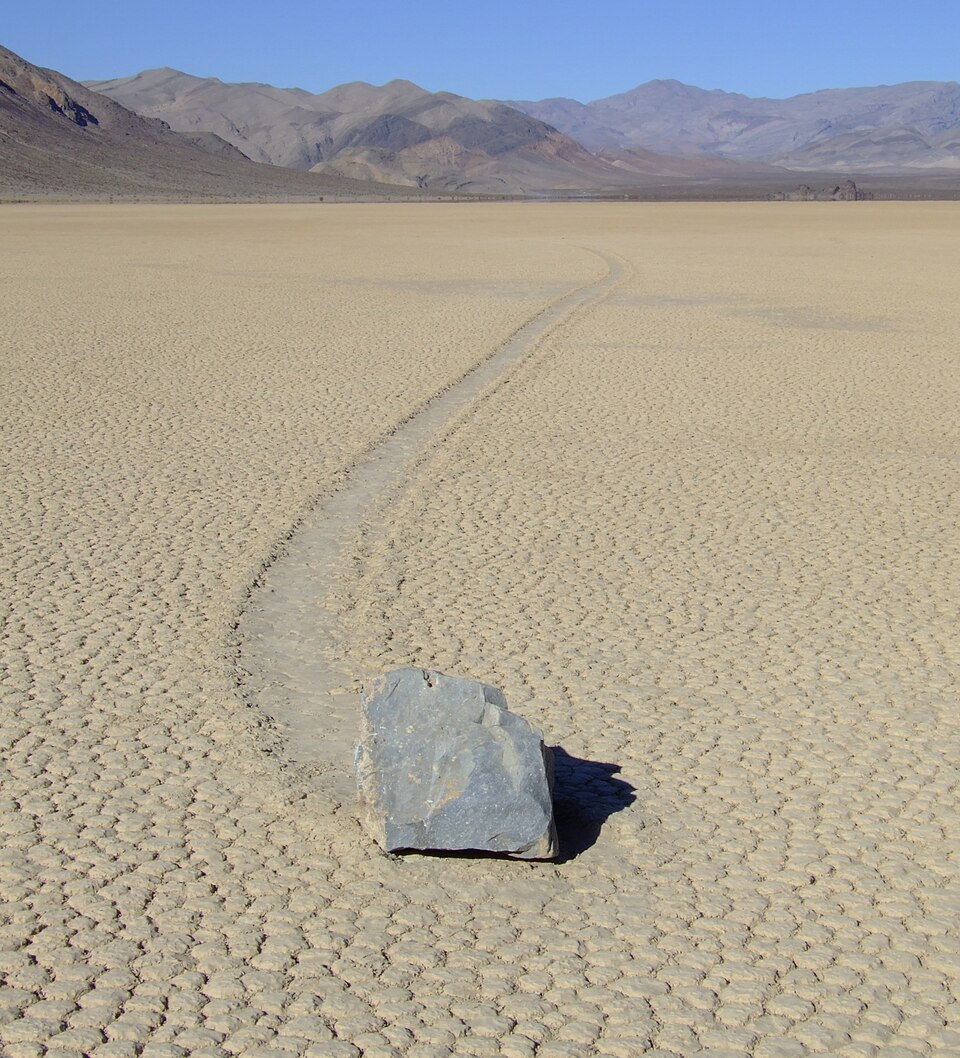
Correct — B, Arid landforms. A bolson is an enclosed desert basin (typical of the Basin-and-Range country of the SW USA and Mexico); its lowest floor holds a playa — a flat, ephemeral salt-encrusted lake bed that fills briefly after rare rains and then dries out by evaporation. Both the bolson and its playa are products of desert (arid) processes, so they belong to the arid class of landforms.
Why the others are wrong
- (a)Fluvial landforms — Fluvial landforms are made by permanently flowing RIVERS (meanders, floodplains, deltas). A playa sits in an internally drained desert basin with only brief, evaporating water — it is not a river landform.
- (c)Glacial landforms — Glacial landforms (moraines, cirques, U-shaped valleys) are carved by moving ICE in cold regions, which is absent in the hot desert setting of a bolson/playa.
- (d)Periglacial landforms — Periglacial landforms form at the fringes of ice sheets by frost action and permafrost — a cold-climate process unrelated to the desert evaporation that creates a playa.
Concept
In arid (desert) regions, mountain-ringed basins with no outlet to the sea are called bolsons. Sediment washed off the surrounding slopes builds alluvial fans and bajadas, and the basin's lowest point becomes a playa — a salt/clay-floored ephemeral lake that mostly stays dry. These are classic arid desert landforms.
Anchor on the setting: a bolson and playa exist in a desert with internal drainage and high evaporation. That immediately rules out the ice-based options (glacial, periglacial). Although sheetwash briefly carries water in, the defining, persistent process is desert evaporation in an enclosed basin — so the landform is classed as arid, not fluvial.
Key facts
- Bolson — an enclosed, internally drained desert basin surrounded by mountains (common in the SW USA/Mexico Basin-and-Range).
- Playa — the flat, ephemeral salt/clay lake bed on a bolson floor; wet briefly after rain, otherwise a dry, cracked salt flat.
- Associated arid landforms: alluvial fans, bajadas, inselbergs, pediments and yardangs.
- Indian examples of playa-type saline lakes: Sambhar, Didwana and Kuchaman in arid Rajasthan.
Study next
Common traps
- Calling a playa 'fluvial' because water occasionally flows in — the persistent, defining process is desert evaporation, so it is arid.
- Confusing a playa (desert salt flat) with an ox-bow lake or a glacial tarn.
Asked by naming a desert feature (playa, bajada, yardang, inselberg) and asking its landform category, or by matching Indian saline lakes to arid Rajasthan.
Related PYQs
With reference to India, Didwana, Kuchaman, Sargol and Khatu are the names of
- (a) glaciers
- (b) mangrove areas
- (c) Ramsar sites
- (d) saline lakes
Answer(d) saline lakes
These are inland playa-type saline lakes of arid Rajasthan — the same arid-basin/playa landform concept the NDA question tests.
Practice
- practice — not a real PYQ
A 'bajada' is a landform associated with which type of environment?
- (a)Glacial
- (b)Coastal
- (c)Arid/desert
- (d)Karst
Answer(c) Arid/desert — a bajada is a coalesced apron of alluvial fans at the foot of desert mountains. - practice — not a real PYQ
Didwana and Sambhar in Rajasthan are examples of:
- (a)Freshwater tarns
- (b)Playa-type saline lakes
- (c)Ox-bow lakes
- (d)Crater lakes
Answer(b) Playa-type saline lakes — ephemeral salt lakes of the arid Rajasthan basin.