
Lightning is due to
- (a)The flow of charges between different parts of the cloud
- (b)The short-circuiting of charges between the upper and lower surfaces of the cloud
- (c)The collection of positively charged particles on the base and collection of negatively charged particles at the top of the cloud
- (d)The induction of positive charge on the ground below the negative charge at the base of the cloud
Answer
Why
Correct — D, the induction of positive charge on the ground below the negative charge at the base of the cloud. In a thundercloud, charge separation leaves the base strongly negative. This negative base induces an opposite (positive) charge on the ground directly beneath it. As the potential difference grows, the air between finally breaks down and a discharge — lightning — leaps between cloud base and ground. Option (d) captures this induction-then-discharge mechanism.
Why the others are wrong
- (a)The flow of charges between different parts of the cloud — This actually describes intra-cloud lightning, which is real and even the commonest form; but the question is framed around the cloud-to-ground process, whose specific cause is the ground-induction described in (d). Treat (a) as a partial/less-complete description rather than the intended answer.
- (b)The short-circuiting of charges between the upper and lower surfaces of the cloud — Lightning is a dielectric breakdown/discharge through ionised air, not a 'short circuit'; and this option again confines the event to within the cloud rather than the cloud-to-ground induction the question targets.
- (c)The collection of positively charged particles on the base and collection of negatively charged particles at the top of the cloud — This has the polarity REVERSED. In a typical cumulonimbus cloud the TOP is positively charged and the BASE is negatively charged — the opposite of what this option states — so it is factually wrong.
Concept
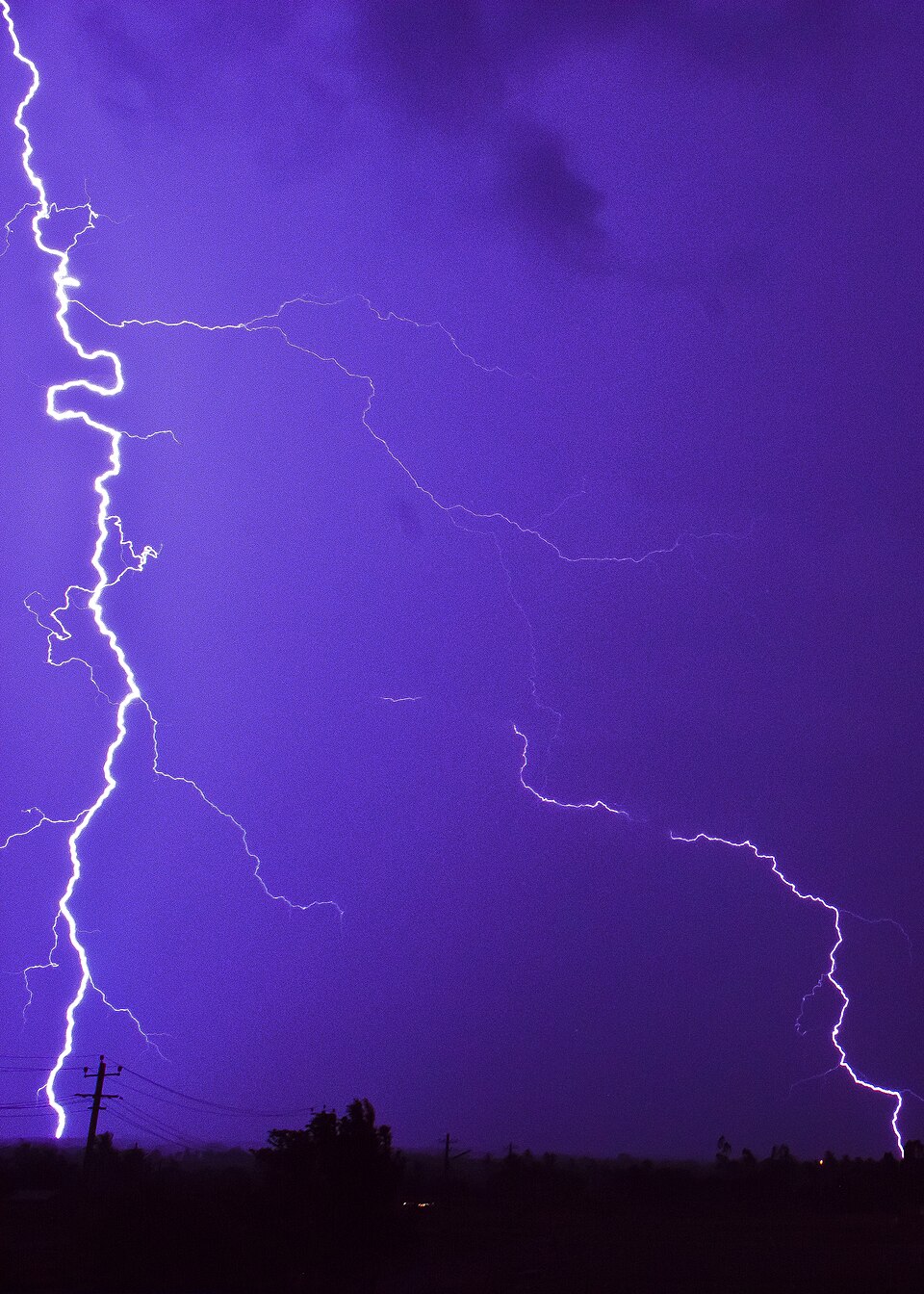
Lightning is a large electrostatic discharge. Inside a cumulonimbus cloud, colliding ice crystals and water droplets separate charge so that the cloud top becomes positive and the base negative. The negative base induces positive charge on the ground below. When the electric field is strong enough to ionise the intervening air, a rapid discharge (lightning) neutralises the charge, heating the air explosively (which we hear as thunder).
Reason from charge separation to discharge. First eliminate option (c) on a factual check — the cloud base is negative, not positive. Then recognise that although charges also move within the cloud (option a, intra-cloud lightning), the question is asking for the cloud-to-ground cause, which is the induction of opposite charge on the ground in (d). This is a case where more than one option touches something true, so pick the most complete, correctly-directed description.
Key facts
- In a typical thundercloud the top is positively charged and the base is negatively charged.
- The negative cloud base induces a positive charge on the ground below it (electrostatic induction).
- Lightning is the discharge that occurs when the air between breaks down and ionises.
- Thunder is the sound of air super-heated and explosively expanded by the lightning discharge.
Study next
Common traps
- Reversing the cloud polarity — the base is negative, the top positive.
- Calling lightning a 'short circuit'; it is a discharge through ionised air.
- Picking the intra-cloud description when the item asks for the cloud-to-ground cause.
NDA asks for the cause of lightning or the working of a lightning conductor — anchor to charge separation in the cloud, induction on the ground, and discharge through ionised air.
Related PYQs
No directly related past PYQ was found.
Practice
- practice — not a real PYQ
A lightning conductor fixed on a tall building protects it by
- (a)attracting all clouds away from the building
- (b)providing a low-resistance path to safely carry the discharge to the ground
- (c)increasing the building's charge
- (d)reflecting the lightning back to the cloud
Answer(b) providing a low-resistance path to safely carry the discharge to the ground, sparing the structure. - practice — not a real PYQ
During a thunderstorm we see the lightning flash before we hear the thunder because
- (a)light is produced first and sound later
- (b)light travels much faster than sound
- (c)thunder is weaker than lightning
- (d)our eyes react faster than our ears
Answer(b) light travels much faster than sound, so the flash reaches us before the thunderclap from the same discharge.