
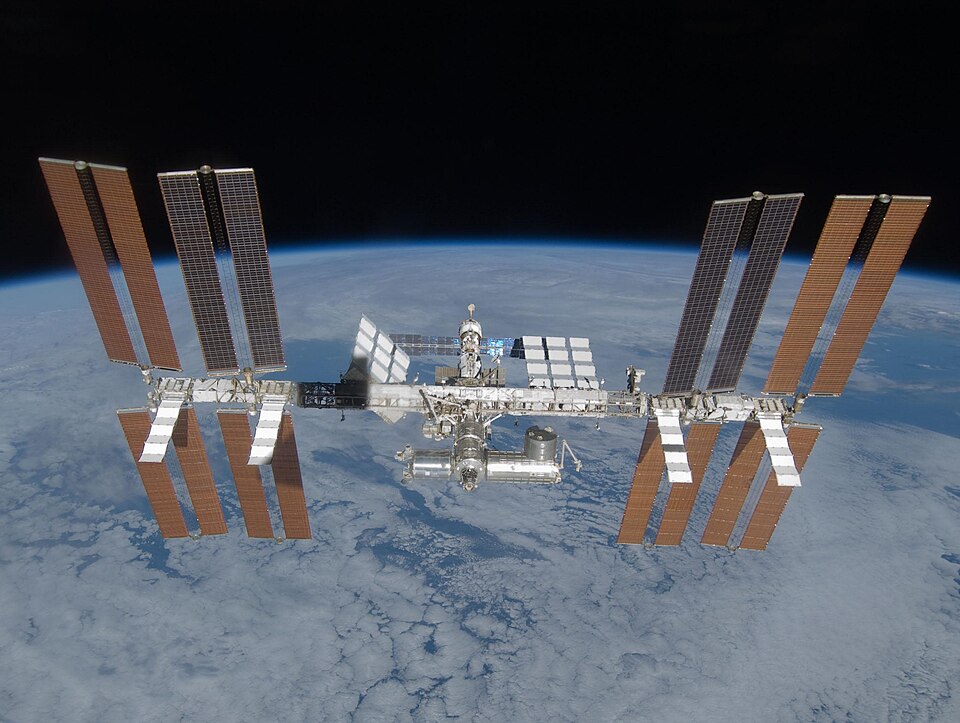
An astronaut whose weight on the Earth is 600 N experiences weightlessness on International Space Station orbiting around the Earth. It means that
- (a)acceleration of the astronaut is zero
- (b)normal reaction of the space-station floor on the astronaut is zero
- (c)gravitational pull of Earth on the astronaut is zero
- (d)space station applies a centrifugal force on the astronaut
Correct — B, the normal reaction of the space-station floor on the astronaut is zero. What we sense as 'weight' is really the support (normal) force a surface pushes back with. In orbit the station and the astronaut are in continuous free fall around the Earth — both accelerate toward the Earth at exactly the same rate — so the floor never has to push on the astronaut. With the normal reaction reduced to zero, the astronaut feels weightless even though gravity is still acting.
- (a)acceleration of the astronaut is zero — The astronaut's acceleration is NOT zero — it is the centripetal acceleration (about 8.7 m/s^2 at the ~400 km ISS altitude) directed toward the Earth's centre, which is precisely what keeps the station in orbit. Weightlessness is a free-fall state, not a zero-acceleration state.
- (c)gravitational pull of Earth on the astronaut is zero — Gravity is very much present at the ISS altitude — roughly 89 percent of its surface value. That gravitational pull IS the centripetal force holding the station in orbit; if it were zero the station would fly off in a straight line. Weightlessness is apparent, not an absence of gravity.
- (d)space station applies a centrifugal force on the astronaut — Centrifugal force is a pseudo-force that appears only when you analyse motion in a rotating (non-inertial) frame; the station does not physically 'apply' any such force. The correct, real-force explanation is simply that the contact/normal force is zero during free fall.
Apparent weight equals the normal (support) force a surface exerts on a body, not the gravitational force itself. When a body is in free fall — like an orbiting spacecraft and everything inside it — there is no supporting surface pushing back, so the apparent weight (normal reaction) is zero. This is 'weightlessness'; true gravity is still present.
An orbit is a state of perpetual free fall: the station is falling toward the Earth, but its huge sideways (tangential) speed means it keeps missing the Earth and curves around it instead. Because the astronaut falls with the station at the same rate, the floor and the astronaut have no tendency to press on each other, so the normal reaction vanishes. Test yourself by asking 'what would a weighing scale under the astronaut read?' — zero, because the scale (the floor) feels no push.
- Apparent weight = normal reaction force; in free fall this is zero.
- The astronaut's real weight at ISS altitude is still about 89 percent of its ground value (gravity is not switched off).
- The ISS orbits at roughly 400 km altitude with a centripetal acceleration of about 8.7 m/s^2 toward Earth.
- Gravity supplies the centripetal force that keeps a satellite in orbit; remove it and the orbit ends.
- Equating 'weightlessness' with 'no gravity' (gravity is nearly full-strength at ISS altitude).
- Thinking zero apparent weight means zero acceleration — the acceleration is centripetal, not zero.
- Invoking a real 'centrifugal force from the station' instead of the zero-normal-reaction explanation.
NDA/UPSC ask why an orbiting astronaut is weightless or why a satellite does not fall down — the answer always turns on free fall and gravity supplying the centripetal force.
An artificial satellite orbiting around the Earth does not fall down. This is so because the attraction of Earth
- (a) does not exist at such distance
- (b) is neutralized by the attraction of the moon
- (c) provides the necessary speed for its steady motion
- (d) provides the necessary acceleration for its motion
Answer(d) provides the necessary acceleration for its motion
Same orbital-mechanics idea: a satellite (or astronaut) does not fall down because Earth's gravity supplies the centripetal acceleration — the free-fall condition that also makes an orbiting astronaut weightless.
- practice — not a real PYQ
A person stands on a weighing scale inside a lift. The scale reads zero when the lift is
- (a)moving up at constant speed
- (b)at rest
- (c)in free fall (cable snapped)
- (d)moving down at constant speed
Answer(c) in free fall — the scale (normal reaction) reads zero when the lift accelerates downward at g, exactly like orbital weightlessness.
- practice — not a real PYQ
A satellite revolving around the Earth in a circular orbit is kept in orbit by
- (a)the vacuum of space
- (b)the Earth's gravitational force acting as centripetal force
- (c)a centrifugal force from the Earth
- (d)the pull of the Moon
Answer(b) the Earth's gravitational force acting as centripetal force — it continuously bends the satellite's path into a circle.