
Domingo Paes describes a king in these words : "Of medium height, and of fair complexion and good figure, rather fat than thin; he has on his face signs of smallpox". Identify the king from the options given below.
- (a)Krishnadeva Raya
- (b)Ram Raya
- (c)Devaraya II
- (d)Devaraya I
Answer
Why
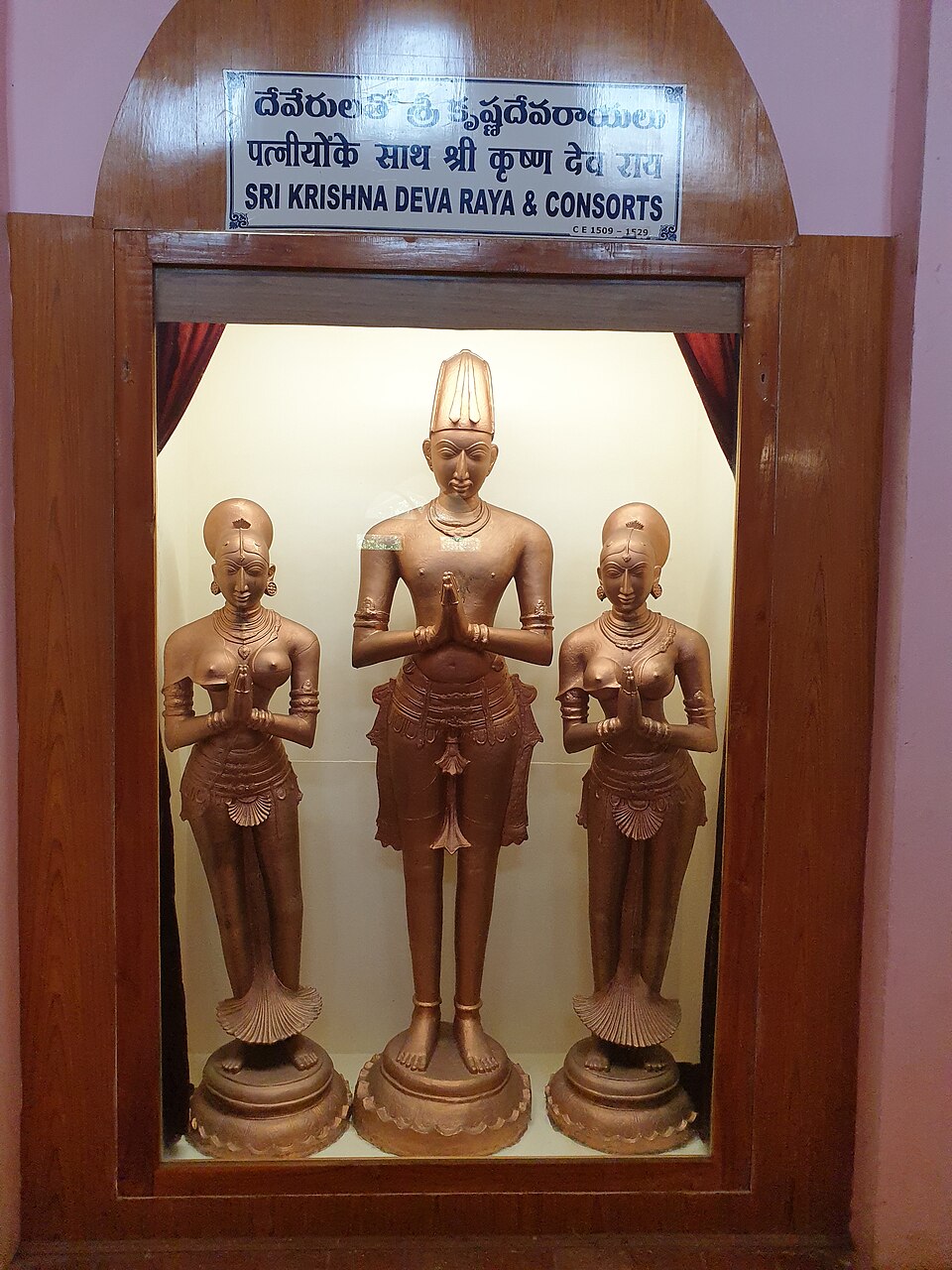
Correct — A, Krishnadeva Raya. Domingo Paes, a Portuguese traveller who visited Vijayanagara around 1520 during the reign of Krishnadeva Raya, left this eyewitness portrait of the king — of medium height, fair, well-built and rather stout, with pockmarks of smallpox on his face. This description is a famous passage attached to Krishnadeva Raya, the greatest of the Tuluva rulers.
Why the others are wrong
- (b)Ram Raya — Aliya Rama Raya was the de facto Aravidu-era ruler defeated and killed at the Battle of Talikota (1565), decades after Paes's visit; Paes wrote during Krishnadeva Raya's reign.
- (c)Devaraya II — Deva Raya II was a 15th-century Sangama-dynasty king (reigned about 1424-1446), long before the Portuguese Domingo Paes arrived in the early 16th century.
- (d)Devaraya I — Deva Raya I (reigned about 1406-1422) was an even earlier Sangama ruler, unconnected to Paes's early-16th-century account.
Concept
Domingo Paes was a Portuguese traveller who visited the Vijayanagara capital at Hampi around 1520-22, during the reign of Krishnadeva Raya. His vivid account of the city and its ruler survives through Robert Sewell's compilation 'A Forgotten Empire (Vijayanagar)' and is a key foreign source for the empire's golden age.
Two clues fix the king as Krishnadeva Raya: the eyewitness is Portuguese (so the visit is early 16th century, after the Portuguese reached India in 1498), and the empire is at its height. The two 'Devaraya' options belong to the earlier Sangama dynasty, and Rama Raya belongs to the later Aravidu period, so both are out of the Portuguese window.
Key facts
- Domingo Paes was a Portuguese traveller who visited Vijayanagara around 1520-22, during Krishnadeva Raya's reign.
- Krishnadeva Raya (reigned 1509-1529) was the greatest ruler of the Tuluva dynasty of Vijayanagara.
- Paes's account survives through Robert Sewell's 'A Forgotten Empire (Vijayanagar)'.
- Krishnadeva Raya wrote the Telugu classic 'Amuktamalyada' and patronised the 'ashtadiggajas' (eight poets).
Study next
Common traps
- Confusing a 'Devaraya' (Sangama dynasty) with Krishnadeva Raya (Tuluva dynasty).
- Placing Rama Raya (Aravidu, defeated at Talikota 1565) in the early-16th-century Portuguese window.
Match a foreign traveller's account or description to the Vijayanagara ruler, or identify the king described.
Related PYQs
Consider the following events: I. Reign of Krishna Deva Raya of Vijayanagara. II. Construction of Qutab Minar. III. Arrival of Portuguese in India. IV. Death of Firoz Tughlaq. Which one of the following is the correct chronological sequence of the above events?
- (a) II, IV, III, I
- (b) II, IV, I, III
- (c) IV, II, I, III
- (d) IV, II, III, I
Answer(a) II, IV, III, I
Same figure — UPSC placed the reign of Krishnadeva Raya (1509-1529) in chronology, coming after the arrival of the Portuguese in India. That order is exactly why a Portuguese traveller like Domingo Paes could describe Krishnadeva Raya, the king named in this NDA question.
Practice
- practice — not a real PYQ
Which Portuguese traveller visited Vijayanagara during the reign of Krishnadeva Raya and left a detailed account of the city?
- (a)Nicolo Conti
- (b)Domingo Paes
- (c)Ibn Battuta
- (d)Megasthenes
Answer(b) Domingo Paes — the Portuguese traveller of about 1520 who described Krishnadeva Raya and his capital. - practice — not a real PYQ
The Telugu literary work 'Amuktamalyada' was composed by which Vijayanagara ruler?
- (a)Deva Raya II
- (b)Krishnadeva Raya
- (c)Bukka I
- (d)Rama Raya
Answer(b) Krishnadeva Raya — the Tuluva king and author of the Amuktamalyada.