
Which one among the following statements with reference to the black cotton soils of India is NOT correct?
- (a)The black cotton soils are also called 'Regur'
- (b)They are highly moisture retentive
- (c)They are rich in lime
- (d)These soils have less clay factor and hence can support a wide variety of crops and vegetables
Answer
Why
Correct — D. Black cotton soil (regur) is defined by a HIGH clay content — it is a deep, montmorillonite-rich clayey soil — so the statement that it has a 'less clay factor' is false, which makes (d) the one that is NOT correct. The other three are all true: it is indeed called 'regur' (a), it is highly moisture-retentive — swelling and becoming sticky when wet, and cracking deeply on drying (b) — and it is rich in lime, along with iron, magnesia and alumina (c).
Why the others are wrong
- (a)The black cotton soils are also called 'Regur' — This is a TRUE statement — 'regur' is the standard Indian name for black cotton soil — so it is not the NOT-correct answer.
- (b)They are highly moisture retentive — True — the fine clay makes regur highly moisture-retentive (it swells when wet and cracks when dry) — so this is not the exception.
- (c)They are rich in lime — True — regur is rich in lime, iron, magnesia and alumina (though poor in nitrogen, phosphorus and humus) — so this is a correct statement, not the answer.
Concept
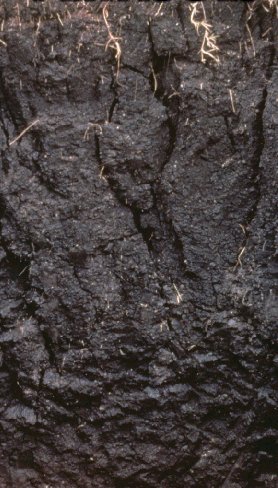
Regur, or black cotton soil, forms in situ from the weathering of the Deccan Trap basalt (fissure/plateau lava). It is dark and clayey, rich in lime, iron, magnesia, calcium and alumina but poor in nitrogen, phosphorus and organic matter. Its fine clay makes it highly moisture-retentive and 'self-ploughing' — it swells when wet and develops deep cracks on drying — and it is the ideal soil for cotton.
The trap in (d) chains a false premise to a true-sounding conclusion: it says the soil has 'less clay' and therefore supports many crops. In reality regur is clay-RICH; its water-holding capacity (a consequence of that clay) is what makes it valuable. Spotting that black cotton soil is high in clay immediately flags (d) as the incorrect statement.
Key facts
- Regur = black cotton soil; formed from the weathering of Deccan Trap basalt (fissure volcanic rock).
- Clay-rich and highly moisture-retentive; swells when wet and cracks deeply when dry ('self-ploughing').
- Rich in lime, iron, magnesia, calcium and alumina; poor in nitrogen, phosphorus and humus.
- Best suited to cotton; found chiefly in Maharashtra, Madhya Pradesh, Gujarat and the Deccan.
- Its dark colour and fertility for cotton give it the name 'black cotton soil'.
Study next
Common traps
- Assuming black soil is low in clay because it 'supports many crops' — it is clay-rich.
- Confusing regur's mineral richness (lime, iron) with overall fertility — it is poor in nitrogen, phosphorus and humus.
Odd-one-out / NOT-correct statement on the properties of black cotton (regur) soil.
Related PYQs
The black cotton soil of India has been formed due to the weathering of
- (a) brown forest soil
- (b) fissure volcanic rock
- (c) granite and achist
- (d) shale and limestone
Answer(b) fissure volcanic rock
Same soil — UPSC tested the ORIGIN of black cotton (regur) soil (weathering of the Deccan-Trap fissure volcanic rock), the concept underlying this properties item.
Practice
- practice — not a real PYQ
Black cotton (regur) soil is formed mainly from the weathering of
- (a)Granite and gneiss
- (b)Basaltic lava of the Deccan Trap
- (c)Shale and limestone
- (d)Sandstone
Answer(b) Basaltic lava of the Deccan Trap. - practice — not a real PYQ
Black cotton soil is best suited for the cultivation of which crop?
- (a)Rice
- (b)Cotton
- (c)Tea
- (d)Coffee
Answer(b) Cotton — hence the name 'black cotton soil'.