
Human body works in the pH range of:
- (a)6.8 – 7.2
- (b)7.0 – 7.8
- (c)6.5 – 7.5
- (d)7.5 – 8.0
Answer
Why
Correct — B, 7.0 – 7.8. The internal environment of the human body is kept slightly alkaline: arterial blood is held very tightly at a pH of about 7.35 to 7.45, and buffer systems resist any drift away from this. Reading the options against that physiological value, the band 7.0 to 7.8 is the one that comfortably encloses the true blood pH while staying on the slightly-alkaline side of neutral, so it is the intended answer. It is worth noting the stem is loosely worded — the body does not 'work over' the whole 7.0 to 7.8 span; that band is simply the option that brackets the real, much narrower, blood pH.
Why the others are wrong
- (a)6.8 – 7.2 — This band is centred on neutral and dips well below the true blood pH. Blood at 6.8-7.2 would be dangerously acidic (acidosis), so this range does not represent the healthy body.
- (c)6.5 – 7.5 — This stretches too far into the acidic region; a body pH near 6.5 is incompatible with life, so the lower half of this range never applies to the healthy human body.
- (d)7.5 – 8.0 — This lies entirely above the true blood pH of ~7.35-7.45. Blood held at 7.5-8.0 would be in severe alkalosis, so this range is too alkaline for the normal body.
Concept
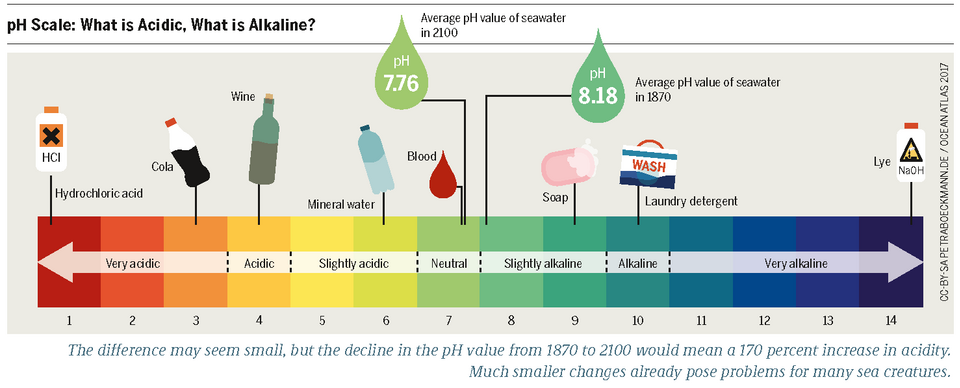
pH measures how acidic or alkaline a solution is on a scale from 0 to 14, where 7 is neutral, lower values are acidic and higher values are alkaline. The human body keeps the pH of its blood and internal fluids within a very narrow, slightly alkaline window, because enzymes and cells function properly only near that value.
The tempting error is to pick a band centred exactly on neutral (7.0). But the body is not neutral — it is slightly alkaline, at about 7.4. So the right answer must sit on the high side of 7 and still contain 7.35-7.45. Only the 7.0 to 7.8 option does this cleanly. The question is best read as asking which range brackets the body's operating pH rather than as a claim that the body varies across that whole span.
Key facts
- pH runs from 0 to 14; 7 is neutral, below 7 is acidic and above 7 is alkaline.
- Human arterial blood is maintained at a pH of about 7.35 to 7.45, slightly alkaline.
- Buffer systems (mainly the bicarbonate buffer), along with the lungs and kidneys, keep blood pH within this narrow range.
- A blood pH below about 7.35 is acidosis and above about 7.45 is alkalosis, both of which are harmful.
Study next
Common traps
- Assuming the body is neutral (pH 7) rather than slightly alkaline (about 7.4).
- Reading the option as the full range the body varies over, when the body actually holds a much narrower window.
Asked as a direct question on the pH of human blood or the range in which the body operates.
Related PYQs
No directly related past PYQ was found.
Practice
- practice — not a real PYQ
The normal pH of human blood is approximately:
- (a)6.4
- (b)7.0
- (c)7.4
- (d)8.4
Answer(c) 7.4 — human arterial blood is held at about 7.35 to 7.45, slightly alkaline. - practice — not a real PYQ
On the pH scale, a value greater than 7 indicates a solution that is:
- (a)Acidic
- (b)Neutral
- (c)Alkaline (basic)
- (d)Saturated
Answer(c) Alkaline (basic) — values above 7 are basic, below 7 are acidic, and 7 is neutral.