
Consider the following events: 1. Launch of Non-Cooperation Movement 2. All-India Khilafat Conference in Delhi 3. Passing of the Rowlatt Act 4. Jallianwala Bagh incident Which one of the following is the correct chronological order of the given events (earliest to latest)?
- (a)1, 2, 3, 4
- (b)3, 4, 2, 1
- (c)3, 2, 4, 1
- (d)2, 3, 4, 1
Answer
Why
Correct — B, the order 3, 4, 2, 1. The Rowlatt Act was passed on 18 March 1919 (event 3), and it was the protest against it that led to the Jallianwala Bagh massacre on 13 April 1919 (event 4). The All-India Khilafat Conference met at Delhi in November 1919 (event 2), and the Non-Cooperation Movement was launched in 1920 (event 1) after both the Punjab wrongs and the Khilafat grievance had come together. So the earliest-to-latest sequence is Rowlatt Act, Jallianwala Bagh, Khilafat Conference, Non-Cooperation Movement, which is 3, 4, 2, 1.
Why the others are wrong
- (a)1, 2, 3, 4 — This puts the Non-Cooperation Movement first and the Rowlatt Act third, which reverses the real order. Non-Cooperation (1920) was the last of the four, not the first, and the Rowlatt Act (1919) came before it, not after.
- (c)3, 2, 4, 1 — This correctly starts with the Rowlatt Act but places the Khilafat Conference (November 1919) before the Jallianwala Bagh massacre (April 1919). The massacre came several months earlier, so 4 must precede 2.
- (d)2, 3, 4, 1 — This starts with the Khilafat Conference, but that conference (November 1919) actually came after both the Rowlatt Act (March 1919) and Jallianwala Bagh (April 1919). The sequence must open with the Rowlatt Act.
Concept
This cluster of events marks the transition from the moderate, constitutional phase of the freedom struggle to the first countrywide mass movement. Repressive British legislation (the Rowlatt Act) triggered protest; the Jallianwala Bagh massacre deepened public anger; the Khilafat cause drew Muslims into the national movement; and Gandhi welded these grievances into the Non-Cooperation Movement.
The key to ordering these is to anchor on 1919: the Rowlatt Act (March) and the Jallianwala Bagh massacre (April) both fall early in that year, in that order, because the massacre grew out of the anti-Rowlatt agitation. The Delhi Khilafat Conference came later in 1919, and Non-Cooperation only in 1920. Students slip when they assume the Khilafat Conference or Non-Cooperation came first because those campaigns feel like the 'cause', when in fact they were the response.
Key facts
- The Rowlatt Act (the Anarchical and Revolutionary Crimes Act) was passed on 18 March 1919.
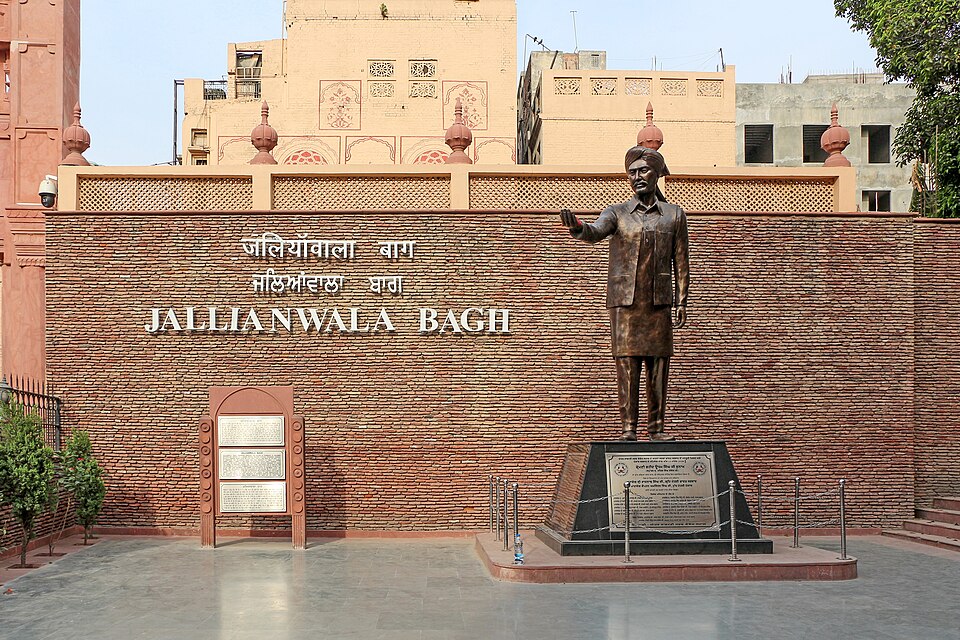
- The Jallianwala Bagh massacre took place on 13 April 1919, during protests against the Rowlatt Act.
- The All-India Khilafat Conference met at Delhi in November 1919, bringing the Khilafat cause into national politics.
- The Non-Cooperation Movement was launched in 1920 and later endorsed at the Nagpur session of the Congress in December 1920.
Study next
Common traps
- Assuming the Khilafat Conference or Non-Cooperation came before the Rowlatt Act and Jallianwala Bagh.
- Swapping the order of the Rowlatt Act and the Jallianwala Bagh massacre, when the massacre grew directly out of the anti-Rowlatt protests.
Asked as a chronological-order or match-the-year question on the 1919-1920 phase of the freedom struggle.
Related PYQs
What is the correct sequence of the following events? I. The Lucknow Pact II. The Introduction of Dyarchy III. The Rowlatt Act IV. The Partition of Bengal
- (a) I, II, III, IV
- (b) IV, I, III, II
- (c) I, III, II, IV
- (d) IV, III, II, I
Answer(b) IV, I, III, II
Same concept — chronological ordering of early-twentieth-century freedom-struggle landmarks, and it turns on the same anchor, the Rowlatt Act of March 1919. Here the sequence runs Partition of Bengal (1905), Lucknow Pact (1916), Rowlatt Act (1919), then dyarchy under the 1919 Act.
Practice
- practice — not a real PYQ
The Jallianwala Bagh massacre of 13 April 1919 took place during protests against which of the following?
- (a)The Partition of Bengal
- (b)The Rowlatt Act
- (c)The Simon Commission
- (d)The Government of India Act 1935
Answer(b) The Rowlatt Act — the massacre occurred during the agitation against this repressive 1919 law. - practice — not a real PYQ
The Non-Cooperation Movement was formally endorsed by the Indian National Congress at its session held in December 1920 at:
- (a)Lucknow
- (b)Lahore
- (c)Nagpur
- (d)Calcutta
Answer(c) Nagpur — the Nagpur session of December 1920 adopted the Non-Cooperation programme.