
First coins in Indian history bearing the names and images of rulers were issued by the:
- (a)Mauryas
- (b)Pushyabhutis
- (c)Guptas
- (d)Indo-Greeks
Answer
Why
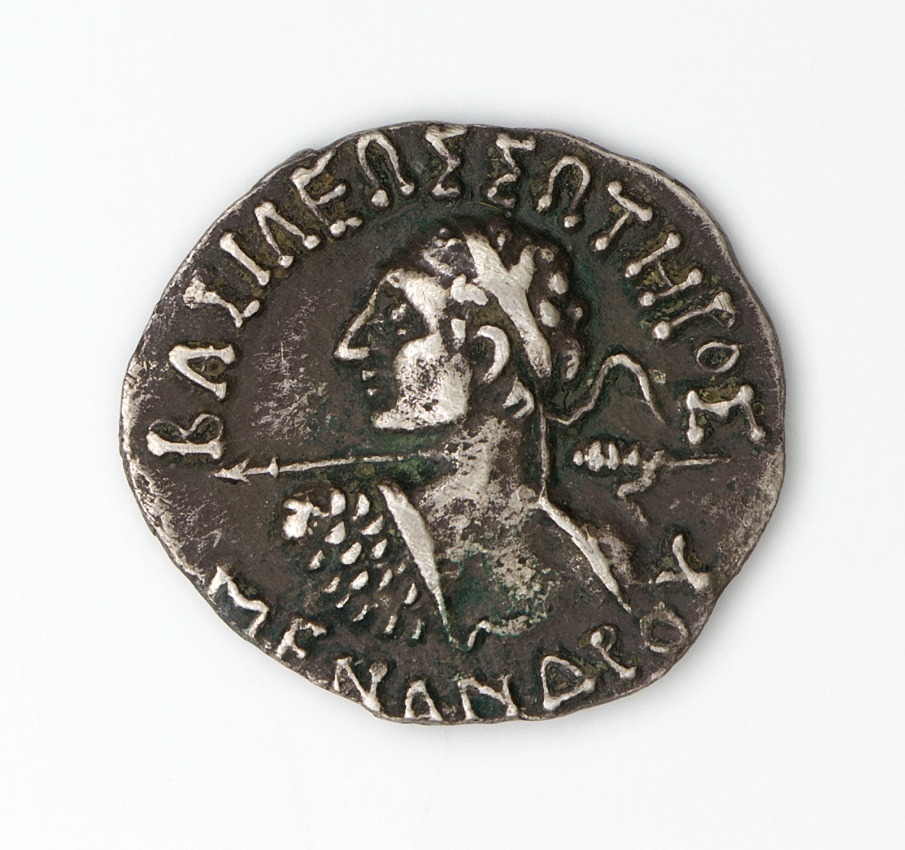
Correct — D, the Indo-Greeks. The earliest coins in the Indian subcontinent to carry both the name and the portrait of the issuing ruler were struck by the Indo-Greek kings who ruled the north-west from about the second century BCE. Their coins bear a realistic royal portrait on the obverse and the king's name in Greek script, a Hellenistic practice they brought from the Greek world. This is why standard textbooks credit the Indo-Greeks with India's first named-and-portrait coinage. The earlier punch-marked coins circulating under the Mauryas and the Mahajanapadas carried only symbols, not the names or faces of rulers; the Guptas issued splendid portrait coins much later, in the fourth and fifth centuries CE.
Why the others are wrong
- (a)Mauryas — Mauryan-era money was largely punch-marked coinage stamped with symbols such as the sun, a hill and a tree — it did not bear the name or image of a ruler.
- (b)Pushyabhutis — The Pushyabhuti (Vardhana) dynasty of Harsha belongs to the seventh century CE, long after the Indo-Greeks had already introduced named portrait coins.
- (c)Guptas — The Guptas issued magnificent gold portrait coins, but only from the fourth century CE — centuries after the Indo-Greeks had pioneered coins bearing rulers' names and images.
Concept
The Indo-Greeks, ruling the north-western subcontinent from around the second century BCE, introduced Hellenistic coin conventions to India — chiefly the practice of depicting the reigning king's portrait alongside his name, a sharp break from the anonymous symbol-based punch-marked coins that preceded them.
The distractors are all real coin-issuing powers, so the question tests chronology and coin type: punch-marked coins (symbols, Mauryan era) came first, Indo-Greek named portrait coins next, and Gupta gold portrait coins much later.
Key facts
- The first coins to bear the names and images of rulers in India were issued by the Indo-Greeks, from about the second century BCE.
- Indo-Greek coins typically show the king's portrait with a legend in Greek script, often with a Kharoshthi legend on the reverse.
- Earlier punch-marked coins bore only symbols, not the identity of any ruler.
- The Guptas' celebrated gold portrait coinage dates to the fourth and fifth centuries CE, well after the Indo-Greeks.
Study next
Common traps
- Choosing the Guptas because of their famous portrait coins — those are far later than the Indo-Greek originals.
- Assuming Mauryan punch-marked coins named rulers — they carried only symbols.
Asked as a who-issued-the-first-named-and-portrait-coins item — attribute the innovation to the Indo-Greeks, distinct from earlier symbol-only punch-marked coins.
Related PYQs
What is the correct chronological order in which the following appeared in India? I. Gold coins II. Punch-marked silver coins III. Iron plough IV. Urban culture Select the correct answer using the codes given below:
- (a) III, IV, I, II
- (b) III, IV, II, I
- (c) IV, III, I, II
- (d) IV, III, II, I
Answer(d) IV, III, II, I — Harappan urban culture came first, then the iron plough of the later-Vedic age, then punch-marked silver coins of the Mahajanapadas, and regular gold coinage much later.
Both test early Indian coinage in chronological terms — the UPSC item asks students to order urban culture, iron plough, punch-marked silver coins and gold coins, reinforcing that symbol-based punch-marked coins preceded later named and portrait coinage.
The Indo-Greek kingdom set up in north Afghanistan in the beginning of the second century BC was
- (a) Bactria
- (b) Scythia
- (c) Zedrasia
- (d) Aria
Answer(a) Bactria — the Indo-Greek realm founded in north Afghanistan in the early second century BC was the Greco-Bactrian kingdom centred on Bactria.
Directly about the Indo-Greeks — the UPSC question identifies Bactria as the Indo-Greek kingdom in north Afghanistan, the same dynasty this item credits with India's first named-and-portrait coins.
Practice
- practice — not a real PYQ
Which type of coins circulated in India before the Indo-Greeks and carried only symbols, not rulers' names?
- (a)Gold dinars
- (b)Punch-marked coins
- (c)Portrait drachms
- (d)Copper Kushana coins
Answer(b) Punch-marked coins — the earliest Indian coins bore symbols such as the sun and a hill, not the names or images of rulers. - practice — not a real PYQ
The Indo-Greek king best known from the Buddhist text 'Milindapanha', whose coins carry his portrait and name, was:
- (a)Demetrius
- (b)Menander I
- (c)Kanishka
- (d)Chandragupta II
Answer(b) Menander I — known as Milinda in the Milindapanha, his portrait coins exemplify Indo-Greek named coinage.