
Which of the following is not a part of compound microscope?
- (a)Mirror
- (b)Stage
- (c)Clip
- (d)Retina
Answer
Why
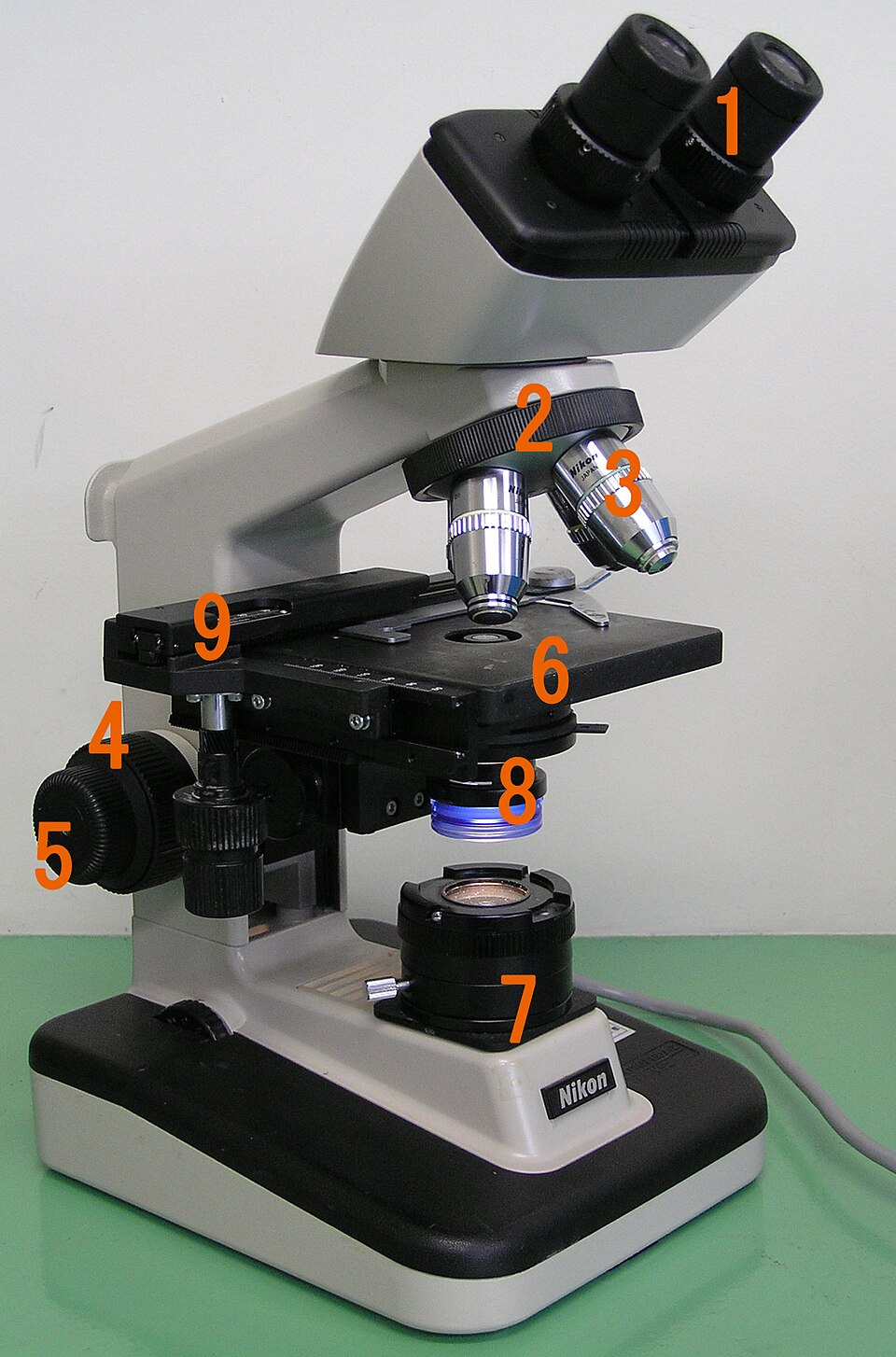
Correct — D, Retina. The retina is the light-sensitive layer at the back of the human EYE, not a part of a compound microscope. A compound microscope's parts include the mirror (which reflects light up through the specimen), the stage (the platform on which the slide rests) and the clips (which hold the slide in place). So the odd one out is the retina.
Why the others are wrong
- (a)Mirror — This is a genuine microscope part — in a light microscope the mirror reflects light through the condenser and specimen.
- (b)Stage — This is a genuine microscope part — the flat platform on which the specimen slide is placed.
- (c)Clip — These are genuine microscope parts — the clips clamp the slide onto the stage.
Concept
A compound microscope uses two lens systems — an objective near the specimen and an eyepiece (ocular) — to produce high magnification. Light from a mirror or built- that the eyepiece magnifies further. Focusing is done with coarse and fine adjustment knobs. The retina, by contrast, belongs to the eye's optical system, where the final image is actually formed.
The question mixes parts of two optical systems — the microscope and the eye. Three options are hardware of the instrument, while the retina is anatomy of the observer's eye, so it is the one that does not belong.
Key facts
- A compound microscope has two lenses — the objective and the eyepiece (ocular).
- The mirror or lamp supplies light, which passes through the condenser and diaphragm.
- The specimen slide sits on the stage and is held by clips; focusing uses coarse and fine knobs.
- The retina is the light-sensitive layer of the eye, where the image forms — not a microscope part.
Study next
Common traps
- Mixing up parts of the eye with parts of the microscope.
- Thinking the mirror is not a microscope part — in light microscopes it reflects light up through the slide.
- Confusing the stage (the platform) with the clips (which hold the slide down).
Instrument questions ask you to pick the part that does NOT belong — separate microscope hardware (mirror, stage, clips, lenses) from eye anatomy such as the retina.
Related PYQs
No directly related past PYQ was found.
Practice
- practice — not a real PYQ
In a compound microscope, total magnification is obtained by multiplying the magnifications of the
- (a)mirror and stage
- (b)objective and eyepiece
- (c)condenser and diaphragm
- (d)coarse and fine knobs
Answer(b) objective and eyepiece — the two lens systems whose magnifications multiply. - practice — not a real PYQ
The retina is a part of which one of the following?
- (a)Compound microscope
- (b)Human eye
- (c)Telescope
- (d)Camera lens
Answer(b) Human eye — the light-sensitive layer at the back where the image forms.