
Consider the following statements about ancient Indian inscriptions : 1. The earliest inscriptions are in Sanskrit. 2. Kharosthi script, used in inscriptions in the north-west, was deciphered with the help of coins of Indo-Greek kings who ruled over the area. 3. Most of the inscriptions mention grand, unique events, and routine agricultural practices do not find mention. How many of the above statements is/are correct ?
- (a)1
- (b)2
- (c)3
- (d)None
Answer
Why
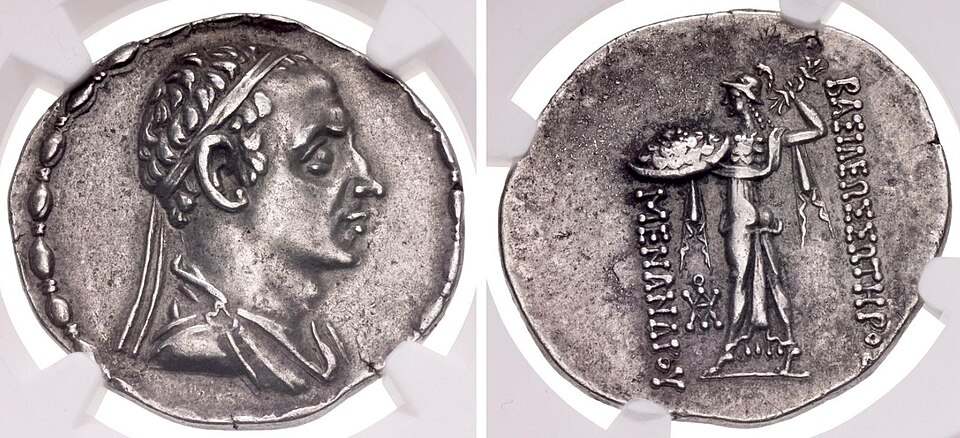
Correct — B, two statements. Statement 1 is wrong: the earliest inscriptions, such as Ashoka's edicts, are in Prakrit (written in the Brahmi script generally, and in Kharosthi in the north-west); inscriptions in Sanskrit become common only later, around the Gupta period. Statement 2 is correct: the Kharosthi script of the north-west was deciphered with the help of the bilingual coins of the Indo-Greek kings, which carried the ruler's name in both Greek and Kharosthi. Statement 3 is correct: inscriptions were meant to record grand or unique events — royal achievements and donations — so ordinary matters such as routine agricultural practices generally go unmentioned. Statements 2 and 3 are correct, so the count is two.
Why the others are wrong
- (a)1 — Undercounts — statements 2 (Kharosthi deciphered via Indo-Greek coins) and 3 (inscriptions record grand events) are both correct.
- (c)3 — Overcounts — statement 1 is false, because the earliest inscriptions are in Prakrit, not Sanskrit.
- (d)None — Wrong — statements 2 and 3 are accurate, so at least two statements are correct.
Concept
Inscriptions, studied through epigraphy, are a key source for early Indian history. The earliest deciphered ones are Ashoka's third-century-BCE edicts, in Prakrit, using Brahmi across most of the subcontinent and Kharosthi in the north-west.
The false statement swaps Prakrit for Sanskrit. Remember that Sanskrit as an inscriptional language spreads only later; the Brahmi and Kharosthi inscriptions of the Mauryan age carry Prakrit.
Key facts
- Ashoka's edicts (3rd century BCE), among the earliest Indian inscriptions, are in Prakrit — using Brahmi generally and Kharosthi in the north-west.
- Brahmi was deciphered by James Prinsep in the 1830s; the reading of Kharosthi was aided by bilingual Indo-Greek coins bearing Greek and Kharosthi legends.
- Kharosthi was written from right to left, unlike the left-to-right Brahmi.
- Inscriptions usually record notable events — conquests, gifts and endowments — rather than everyday economic routines.
Study next
Common traps
- Assuming the oldest inscriptions are in Sanskrit — they are in Prakrit; Sanskrit inscriptions become common only later.
- Forgetting that inscriptions are selective — they record grand events, not routine daily or agricultural life.
A 'how many statements are correct' epigraphy item — the language-of-the-earliest-inscriptions claim (Prakrit versus Sanskrit) is the usual trap.
Related PYQs
Which one of the following scripts of ancient India was written from right to left?
- (a) Brahmi
- (b) Nandnagari
- (c) Sharada
- (d) Kharosthi
Answer(d) Kharosthi — used in the north-west and written from right to left, unlike the Brahmi-derived scripts.
Directly on the Kharosthi script of statement 2 — the north-western script whose decipherment was aided by Indo-Greek coins.
The name by which Asoka is generally referred to in his inscriptions is
- (a) Chakravarti
- (b) Dharmadeva
- (c) Dharmakirti
- (d) Priyadarshini
Answer(d) Priyadarshini — Ashoka calls himself 'Devanampiya Priyadarsi' in his edicts.
Draws on Ashoka's inscriptions as a historical source — the same body of early Prakrit edicts this NDA question is built around.
Practice
- practice — not a real PYQ
The Brahmi script of Ashoka's inscriptions was first deciphered in the 1830s by:
- (a)William Jones
- (b)James Prinsep
- (c)John Marshall
- (d)Alexander Cunningham
Answer(b) James Prinsep — he deciphered the Brahmi script of Ashoka's edicts in the 1830s. - practice — not a real PYQ
Which ancient Indian script, used in the north-west, was written from right to left?
- (a)Brahmi
- (b)Kharosthi
- (c)Sharada
- (d)Nagari
Answer(b) Kharosthi — unlike the left-to-right Brahmi, Kharosthi was written from right to left.