
Which one of the following is the best shape of a solid metal rod to form the top end of a lightning conductor?
- (a)Pointed (conical tip)
- (b)Flat-topped cylinder
- (c)Spherical head
- (d)Flat rectangular block
Answer
Why
Correct — A, pointed (conical tip). On a charged conductor the surface charge density, and therefore the electric field just outside, is largest where the surface curves most sharply. A fine point creates such an intense field that it ionises the surrounding air, giving a continuous corona or point discharge that quietly bleeds away the charge the storm cloud induces on the building. This 'action of points' is exactly why the top of a lightning conductor is made pointed, so option (a) is best.
Why the others are wrong
- (b)Flat-topped cylinder — A flat top has a large radius of curvature over most of its surface, so it concentrates charge far less than a point. The field there is too weak to set up the corona discharge that makes a lightning conductor effective.
- (c)Spherical head — A sphere has the largest, most uniform radius of curvature, so it holds charge with the lowest field per unit charge. Smooth spheres are used precisely to STORE charge without leaking it (as on a Van de Graaff dome), the opposite of what a conductor tip should do.
- (d)Flat rectangular block — A bulky block has broad flat faces and only blunt edges, so it lacks the fine tip needed for a strong local field and point discharge. It is far less effective than a sharp conical point.
Concept
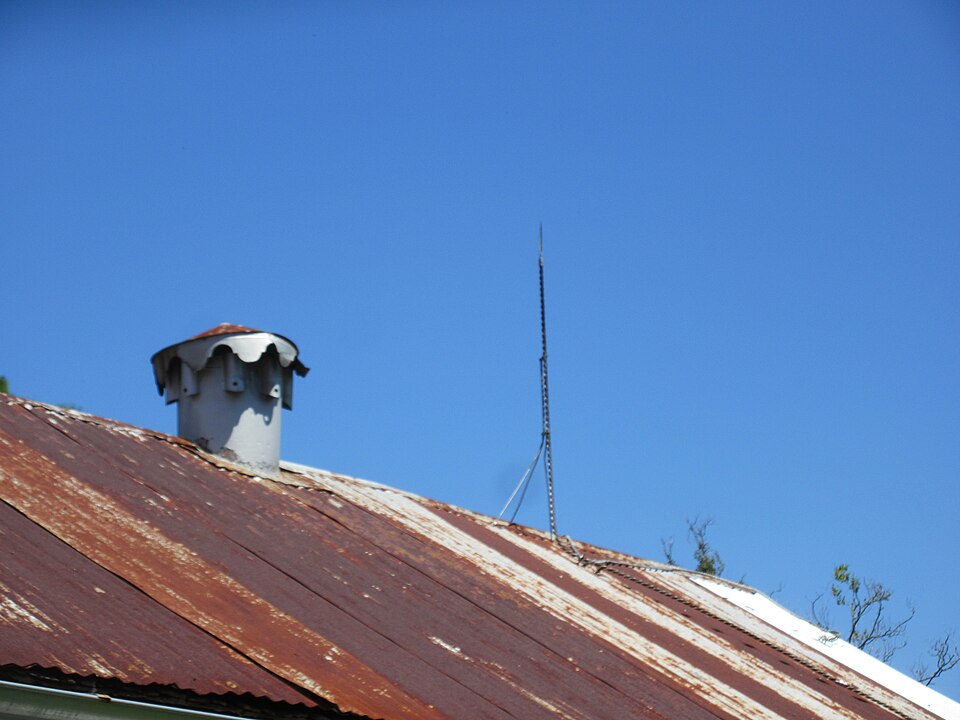
A lightning conductor is a pointed metal rod fixed at the highest point of a building and joined by a thick metal strip to a plate buried in moist earth. It protects the structure in two ways: the sharp point sets up a point (corona) discharge that partly neutralises the charge the cloud induces, and if a strike does occur the rod offers a low-resistance path that carries the huge current safely to the ground.
Reason from the electrostatics of conductors. Charge crowds onto regions of small radius of curvature, so the field is strongest at a sharp point and weakest on a smooth sphere. Choosing the shape that maximises the local field means choosing the sharpest point, which rules out the flat, cylindrical and spherical options and leaves the conical tip.
Key facts
- On a charged conductor the surface charge density is highest where the radius of curvature is smallest — the action of points.
- A sharp point produces so strong a field that it ionises nearby air, giving a corona (point) discharge.
- A lightning conductor runs from a pointed rod on the roof through a thick conductor to a metal plate in moist earth (earthing).
- It both eases charge away by point discharge and carries any strike safely to the ground along a low-resistance path.
- The pointed lightning rod was introduced by Benjamin Franklin in 1752.
Study next
Common traps
- Thinking a smooth sphere or flat top is better because it 'looks stronger' — sharpness, not bulk, drives point discharge.
- Believing a lightning conductor attracts or repels clouds; it works by discharge and by earthing a strike.
- Forgetting the rod must be earthed to a plate in moist soil to actually carry the current away.
NDA/UPSC ask for the shape of a lightning conductor's tip or how it protects a building — anchor to the action of points, corona discharge and earthing.
Related PYQs
No directly related past PYQ was found.
Practice
- practice — not a real PYQ
The pointed tip of a lightning conductor is effective mainly because
- (a)charge concentrates at a sharp point, giving a strong field and point (corona) discharge
- (b)it magnetically attracts the storm cloud
- (c)it reflects the lightning back to the cloud
- (d)it insulates the building from the cloud
Answer(a) charge concentrates at a sharp point, giving a strong field and point (corona) discharge that bleeds the induced charge away. - practice — not a real PYQ
For a lightning conductor to work, its lower end must be connected to
- (a)a large metal plate buried in moist earth
- (b)the building's water tank
- (c)the mains electricity supply
- (d)nothing at all
Answer(a) a large metal plate buried in moist earth — proper earthing gives the strike a low-resistance path to the ground.