
Consider the following statements about Ajanta paintings: 1. The surface of the rock was coated with clay mixed with rice husk and gum and a coat of lime was applied over this. 2. The outline drawing was done first on the lime coating and colours were added subsequently. Which of the statements given above is/are correct?
- (a)1 only
- (b)2 only
- (c)Both 1 and 2
- (d)Neither 1 nor 2
Answer
Why
Correct — C, both 1 and 2. At Ajanta the artists first prepared the rough rock wall with a ground of clay mixed with rice husk (and vegetable fibre) bound with gum, over which they laid a fine coat of lime, exactly as statement 1 describes. They then drew the outlines of the figures on this lime surface and filled in the colours afterwards, which is what statement 2 states. This is the tempera technique on a dry, prepared ground (fresco-secco), so both statements are correct.
Why the others are wrong
- (a)1 only — Statement 2 is also correct — the outlines were drawn first on the prepared surface and the colours added afterwards.
- (b)2 only — Statement 1 is also correct — the ground was clay mixed with rice husk and gum, finished with a coat of lime.
- (d)Neither 1 nor 2 — Both statements accurately describe the Ajanta technique — the prepared ground and the outline-then-colour sequence — so 'neither' is wrong.
Concept
The Ajanta caves in Maharashtra hold some of the finest surviving murals of ancient India. The paintings were not done on wet plaster like true fresco; instead the artists worked on a specially prepared dry ground using the tempera technique, which is why the method of preparing the wall and laying on the colours is a favourite exam point.
The two statements test whether a candidate knows the actual Ajanta method. The wall was first given a rough ground of clay, rice husk and gum, then a smooth lime coat; outlines were drawn and colours filled in from natural mineral pigments. Both details are correct, so the trap is to reject one out of a vague sense that fresco is painted straight onto wet plaster.
Key facts
- The Ajanta caves in Aurangabad district, Maharashtra, are a UNESCO World Heritage rock-cut Buddhist site.
- The murals used a tempera (fresco-secco) technique on a dry, prepared ground, not wet-plaster true fresco.
- The ground was clay mixed with rice husk and gum, finished with a coat of lime.
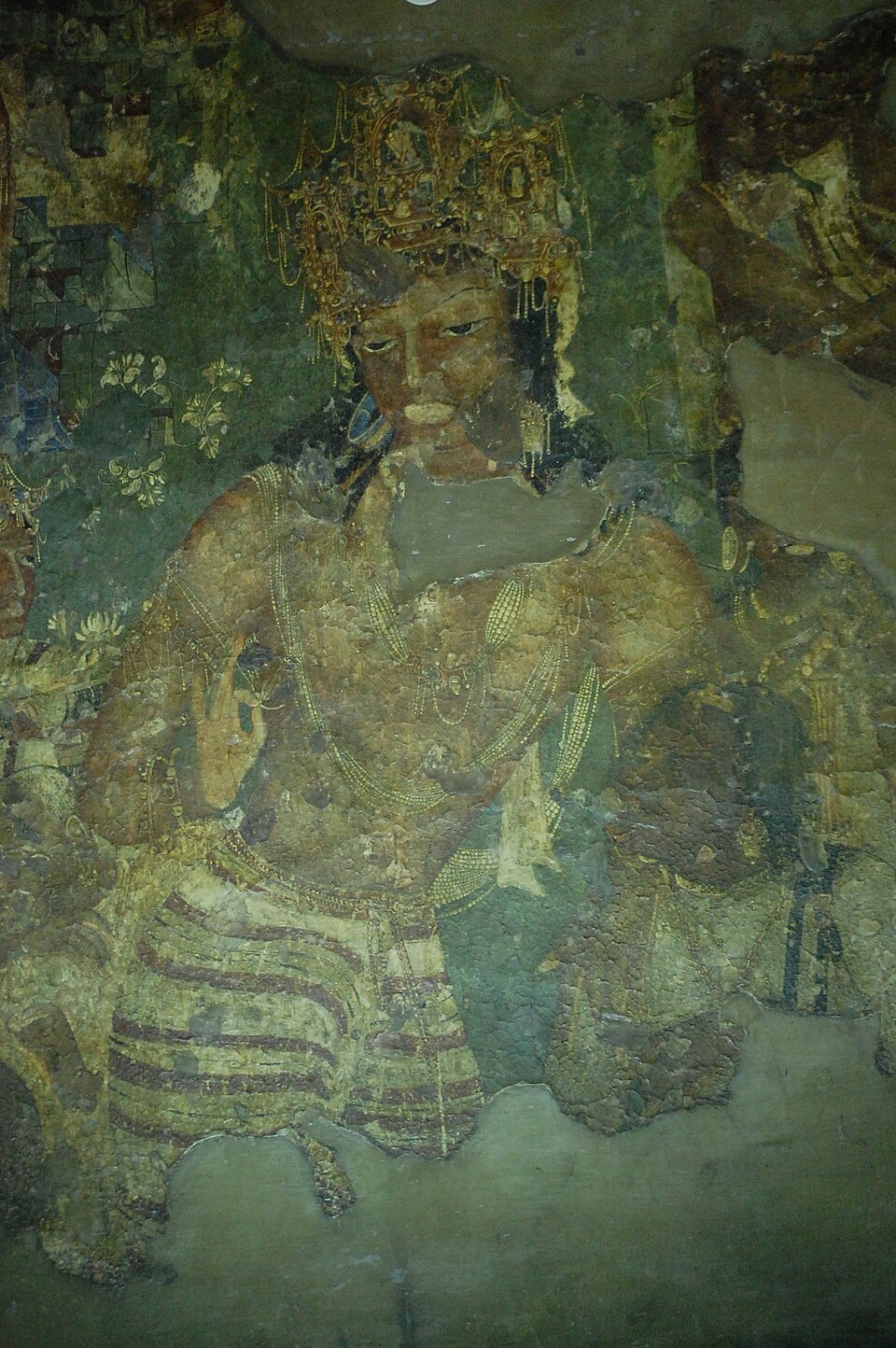
- Outlines were drawn first and colours from natural mineral pigments were added afterwards; famous panels include the Padmapani and Vajrapani Bodhisattvas in Cave 1.
Study next
Common traps
- Calling the Ajanta murals true 'frescoes' — they are tempera on a dry ground (fresco-secco), not painted on wet plaster.
- Reversing the sequence — the outline was drawn before the colours were added, not after.
A two-statement correctness item on Ajanta painting technique — both the preparation of the ground and the outline-then-colour sequence are correct.
Related PYQs
There are only two known examples of cave paintings of the Gupta period in ancient India. One of these is paintings of Ajanta caves. Where is the other surviving example of Gupta paintings?
- (a) Bagh caves
- (b) Ellora caves
- (c) Lomas Rishi cave
- (d) Nasik caves
Answer(a) Bagh caves — the other surviving Gupta-era murals, in Madhya Pradesh, alongside Ajanta.
Same concept — the cave murals of the Gupta age, pairing Ajanta with the Bagh caves, exactly the Ajanta painting tradition this NDA question tests.
Consider the following historical places : 1. Ajanta Caves 2. Lepakshi Temple 3. Sanchi Stupa. Which of the above places is/are also known for mural paintings?
- (a) 1 only
- (b) 1 and 2 only
- (c) 1, 2 and 3
- (d) None
Answer(b) 1 and 2 only — Ajanta and the Lepakshi temple are known for murals; Sanchi is famed for its sculptures and gateways, not wall paintings.
Directly tests Ajanta as a centre of mural painting, the same subject as this question on the Ajanta painting technique.
Practice
- practice — not a real PYQ
The murals at Ajanta were executed using which technique?
- (a)True wet fresco
- (b)Tempera on a dry prepared ground
- (c)Oil on canvas
- (d)Encaustic (hot wax)
Answer(b) Tempera on a dry prepared ground — the Ajanta paintings were done on a dry lime-finished surface, a fresco-secco method. - practice — not a real PYQ
Apart from Ajanta, the other surviving example of Gupta-period cave paintings is found at
- (a)Ellora caves
- (b)Bagh caves
- (c)Elephanta caves
- (d)Nasik caves
Answer(b) Bagh caves — in Madhya Pradesh, the other known set of Gupta-era murals besides Ajanta.