
Which one of the following texts is a commentary written by Chakrapanidatta (11th Century CE from Bengal) on the Sushrut Samhita ?
- (a)Sabdachandrika
- (b)Bhanumati
- (c)Nitiratnakara
- (d)Lohasarvasava
Answer
Why
Correct — B, Bhanumati. Chakrapanidatta was an eleventh-century CE physician and commentator from Bengal, celebrated in the Ayurvedic tradition for his commentaries on the two great classical medical texts. His commentary on the Sushruta Samhita, the foundational text of ancient Indian surgery, is titled Bhanumati, while his commentary on the Charaka Samhita is the well-known Ayurveda Dipika. Since the question asks for his commentary on the Sushruta Samhita, the answer is Bhanumati.
Why the others are wrong
- (a)Sabdachandrika — This is not Chakrapanidatta's commentary on the Sushruta Samhita; his Sushruta commentary is Bhanumati.
- (c)Nitiratnakara — Not a commentary by Chakrapanidatta on the Sushruta Samhita; the Sushruta commentary keyed here is Bhanumati.
- (d)Lohasarvasava — The name points to a medicinal (iron-based) preparation rather than a text commentary, and it is not Chakrapanidatta's Sushruta commentary, which is Bhanumati.
Concept
Chakrapanidatta (11th century CE, Bengal) belongs to the tradition of medieval commentators who preserved and interpreted the classical Ayurvedic Samhitas. Commentaries mattered because the base texts were terse and archaic; a good commentary explained obscure terms, reconciled passages and kept the medical knowledge usable for later generations of physicians.
The reasoning is to pair the commentator with the right base text and its commentary name. Chakrapanidatta commented on both great texts, so the distinction to hold is that Bhanumati is his commentary on the Sushruta Samhita (surgery), whereas Ayurveda Dipika is his commentary on the Charaka Samhita (medicine).
Key facts
- Chakrapanidatta was an eleventh-century CE physician and commentator from Bengal.
- Bhanumati is his commentary on the Sushruta Samhita, the classical text of Indian surgery.
- Ayurveda Dipika (Ayurvedadipika) is his commentary on the Charaka Samhita.
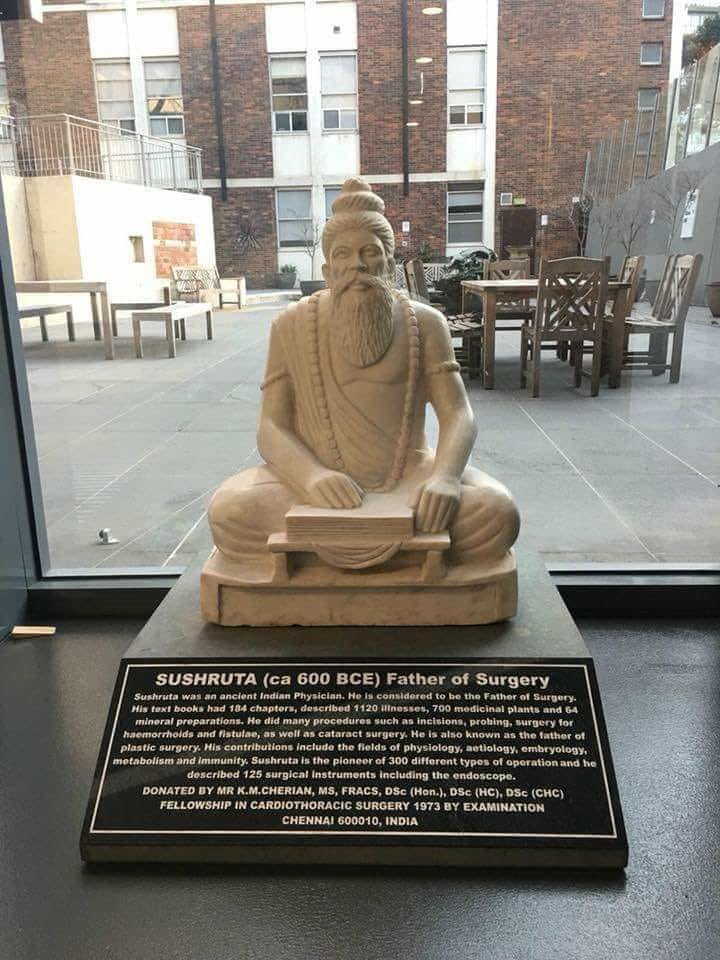
- The Sushruta Samhita, attributed to the ancient surgeon Sushruta, is the foundational text of the surgical (Shalya) branch of Ayurveda.
Study next
Common traps
- Assuming Bhanumati is the commentary on Charaka — it is on Sushruta; the Charaka commentary is Ayurveda Dipika.
- Picking an option that sounds like a medicinal preparation rather than a text (for example Lohasarvasava).
A single-best-answer recall item — match the commentator (Chakrapanidatta) and the base text (Sushruta Samhita) to the commentary name, Bhanumati.
Related PYQs
Match List I with List II and select the correct answer by using the codes given below the lists: List I: I. Visakhadatta II. Varahamihira III. Charaka IV. Brahmagupta; List II: A) Medicine B) Drama C) Astronomy D) Mathematics
- (a) I – A, II – C, III – D, IV – B
- (b) I – B, II – A, III – C, IV – D
- (c) I – B, II – C, III – A, IV – D
- (d) I – C, II – B, III – A, IV – B
Answer(c) I – B, II – C, III – A, IV – D — Visakhadatta (drama), Varahamihira (astronomy), Charaka (medicine) and Brahmagupta (mathematics).
Same concept of classical Indian scholars and their fields — including Charaka and medicine, the very tradition whose Sushruta and Charaka Samhitas Chakrapanidatta later commented upon.
Practice
- practice — not a real PYQ
Chakrapanidatta's commentary Ayurveda Dipika was written on which classical text?
- (a)Sushruta Samhita
- (b)Charaka Samhita
- (c)Ashtanga Hridaya
- (d)Bhela Samhita
Answer(b) Charaka Samhita — Ayurveda Dipika is Chakrapanidatta's commentary on the Charaka Samhita. - practice — not a real PYQ
The Sushruta Samhita is chiefly associated with which branch of ancient Indian medicine?
- (a)Surgery
- (b)Astronomy
- (c)Metallurgy
- (d)Grammar
Answer(a) Surgery — the Sushruta Samhita is the foundational text of the surgical (Shalya) tradition of Ayurveda.