
LIGO experiment confirmed one of the predictions of:
- (a)String theory
- (b)Special theory of relativity
- (c)Quantum mechanics
- (d)General theory of relativity
Answer
Why
Correct — D, General theory of relativity. LIGO, the Laser Interferometer Gravitational-Wave Observatory, made the first direct detection of gravitational waves in September 2015, from the merger of two black holes. Gravitational waves — ripples in the fabric of space-time produced by accelerating masses — were predicted by Albert Einstein in 1916 as a consequence of his general theory of relativity. LIGO's detection therefore confirmed a century-old prediction of general relativity, so option (d) is correct.
Why the others are wrong
- (a)String theory — String theory is a speculative framework for unifying the forces and has no such confirmed experimental prediction; gravitational waves come from general relativity, not string theory.
- (b)Special theory of relativity — Special relativity deals with space, time and motion at constant velocity (and gives the mass-energy relation), but it does not describe gravity or predict gravitational waves — that is the work of the general theory.
- (c)Quantum mechanics — Quantum mechanics governs matter at atomic and subatomic scales; gravitational waves are a large-scale gravitational phenomenon predicted by general relativity, not by quantum theory.
Concept
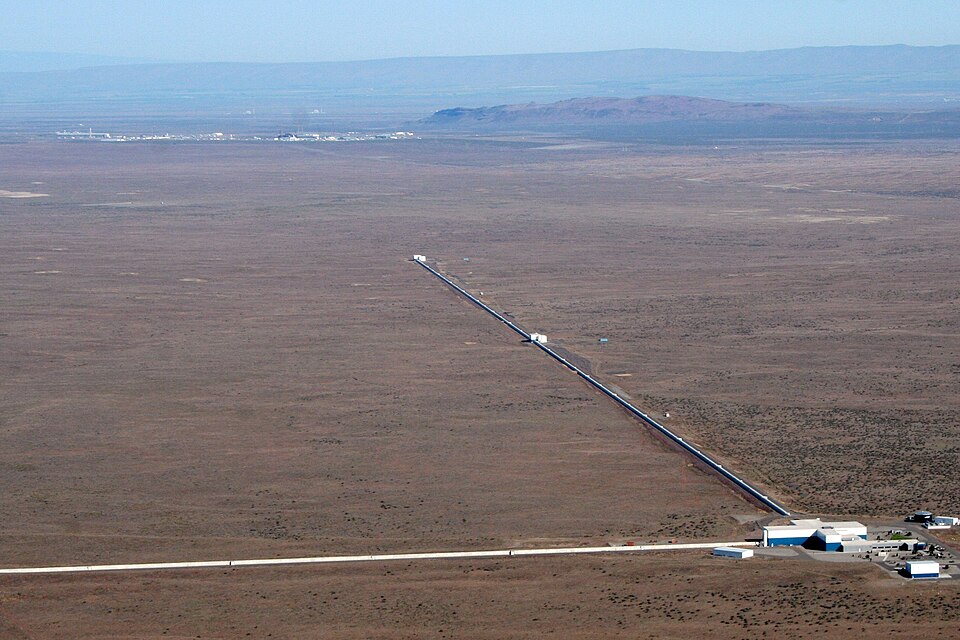
Einstein's general theory of relativity (1915) describes gravity as the curvature of space-time caused by mass and energy. One of its predictions is that violently accelerating masses — such as two black holes or neutron stars spiralling together — send out gravitational waves, ripples that stretch and squeeze space as they pass. LIGO detects these minute distortions using laser interferometry over kilometre-long arms.
Separate the theories by what they predict. Gravitational waves are a gravity phenomenon, and general relativity is the theory of gravity, so the answer must be (d). Special relativity has no gravity, quantum mechanics is the physics of the very small, and string theory offers no confirmed prediction here.
Key facts
- Gravitational waves were predicted by Einstein in 1916 from the general theory of relativity.
- LIGO announced the first direct detection, event GW150914, on 11 February 2016, from a binary black-hole merger observed in September 2015.
- The 2017 Nobel Prize in Physics went to Rainer Weiss, Barry Barish and Kip Thorne for the LIGO detector and the observation of gravitational waves.
- LIGO uses two widely separated L-shaped laser interferometers with 4-km arms to sense space-time distortions far smaller than the width of a proton.
Study next
Common traps
- Confusing special relativity (no gravity) with general relativity (gravity and space-time curvature).
- Attributing gravitational waves to quantum mechanics or string theory.
- Thinking LIGO 'saw' the black holes directly — it detected the gravitational waves from their merger.
A current-science recall linking a landmark experiment (LIGO and gravitational waves) to the theory it confirmed (general relativity).
Related PYQs
Recently, scientists observed the merger of giant 'blackholes' billions of light-years away from the Earth. What is the significance of this observation?
- (a) 'Higgs boson particles' were detected.
- (b) 'Gravitational waves' were detected.
- (c) Possibility of inter-galactic space travel through 'wormhole' was confirmed.
- (d) It enabled the scientists to understand 'singularity'.
Answer(b) 'Gravitational waves' were detected — the black-hole merger radiated gravitational waves, the same signal LIGO detected.
Describes exactly the event type behind this NDA question — a black-hole merger radiating gravitational waves predicted by general relativity.
What is the purpose of 'evolved Laser Interferometer Space Antenna (eLISA)' project?
- (a) To detect neutrinos
- (b) To detect gravitational waves
- (c) To detect the effectiveness of missile defence system
- (d) To study the effect of solar flares on our communication systems
Answer(b) To detect gravitational waves — eLISA is a space-based interferometer for gravitational-wave astronomy.
Concerns the same gravitational-wave detection that LIGO pioneered, extending the theme of general relativity's predictions to a space-based interferometer.
Practice
- practice — not a real PYQ
Gravitational waves, first detected by LIGO, are best described as:
- (a)beams of light from distant stars
- (b)ripples in space-time caused by accelerating masses
- (c)streams of neutrinos
- (d)radio waves from pulsars
Answer(b) ripples in space-time caused by accelerating masses — as predicted by general relativity. - practice — not a real PYQ
The 2017 Nobel Prize in Physics was awarded for work associated with:
- (a)discovery of the Higgs boson
- (b)detection of gravitational waves (LIGO)
- (c)the theory of black-body radiation
- (d)invention of the transistor
Answer(b) detection of gravitational waves (LIGO) — awarded to Weiss, Barish and Thorne.