
A microscope may be a combination of:
- (a)two convex lenses.
- (b)a convex and a concave lens.
- (c)two concave lenses.
- (d)a convex lens and a convex mirror.
Answer
Why
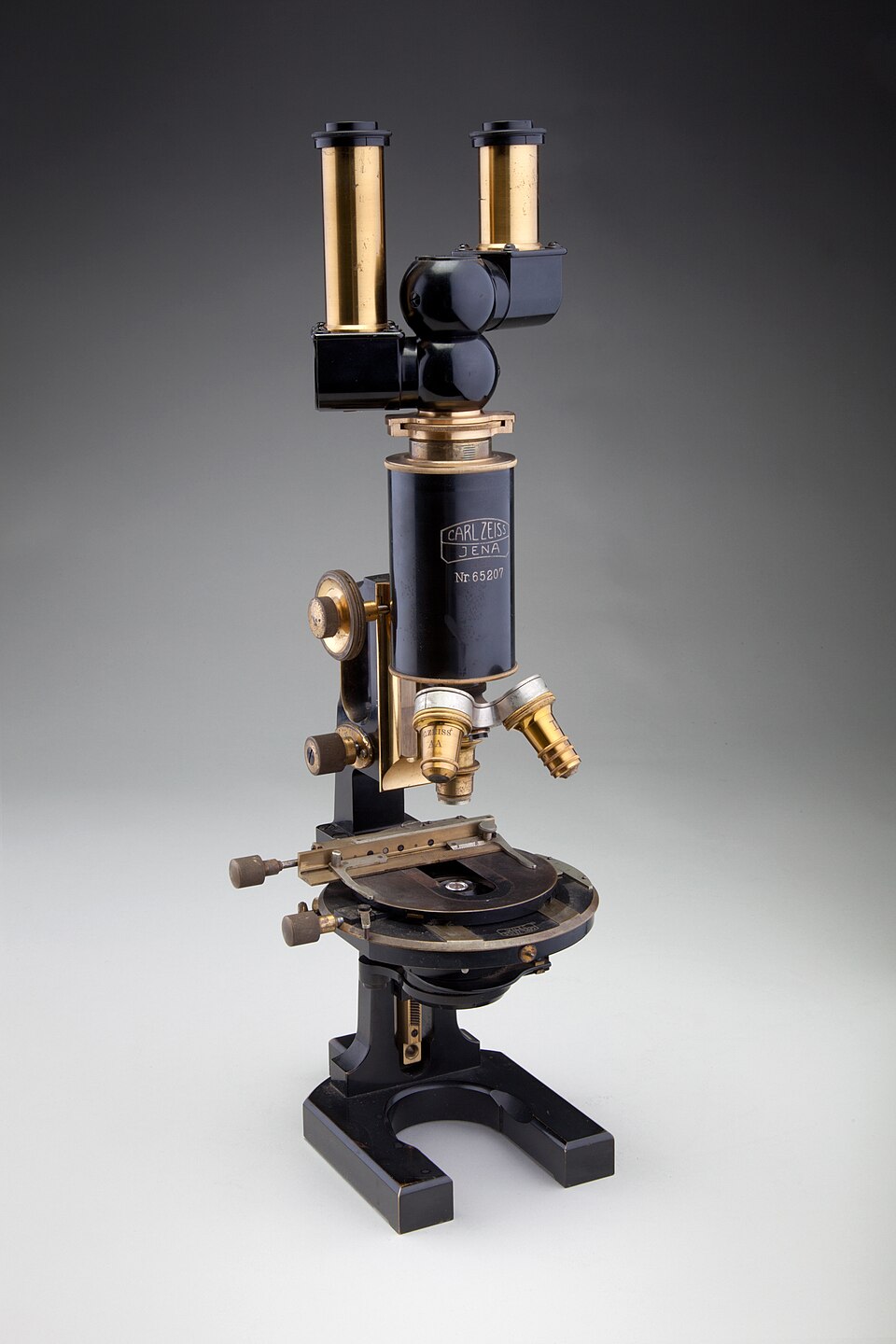
Correct — A, two convex lenses. A compound microscope is built from two converging (convex) lenses mounted at the ends of a tube. The objective lens, close to the specimen, forms a real, magnified image inside the tube, and the eyepiece then magnifies that image further, acting like a simple magnifier. Both lenses must be convex to converge light and build up the large overall magnification, so option (a) is correct.
Why the others are wrong
- (b)a convex and a concave lens. — A concave lens diverges light and forms a diminished, virtual image, which would work against magnification. A compound microscope uses two converging lenses, not one diverging lens.
- (c)two concave lenses. — Two concave (diverging) lenses would only shrink the image — the opposite of what a microscope is meant to do.
- (d)a convex lens and a convex mirror. — A microscope is built from lenses that refract light through a tube, not from a mirror. A convex mirror also diverges reflected light and cannot form the magnified real image the instrument needs; the mirror sometimes fitted below the stage is only for illumination.
Concept
A compound microscope magnifies tiny, nearby objects using two convex lenses in series. The objective forms a real, inverted, enlarged image of the specimen; the eyepiece then treats that image as its object and magnifies it again to give a large virtual final image. The total magnification is the product of the magnifications of the two lenses.
Sort the options by the kind of lens a magnifier needs. Magnification requires converging (convex) lenses; concave lenses and convex mirrors both diverge light and cannot build up magnification. Only 'two convex lenses' fits, so the other three fall away.
Key facts
- A compound microscope has two convex lenses — the objective, near the object, and the eyepiece, near the eye.
- The objective forms a real, inverted, magnified image, which the eyepiece then magnifies further as a simple magnifier.
- Total magnification equals the magnification of the objective multiplied by that of the eyepiece.
- An astronomical refracting telescope also uses two convex lenses, but with a long-focus objective and a short-focus eyepiece, unlike the microscope.
Study next
Common traps
- Confusing the illuminating mirror (often concave), used only to light the slide, with the magnifying lenses.
- Thinking a diverging (concave) lens can magnify — it cannot.
- Mixing up the microscope's lens arrangement with that of a telescope.
Direct recall of the compound microscope's optics — two convex lenses, the objective and the eyepiece.
Related PYQs
An air bubble in water will act like a
- (a) convex mirror
- (b) convex lens
- (c) concave mirror
- (d) concave lens
Answer(d) concave lens — the low-index air bubble in higher-index water diverges the light passing through it, behaving as a concave (diverging) lens.
Tests the same distinction this NDA question turns on — converging (convex) versus diverging (concave) lens behaviour — the reason a microscope needs two convex lenses.
Practice
- practice — not a real PYQ
In a compound microscope, the lens closest to the object being viewed is called the:
- (a)Eyepiece
- (b)Objective
- (c)Condenser
- (d)Field lens
Answer(b) Objective — it lies near the specimen and forms the first, real magnified image. - practice — not a real PYQ
The total magnification of a compound microscope is equal to the:
- (a)sum of the two lens magnifications
- (b)difference of the two lens magnifications
- (c)product of the objective and eyepiece magnifications
- (d)magnification of the eyepiece alone
Answer(c) product of the objective and eyepiece magnifications — the two lenses magnify in series.